

China to issue new rules on market access, cross-border data flows, Premier Li tells global CEOs
 Add BT as a preferred source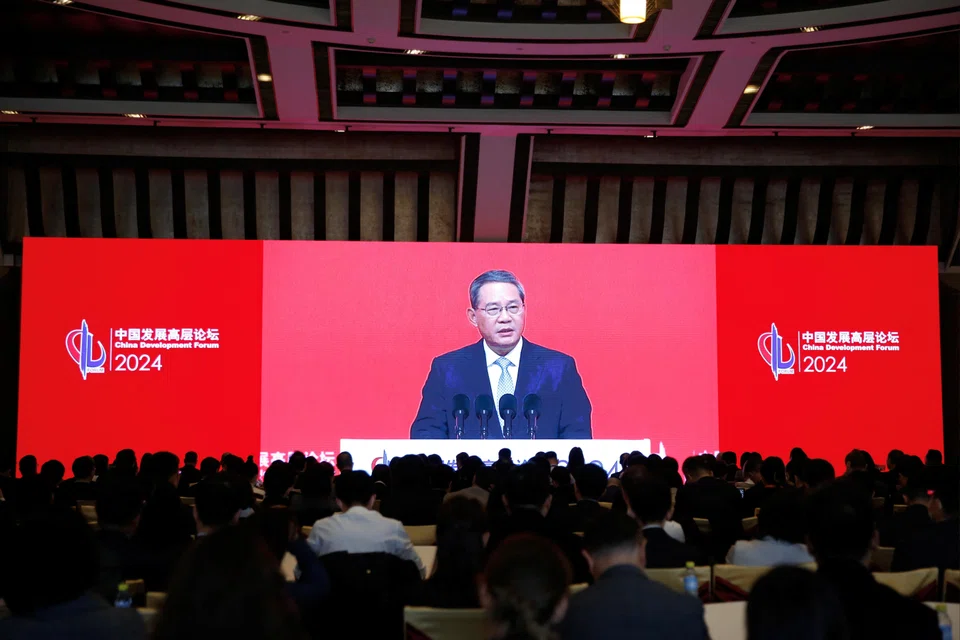
CHINA will carefully study issues of market access and cross-border data flows and will soon issue relevant regulation in these areas, Premier Li Qiang told an audience of global CEOs and Chinese policymakers on Sunday (Mar 24).
China is pushing to develop emerging industries such as biological manufacturing and will step up development of artificial intelligence and the data economy, Li said at the China Development Forum in Beijing.
China’s inflation rate and the central government’s debt burden are relatively low, leaving room for further macro policy measures, Li added. He pointed to measures China rolled out last year to diffuse property and debt risks, which he said have been effective.
Li cited one trillion yuan (S$190 billion) in previously announced ultra-long special treasury bonds. These will spur investment and stabilise economic growth, he said.
Fork in the road
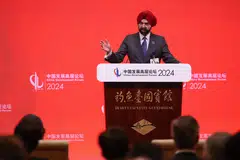
Also on Sunday, International Monetary Fund (IMF) managing director Kristalina Georgieva said that China needs to “reinvent itself” with economic policies to speed resolution of its property market crisis and boost domestic consumption and productivity. “China faces a fork in the road – rely on the policies that have worked in the past, or reinvent itself for a new era of high-quality growth,” she said in remarks to a meeting of senior Chinese officials and executives from global companies.
Officials who spoke at the opening of the China Development Forum expressed confidence that China would hit its economic targets, including growth of about 5 per cent this year, and pledged further support for companies in strategically important sectors, an area that Chinese President Xi Jinping has dubbed “new productive forces”.
Navigate Asia in
a new global order
Get the insights delivered to your inbox.
But those commitments stopped short of the more sweeping changes urged by the IMF. Georgieva said an analysis by the IMF showed a more consumer-centred policy mix could add US$3.5 trillion to China’s economy over the next 15 years. If achieved, that boost would be equivalent to adding output equivalent to more twice the size of South Korea’s economy.
To do that China would need to take “decisive” steps to complete unfinished housing stranded by bankrupt developers and to reduce risks from local government debt, the IMF chief said.
“A key feature of high quality growth will need to be higher reliance on domestic consumption,” Georgieva, a Bulgarian economist, said. “Doing so depends on boosting the spending power of individuals and families.”
Other economists have also urged a new growth model for China. But the IMF remarks were significant in coming at the outset of a two-day meeting where Beijing is looking to push the message that China is open for business.
Foreign investment flows into China shrank nearly 20 per cent in the first two months of the year, data released on Friday showed, and officials have been stepping up efforts to attract investors at a time when many companies have been looking to “de-risk” supply chains and operations away from China.
In 2023, foreign direct investment into China contracted by 8 per cent, reflecting a shaky economic recovery and tensions with the United States and its allies on a range of issues.
Apple CEO Tim Cook, the highest-profile executive at the Beijing event, told China state broadcaster CGTN he had an “outstanding” meeting with Premier Li.
“I think China is really opening up,” Cook told a CGTN interviewer on the sidelines of the meeting. He later said Apple’s China-based suppliers had helped deliver gains in more sustainable manufacturing, including lowering water use and recycling metals such as aluminium and cobalt.
Stephen von Schuckmann, a board member and executive at ZF Group who oversees the auto supplier’s battery-drive operations, said the company was committed to China, which leads the world in electric car sales and production.
The two-day forum is being held at a time when the US$18 trillion economy is facing multiple headwinds, from a property crisis, local government debt woes, and industrial overcapacity to deflationary risks and cooling foreign investment.
Organised annually by Beijing since 2000, the high-level forum traditionally serves as an opportunity for global CEOs and Chinese policymakers to meet and discuss foreign investment.
Decoding Asia newsletter: your guide to navigating Asia in a new global order. Sign up here to get Decoding Asia newsletter. Delivered to your inbox. Free.
Share with us your feedback on BT's products and services
TRENDING NOW
Middle East-linked energy supply shocks put Asean Power Grid back in focus

US-China rivalry and the Kindleberger Trap: Why inaction – not escalation – is the biggest risk

As more Asean states turn to Russia for fuel, will Moscow boost its influence in the region?
How China’s young workers are securing their future even as AI disrupts job market, triggers pay cuts

