China market gloom spurs fund managers to scour hidden gems
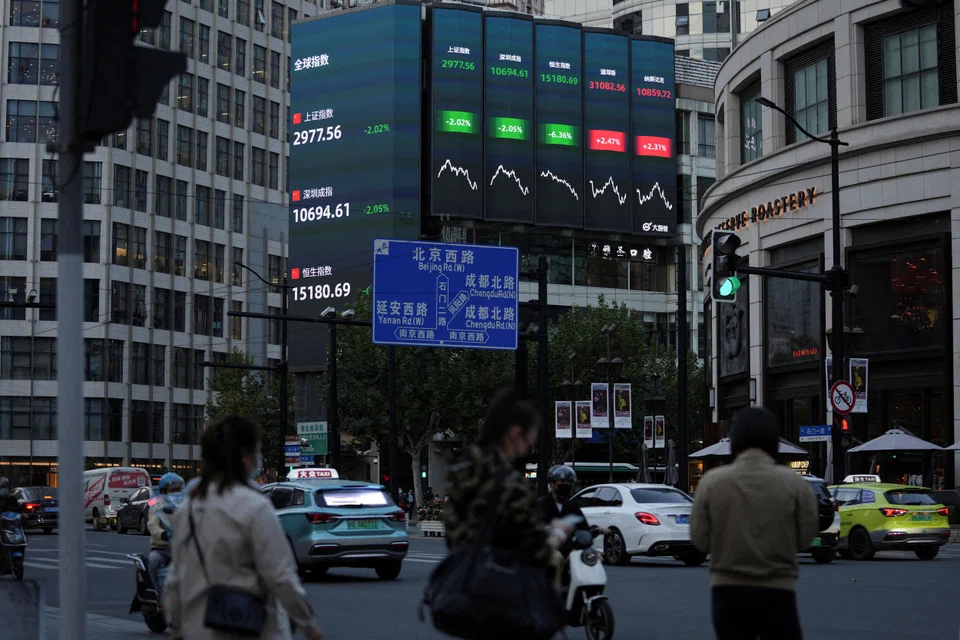
THE relentless sell-off in Chinese stocks has made the market the worst performer in the world over the past three years. And that is exactly the reason some funds are looking to unearth pockets of value.
They see a contrarian signal in the extreme pessimism towards Chinese assets in recent months amid an economic slowdown, unpredictable government crackdowns and rolling property woes. Global funds as a whole have slashed their China stock positioning to the lowest since October, which to some means more room for potential buying.
“China has a growth problem today, but not a systemic crisis,” said John Lin, Singapore-based chief investment officer for China equities at AllianceBernstein, which oversees US$694 billion globally. “The way you make money is you have to go company by company. There’s a lot of nice cash-flow companies, nice dividend-yield companies that are still under-appreciated.”
The MSCI China Index has tumbled 55 per cent from a high set in February 2021, while a gauge of mainland firms traded in Hong Kong has slumped 50 per cent and is the worst performer of 92 global indexes compiled by Bloomberg over the past three years.
One of the major drivers of the downtrend has been selling by global funds. After making net purchases earlier this year, offshore money managers offloaded a record US$12 billion of mainland shares in August via trading links with Hong Kong, and have sold another US$3.2 billion this month.
That bearish positioning opens up the prospect of a rebound, while signs of stabilisation in parts of the economy mean it makes sense to look for value now, bulls say.
A-shares
AllianceBernstein’s Lin says he favours companies in China’s local share market, which is primarily traded by domestic investors.
“We like A-shares because they are more domestic-oriented, and therefore are less susceptible to capital flows based on geopolitical tensions,” he said. “You can find a lot of interesting stocks that have their own idiosyncratic dynamics.”
Some of the most attractive companies are industrial-cyclical stocks such as bus-makers and diesel-engine makers that export to places such as Asean, central Asia and Middle East, and also have a presence in the domestic market so they will participate in the eventual local economic recovery, he said.

Healthcare
For Amundi, China’s healthcare stocks are where it sees value.
Medical shares have been beaten down amid an anti-corruption clampdown but the sector has probably already reached a bottom with all the bad news in the price, said Nicholas McConway, head of Asia ex-Japan equities at Europe’s largest money manager in London.
McConway is focusing on companies that are self-funded with robust drug pipelines. The prospect that global central banks are nearing an end to interest-rate hikes may also favour these companies as they can take years to turn profitable so tend to perform better in a lower-rate environment, he said.
Pharma
Guinness Global Investors favours pharmaceutical names that are transitioning from generic drugs to developing new products themselves or acquiring them through mergers and acquisitions.
Examples include CSPC Pharmaceutical Group, Sino Biopharmaceutical and China Medical System Holdings, said Sharukh Malik, a fund manager at Guinness Global in London who has spent the last eight years investing in Asian stocks.
“We estimate that for these three companies, valuations are now low enough that investors are paying nothing for the cash flows from future growth capex,” he said. “If we think these companies will eventually successfully make novel drugs themselves, the risk-reward ratio is very favourable for us.”
Tech giants
Some of the largest firms in the beaten-up technology sector now look attractive, according to Mondrian Investment Partners, which manages US$45.6 billion in assets.
Tech has seen some of the biggest losses over the past three years due to a government crackdown after authorities blocked a planned US$37 billion initial public offering by Ant Group in late 2020. The sector was a relative bright spot in second-quarter earnings, which has led to analyst estimate upgrades.
Mondrian Investment has been adding to positions in e-commerce giant Alibaba Group Holding as its stock price failed to capture the potential payouts that will be distributed to shareholders during its six-way split, said Ginny Chong, head of Chinese equities in London with over 20 years of experience in emerging markets.
She has also been also adding shares of Tencent Holdings and sees Baidu as undervalued. BLOOMBERG
Decoding Asia newsletter: your guide to navigating Asia in a new global order. Sign up here to get Decoding Asia newsletter. Delivered to your inbox. Free.
Share with us your feedback on BT's products and services