China to merge health insurance for urban and rural residents
 Add BT as a preferred source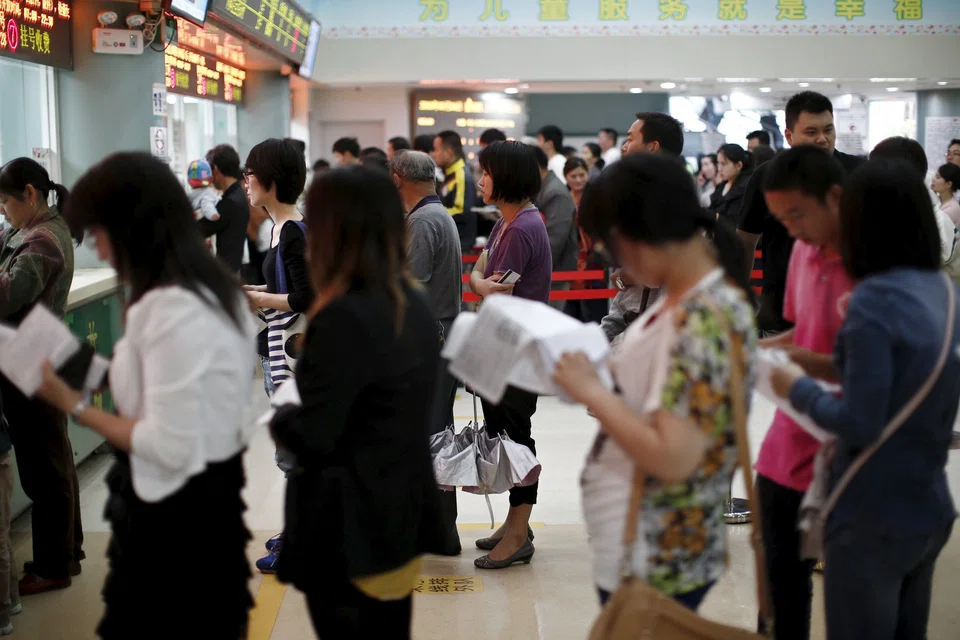
[BEIJING] China plans to combine public health insurance schemes for urban and rural residents that are currently separate, a bid to equalise access to health care as the incidence of conditions like cancer and diabetes surge.
The government-run insurance programmes will be consolidated in terms of fundraising, breadth of coverage and drug reimbursement, the official Xinhua news agency reported on Wednesday, citing decisions made at a meeting chaired by President Xi Jinping.
Private health insurance is rare in China and most patients rely on basic state-run programmes. Many patients struggle to make out-of-pocket payments for diseases like cancer, pushing the government to find new ways to broaden coverage.
Growth in pharmaceutical spending in China is set to slow to below 10 per cent through 2020 due to weaker economic growth and the substantial costs borne by patients, IMS Institute for Healthcare Informatics estimates.
China currently has three separate health insurance systems for employed urban residents, other city dwellers and rural residents that are managed by different government ministries, according to Xinhua.
Due to different sources of funding and regulations, the three schemes often have different reimbursement rates and coverage for diseases.
BLOOMBERG
Share with us your feedback on BT's products and services