

China now spurning ‘ugliest buildings’ that symbolised its meteoric rise
A SHANGHAI mall that mimics the Hanging Gardens of Babylon. A museum in Anhui province with a giant seated figure resembling a toilet built into its side. An opera house in Guangxi shaped like a metallic osmanthus flower.
These are some of the most extravagant – and visible – symbols of China’s meteoric economic rise in the last few decades. But they are also among the 2022 winners of the annual Ugliest Buildings Survey, an online poll started by Beijing-based architecture website Archcy.com that’s now in its 13th year.
“The hyperspeed urbanisation of the past two decades has led to an explosive overbuilding everywhere in the nation,” wrote Zhou Rong, one of the survey’s founding judges and an associate professor of architecture at Tsinghua University, in an essay in 2020.
“Lacking regulation, the construction spurt has been like sprinting blindfolded, outstripping public consensus and leading to a breakdown in cultural thought and design.”
As a result, buildings that imitated or idolised foreign cultures began to proliferate. They prioritised magnitude, flaunted wealth, pursued oddity for the sake of novelty, or were of shoddy quality, according to Zhou.
The Ugliest Buildings Survey was created against this backdrop, surfacing as a critique of this era as well as an emotional outlet for the public to vent, he wrote.
The public backlash against such buildings has been so severe that even the government has stepped in, likely at the behest of President Xi Jinping, who personally called for an end to “weird buildings” at a literary symposium in 2014.
Last year, China’s top economic planner released an ambitious urbanization plan designed to “optimise” city life “with Chinese characteristics,” in adherence to “Xi Jinping thought.” It reiterated a ban on “oversized, xenocentric, odd” buildings and an earlier restriction on the construction of skyscrapers over 500 meters.
But the trend showed no signs of stopping.
“We thought the contest would run out of material in a year or two, but even now ugly buildings are still mushrooming,” said Zhou at a public lecture in 2022. “The only thing that’s changed is their form of ugliness.”
To sift through the poll’s winners is to trace the evolution of aesthetics in Chinese modern architecture. Many of the early finalists were representative of the shanzhai culture in the 2000s, a term which connotes creative counterfeiting.
These could include buildings such as replicas of the US Capitol building or Tiananmen Square, which popped up around the country.
But before that was Shanghai’s infrastructure splurge, where China’s first mega-projects of spectacle of the post-reform era can be found.
In the 1980s, Pudong, the eastern part of the city, was all farmhouses and shipyards. There, China’s political leaders saw an opportunity to build a global financial hub on par with London and New York.
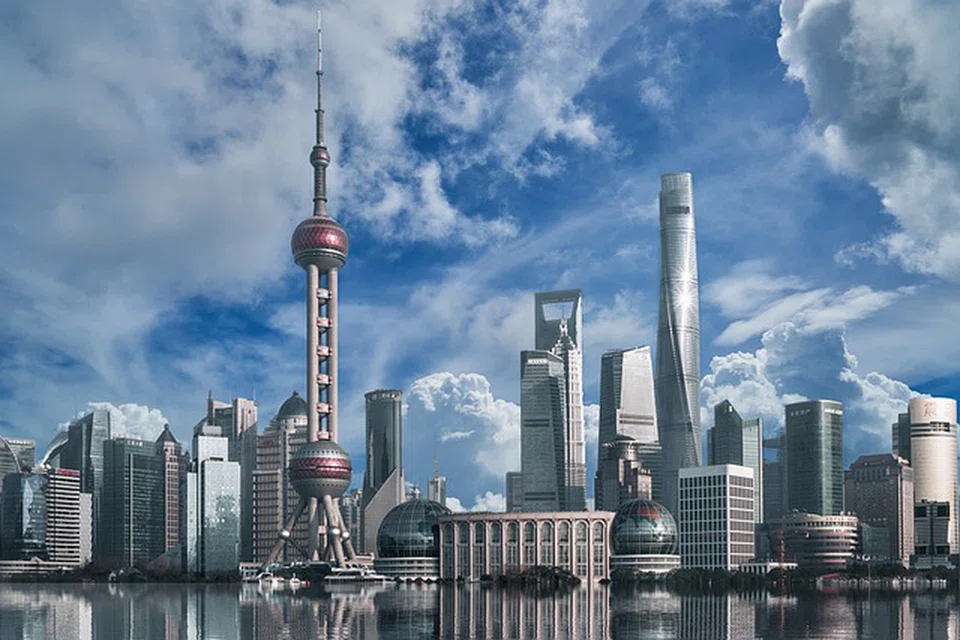
The plan included the development of three skyscrapers in a tight cluster that would become a visual shorthand of Shanghai’s future.
The first was the 468-meter-high Oriental Pearl TV Tower, completed in 1994, then the highest tower in Asia. The last of these to be built, the 632-meter Shanghai Tower, was completed in 2015 and is still the world’s third-tallest building.
Other Chinese cities began emulating Shanghai’s model.
“When you have local government officials keen on developing areas of cities that are meant either for tourist purposes or for attracting businesses, they do want signature buildings,” said Wu Weiping, an urban planning professor at Columbia University.
It was the 2008 Beijing Olympics, however, which firmly swung the pendulum toward bombastic buildings as a way to showcase China’s progress to the world.
These include the Rem Koolhaas-designed CCTV headquarters that’s been nicknamed “Big Pants,” the egg-shaped National Grand Theater, and sports venues like the latticed Bird’s Nest stadium and Water Cube aquatics center. Xi even targeted the CCTV building in his 2014 speech lambasting “weird buildings.”
But the experimental building boom continued, as economic growth continued to soar and designers saw China as a loosely regulated tabula rasa to test the most outlandish ideas.
The Italian-designed Circle Building in Guangzhou, which was completed in 2014 and resembles a golden doughnut, and the coin-shaped Fang Yuan building in Shenyang are past Ugliest Buildings winners.
Other over-the-top showpieces that populated the ranks of the poll were buildings resembling a liquor bottle, folk deity statues, a babushka doll, a gold ingot, a violin and even a crab. The list goes on.
More recently, criticism of the prize has centered around issues of cultural sensitivity as more international designers have taken the title.
Tian An 1,000 Trees, a mall in downtown Shanghai designed by British architect Thomas Heatherwick that won in 2022, was lambasted for its resemblance to a traditional Chinese tomb.
It features tree-adorned columns sloping down a stepped terrace, reminiscent of a cemetery – a particular point of controversy during China’s wave of Covid deaths late last year.
The 2019 winner was the Moshe Safdie-designed Raffles City Chongqing, which judges said “brutally trampled on Chongqing’s heritage.”
The eight towers erected over the city’s waterfront was also criticized for being too similar to Singapore’s Marina Bay Sands resort, another Safdie design.
To Chongqing native Alice Gao, the Raffles City is “tu,” a Chinese word for earth or soil which colloquially means unrefined or crude.
“Chongqing is a mountainous city, but this landmark doesn’t meld with the surrounding landscape, the towers jut out like nails,” said the 42-year-old marketing professional. “I reject it in my heart. A building stays for a long time – when it’s ugly, that impacts an entire local generation and our memory of the city.”
Three years of pandemic may at last usher in a new chapter for China’s ugly buildings. After decades of infrastructure binge, debt-laden local governments are now moving more cautiously.
Housing regulators last year issued new rules on building low-carbon cities, towns and villages, where at least 70% of the housing must be six stories or less. High-rises and massive signature buildings will also be de-emphasized in favor of amenities that may not earn immediate revenues.
But as China seeks to bolster its post-Covid economy, it may be tempted to once again build itself out of a slump, as land sales remain one of the most important sources of local government income. Top leaders have vowed to maintain a “necessary” magnitude of public spending in 2023, and construction activity has roared back.
Even then, reverting to the old playbook of vanity buildings no longer makes much sense. Beijing’s “common prosperity” campaign discourages ostentatious displays of wealth and excess. A more patriotic China is also warier of catering to foreign tastes and enlisting international architects, with officials and competitors for commissions embracing conservatism in recent years.
“As our civilisation figures out its cultural identity through public architecture, trial and error is part of the process,” said Zhou, the competition judge. “What’s important is to have a mechanism for self-correction. That’s the Ugliest Buildings Survey – it’s the sword of Damocles hanging overhead.” BLOOMBERG
Decoding Asia newsletter: your guide to navigating Asia in a new global order. Sign up here to get Decoding Asia newsletter. Delivered to your inbox. Free.
Share with us your feedback on BT's products and services






