China slashes quarantine for inbound travellers to 7 days
 Add BT as a preferred source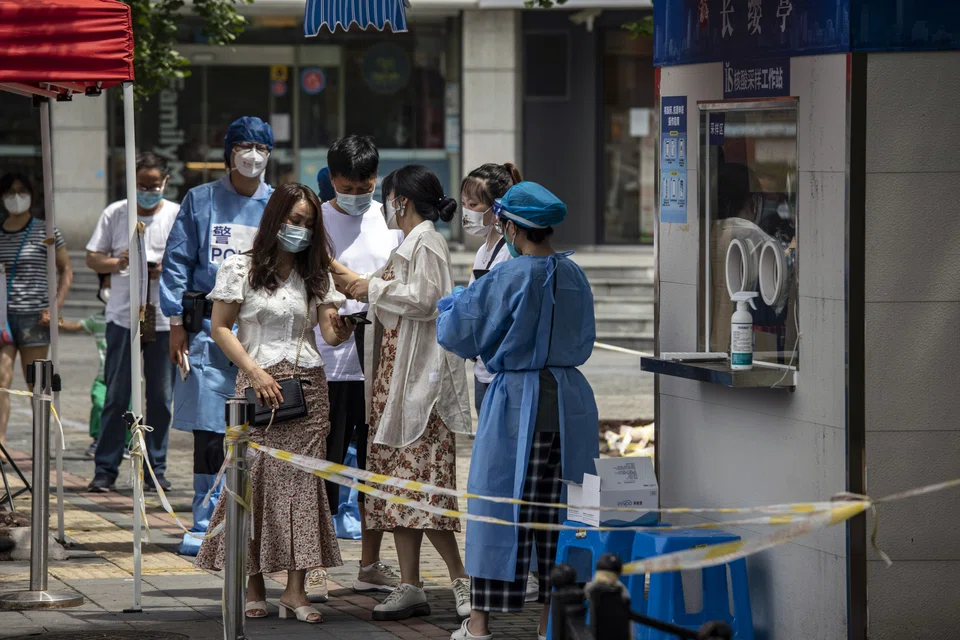
DeeperDive is a beta AI feature. Refer to full articles for the facts.
CHINA on Tuesday (Jun 28) slashed the quarantine time for inbound travellers by half in a major easing of one of the world’s strictest Covid-19 curbs, which have deterred travel in and out of the country since 2020.
Quarantine at centralised facilities has been cut to 7 days from 14, and subsequent at-home health monitoring has been reduced to 3 days from 7, the National Health Commission said in a statement.
The latest guidelines from the health authority also eased quarantine requirements for close contacts of people who have tested positive for the new coronavirus.
China has cautiously eased its Covid-19 curbs on cross-border travellers in recent months, with health officials saying the shorter incubation period of the Omicron variant allows for an adjustment of quarantine periods.
The Chinese capital Beijing in recent months has already reduced the quarantine period at centralised facilities to 10 days from 14.
Last month, China also removed some Covid-19 test requirements for people flying in from countries such as the United States.
Navigate Asia in
a new global order
Get the insights delivered to your inbox.
Stock markets rose in Hong Kong and the mainland, with the Hang Seng Index reversing losses and ticking up roughly 0.4 per cent and the CSI300 Index gaining 0.7 per cent. Shares in mainland tourism companies jumped more than 5 per cent.
Beijing and Shanghai reported no new local Covid-19 infections on Tuesday, the first time both cities were in the clear simultaneously since late February, after months of fighting their worst-ever outbreaks.
The milestone for the 2 cities, achieved on Monday, came after their daily caseloads dropped to single digits over the past week, allowing Shanghai to gradually resume eating in at restaurants and Beijing to reopen some leisure venues including the Universal Beijing Resort.
Shanghai Communist Party chief Li Qiang declared last Saturday that authorities had “won the war to defend Shanghai” against Covid-19, after a crushing 2-month citywide lockdown that was finally lifted in early June.
The Walt Disney’s Shanghai Disney Resort said on Tuesday that it would reopen the Disneyland theme park on June 30, having been shut for more than 3 months.
Authorities, however, remained wary and were adamant that the government’s so-called dynamic zero-Covid policy, which aims at blocking flare-ups from spreading as they crop up, remains in place.
Beijing would “fight against any new outbreaks at the outset and with speed and resolutely break their transmission channel”, Cai Qi, the city’s top Communist Party chief, was quoted as saying in a report by the party-backed Beijing Daily.
The city would build “a solid virus barrier”, Cai was quoted as saying on Monday.
Earlier on Monday, the Beijing Daily apparently misquoted Cai as saying the city would maintain its Covid control effort for “the next five years”. The newspaper afterwards removed the reference and its chief, Zhao Jingyun, said it was an error but that did not prevent some suspicion among the public.
“Surely it wasn’t a mistake! It’s meant to gauge public opinion!” said a user of the Weibo social media platform.
Another Weibo user said even if it was a mistake, “at least the higher-ups are now aware of how helpless we all feel and how we detest the current counter-epidemic policies”.
Despite easing Covid-19 restrictions in Beijing and Shanghai, their combined 47 million residents have been told to go through Covid testing every few days, to maintain access to public spaces and transport.
Elsewhere in mainland China, a total of 22 domestically transmitted infections were reported for June 27, including 5 in the southern technology hub Shenzhen. REUTERS
Decoding Asia newsletter: your guide to navigating Asia in a new global order. Sign up here to get Decoding Asia newsletter. Delivered to your inbox. Free.
Share with us your feedback on BT's products and services