China sovereign fund buys ETFs in new bid to boost stocks
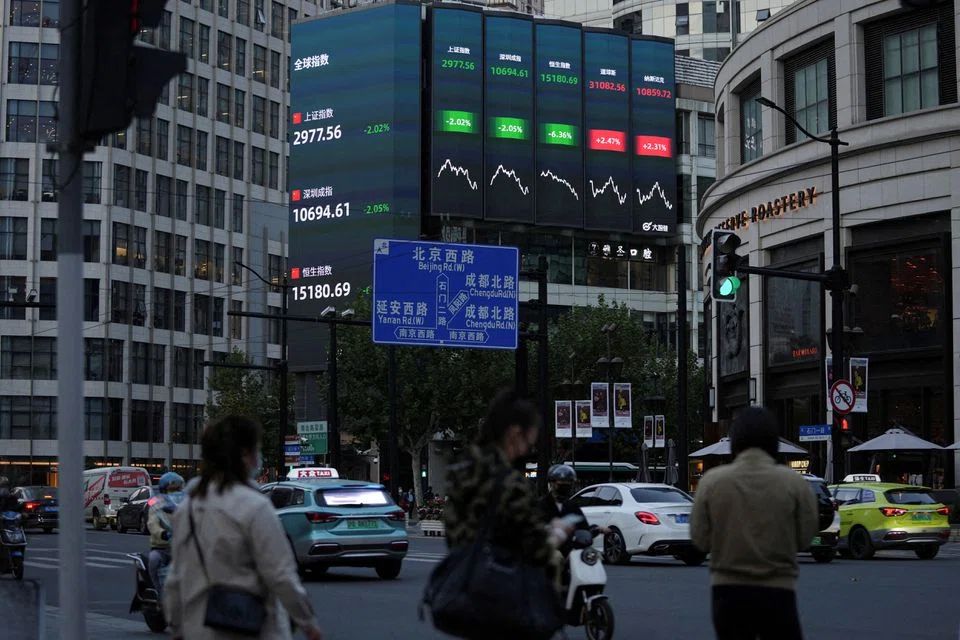
CHINA’S sovereign wealth fund bought exchange-traded funds (ETFs) on Monday (Oct 23), expanding its purchases beyond bank shares as authorities step up attempts to boost the country’s slumping stock market.
Central Huijin Investment, a unit of the US$1.4 trillion wealth fund China Investment that’s long served as the main vehicle for China’s holdings in state-run banks, bought an undisclosed amount of ETFs and vowed to keep increasing its holdings, it said late Monday.
Huijin may have purchased 10 billion yuan (S$1.87 billion) in ETFs, the China Fund newspaper reported on Tuesday, citing brokerage estimates. The purchases may be focused on ETFs tracking technology-stock indices, which comes in line with regulators’ support of innovation, it said, citing Huachuang Securities analysis.
The move came shortly after the sovereign fund bought about US$65 million of shares in the nation’s biggest banks this month, a symbolic step that has so far failed to boost sentiment. The benchmark CSI 300 Index has fallen 10 per cent this year, closing at the lowest level since February 2019 on Monday, as investors remain worried about growth and the property-market crisis even after the government’s rounds of support measures.
Central Huijin’s purchases of ETFs tracking indices can have “more direct, more obvious” effects on the market than buying bank shares, especially as the economy is stabilising, Li Zhan, chief economist at China Merchants Fund Management’s research department, was cited by the official Shanghai Securities News as saying.
Turnover on the Huatai-Pinebridge CSI 300 ETF, one of the most-held ETF products by Huijin, jumped to the highest in two months on Monday, nearly three times its average over the past year.
The sovereign fund’s moves underscore concerns among top leaders over the sinking market. China is considering forming a state-backed stabilisation fund to shore up confidence in its US$9.5 trillion stock market, sources familiar with the matter told Bloomberg earlier this month. After at least two rounds of consultation with industry participants over a period of months, financial regulators including the China Securities Regulatory Commission recently submitted a preliminary plan to the nation’s top leadership, said the sources.
There have been growing calls from Chinese economists and hedge funds for the government to directly intervene with a stabilisation fund to buy stocks for the first since the market crashed in 2015. The fund could buy different values of stocks when the index is below certain levels and sell when the gauge rises above designated lines, preventing both excessive declines and overheating while making a profit, Li Bei, founder of Shanghai Banxia Investment Management Center, wrote in an Oct 10 WeChat article that was removed the following day.
Good effects
Central Huijin’s two previous publicly announced moves to purchase ETFs, which occurred in June 2013 and July 2015, were both followed by gains of more than 20 per cent in Shanghai stock indices within three months. That shows such moves, couple with other policy measures, can have “relatively good” effects on supporting market liquidity and stabilising investor expectations, according to a China International Capital (CICC) report on Tuesday.



The move not only shows the market now has good investment value for the medium term, but it can also ease broader liquidity conditions and help more stocks than buying bank shares, CICC analysts led by Huang Kaisong wrote in the note.
While there are signs that China’s economy may be bottoming out in the short term, Bloomberg Economics now forecasts growth weakening to 3.5 per cent in 2030 and to about 1 per cent by 2050. That’s lower than prior projections of 4.3 per cent and 1.6 per cent, respectively.
During the 2015 rout, Beijing tapped China Securities Finance as its main stabilisation vehicle by allowing it to access as much as three trillion yuan of borrowed funds from sources including the central bank and commercial lenders. The money was used to buy stocks directly and provide liquidity to brokerages. Even so, the turbulence did not end until a year later. BLOOMBERG
Decoding Asia newsletter: your guide to navigating Asia in a new global order. Sign up here to get Decoding Asia newsletter. Delivered to your inbox. Free.
Share with us your feedback on BT's products and services