

China targets 100 trillion yuan services sector by 2030 in upgrade push
Policy aims to use services to boost industry, meet livelihood needs, and expand employment
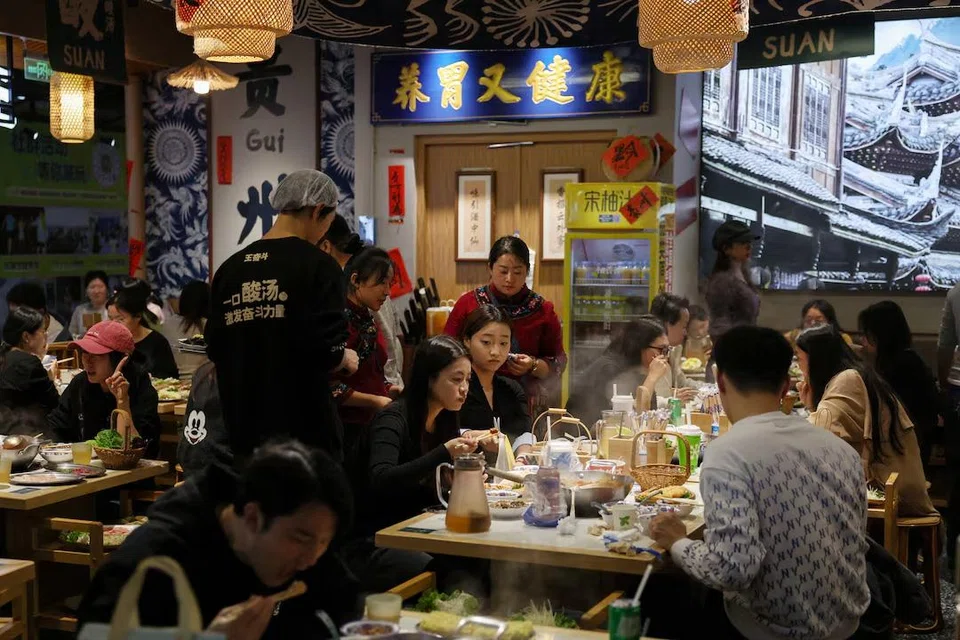
[BEIJING] China has unveiled plans to expand its services sector to 100 trillion yuan (S$18.7 trillion) by 2030 and upgrade service quality, as it seeks to boost the sector’s role in job creation and consumption.
Growth will be driven by demand, reform, tech innovation and greater openness, while institutional barriers will be removed and market forces better aligned with government support, the State Council said in a policy document issued on Tuesday (Apr 21).
“By 2030, notable progress will be achieved in the high-quality development of the services sector, with the sector’s total size reaching the 100 trillion yuan mark,” the Cabinet said, adding it aims to foster more globally competitive and internationally recognised “China Services” brands.
China’s services sector grew 5.4 per cent year on year to 80.89 trillion yuan in 2025, official data shows.
The policy aims to better leverage the services sector’s role in supporting industrial upgrading, meeting people’s livelihood needs and expanding employment.
The plans will focus on strengthening business services such as R&D, logistics, software, supply-chain finance and green services, while upgrading consumer sectors including retail, healthcare, elderly care, childcare, tourism and culture.
Authorities also pledged stronger fiscal and financial support, including loan interest subsidies, relending tools, government investment funds and wider use of services-sector real estate investment trusts (Reits).
Earlier this month, President Xi Jinping called for a demand-driven approach coupled with reform and technological empowerment to develop the service sector.
Beijing has been signalling a policy shift to focus on services this year as it tries to redirect some stimulus from sometimes-wasteful investments on transport, housing and industrial infrastructure to potentially more productive areas. Soft consumer demand has hobbled the economy and Beijing’s measures so far haven’t turned it around.
SEE ALSO




China’s services spending has outpaced goods consumption growth in recent years but still lags far behind developed economies. Per-capita services consumption accounted for 46.1 per cent of total consumption in 2025, well below the roughly 70 per cent seen in the US.
China’s new five-year plan pledged to “significantly” raise the share of household consumption in the economy over the next five years from around 40 per cent at present, though it stopped short of setting a specific target. REUTERS
Decoding Asia newsletter: your guide to navigating Asia in a new global order. Sign up here to get Decoding Asia newsletter. Delivered to your inbox. Free.
Share with us your feedback on BT's products and services
TRENDING NOW

DBS, OCBC, UOB rout lops billions off STI as inflation, rate concerns spook investors

Grab CEO’s wife Chloe Tong on life with Anthony Tan and finding her purpose

OCBC sheds S$8 billion in value as shares close nearly 6% down; analysts cautious on banks

Deal between tycoon friends sparks scrutiny of Philippine power sector

