China to continue with people-oriented growth as top priority

CPC releases publication that condenses its 100-year journey to rejuvenate China and vision for future

Angela Tan
Published Thu, Aug 26, 2021 · 09:50 PM

    Singapore

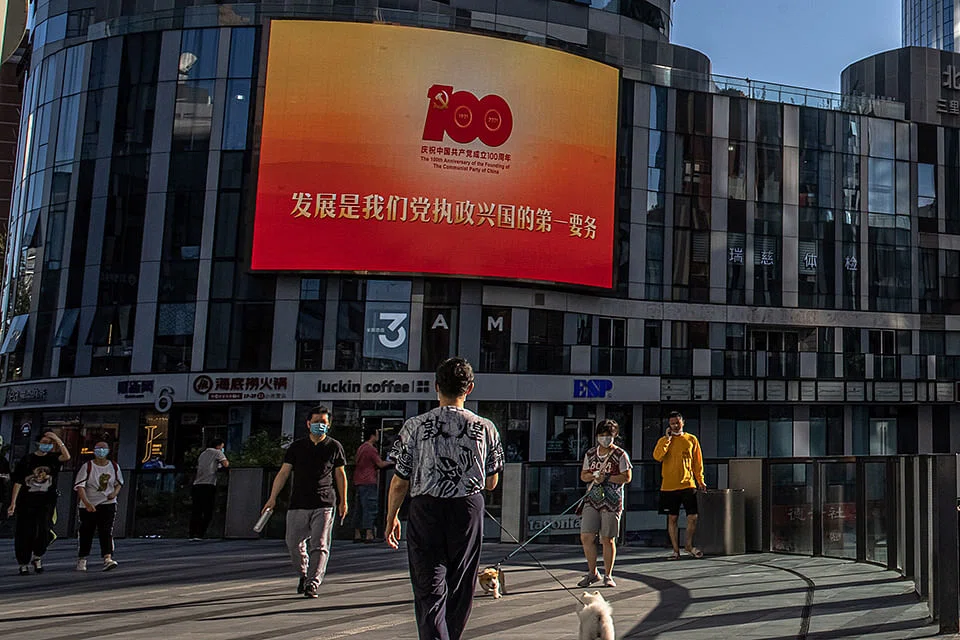
    THE Communist Party of China (CPC) will pursue a people-oriented development as its top priority even as it continues its reforms and opens up the economy to the rest of the world, but it also warns that the journey will not be smooth though the "prospects are bright and broad".

    The publicity department of the CPC Central Committee on Thursday released a key publication entitled The CPC: Its Mission and Contributions, which condenses the party's 100-year journey to rejuvenate China, and vision for the future.


    According to the document which reflects the fundamental principles by which the CPC will lead the country, China will become a modern socialist country by 2035.

    "On the journey ahead, the CPC will always put the people first, and work hard to resolve imbalances and inadequacies in development and the pressing difficulties and problems that are of the greatest concern to the people," the CPC said in the document.

    At a press conference in Beijing, a CPC senior official said China's push for common prosperity would not rob the rich. "We will continue to make the economic pie bigger and divide it well," said Han Wenxiu, deputy director of the Office of the Central Financial and Economic Affairs Commission. Charitable donations will be encouraged through taxation policies and to improve the income distribution structure, but they are "not compulsory".

    He said recent policies regulating Internet companies were aimed at irregularities and illegal behaviour, and "absolutely" did not target private companies or foreign companies.

    The CPC said that despite its systematic planning, it was not an easy task to realise common prosperity and ensure the comforts of modern life for more than 1.4 billion people.

    "The journey ahead will not be smooth, but the prospects are bright and broad," it said, promising to break any shackles hindering common prosperity, equity and justice.

    Since the implementation of the first five-year plan (1953-1957), the CPC has introduced a total of 14 such plans, with the 14th one (2021-2025) now under way.

    The party has adopted the use of pilot programmes to roll out major reform initiatives to mitigate risks from a nationwide roll-out.

    These pilots include special economic zones; China (Shanghai) pilot free trade zone; Shenzhen pilot demonstration zone for Chinese socialism; and Zhejiang demonstration zone for common prosperity.

    In its reforms, the CPC intends to follow "a unique Chinese path" to modernisation, which will continue to adapt Marxism to China's conditions. "This will ensure that economic, political, cultural, social and eco-environmental development is of higher quality, more efficient, more equitable, more sustainable and more secure, so that the people will enjoy a greater share of its benefits."

    Besides domestic development, the CPC is also committed to pursuing development with its global neighbours. It will pursue "cooperation rather than confrontation, opening up rather than isolation, and mutual benefits rather than the zero-sum game".

    "In terms of politics, China calls on all countries to respect each other, discuss international issues as equals, reject the Cold War mentality and power politics, and take a new approach to developing state-to-state relations based on communication, not confrontation, and based on partnership, not alliance," the CPC said.

    Touching on security, China calls on all countries to commit to settling disputes through dialogue and to resolving differences through discussion, to coordinate responses to conventional and non-conventional threats, and to oppose terrorism in all forms.

    As for economic development, it said countries should work together, to facilitate free trade and investment, and to make economic globalisation more open, inclusive, and balanced, so that the benefits are shared by all.

    On the whole, the party said countries should respect the diversity of civilisations, and should replace estrangement with exchange, clashes with mutual learning, and cultural superiority with coexistence of diverse cultures.

    It cited the Belt and Road Initiative (BRI) as an important platform for building a global community of shared future. To date, China has signed more than 200 documents on BRI cooperation with 140 countries and 32 international organisations.

    READ MORE: China's push for 'common prosperity' may drive assets overseas if not for curbs