China warns US against forming Pacific 'Nato' and backing Taiwan
 Add BT as a preferred source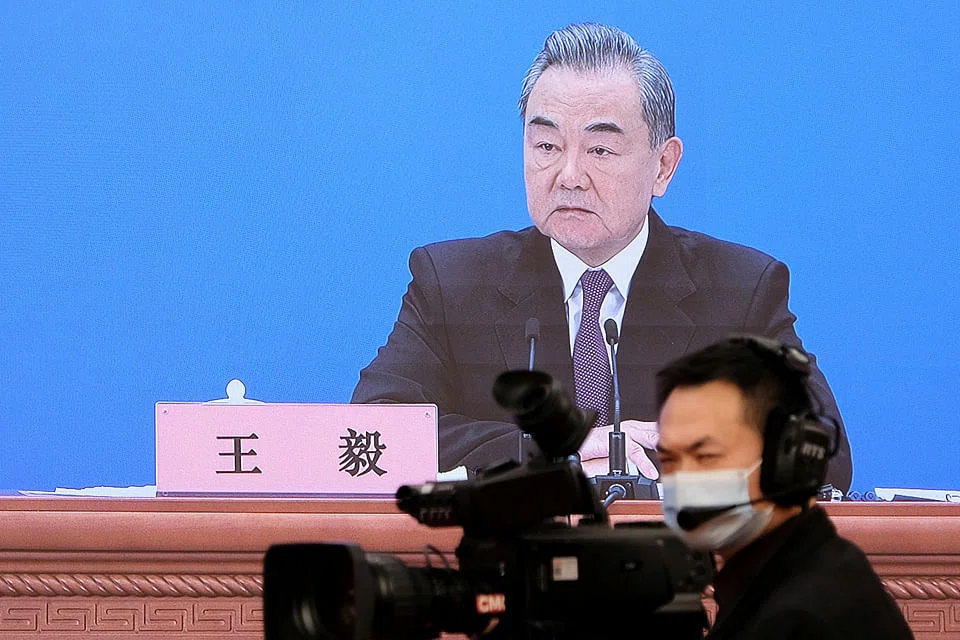
DeeperDive is a beta AI feature. Refer to full articles for the facts.
Beijing
CHINA warned the US against trying to build what it called a Pacific version of the North Atlantic Treaty Organization (Nato), while declaring that security disputes over Taiwan and Ukraine were "not comparable at all".
Foreign Minister Wang Yi told his annual news briefing on Monday (Mar 7) that the "real goal" of the US's Indo-Pacific strategy was to form Asia's answer to Nato. China has often accused the US of trying to form blocs to suppress its growth, a complaint that is likely to attract greater attention after Russian President Vladimir Putin cited similar grievances before his invasion of Ukraine.
"The perverse actions run counter to the common aspiration of the region for peace, development, cooperation and win-win outcomes," Wang added. "They are doomed to fail."
Complaints about US efforts to strengthen its alliance network in Asia were among several points of contention raised by Wang in the almost 2-hour briefing on the sidelines of the National People's Congress (NPC) in Beijing. The senior diplomat repeatedly alluded to the US as the source of problems with countries around the globe and issued some of China's most pointed warnings yet against calls to expand US ties with Taiwan.
"This would not only push Taiwan into a precarious situation, but will also bring unbearable consequences for the US side," Wang said on the sidelines of the NPC in Beijing, later adding: "Taiwan will eventually return to the embrace of the motherland."
Navigate Asia in
a new global order
Get the insights delivered to your inbox.
Several Asian nations - like their counterparts on Russia's European frontier - have sought closer security ties with the US to keep from being dominated by the region's biggest player. The Biden administration outlined efforts to push back against growing Chinese clout in its Indo-Pacific strategy released last month. The US has sought to build a coalition of democracies around the world, including both traditional treaty partners such as Japan and new groupings such as the Quadrilateral Security Dialogue, which includes Australia and India.
Russia's attack on Ukraine has undermined confidence that world powers would be able to prevent a crisis from similarly erupting over Taiwan, a democratically governed island of more than 23 million people and key global source of semiconductors.
"Some, while being vocal about the principle of sovereignty on the Ukrainian issue, have kept undermining China's sovereignty and territorial integrity on the Taiwan question - this is a blatant double standard," Wang said.
Russia launched its military action in Ukraine weeks after Chinese President Xi Jinping hosted Putin in Beijing and publicly declared their friendship had "no limits". China has sought to avoid taking a position in the conflict, as it attempts to balance support for Russian efforts to challenge US dominance with its interest of being regarded as a responsible major power.
Wang passed up another opportunity to criticise Russia's military action or call it an "invasion", instead saying that ties between the two countries remained "rock solid". Russia is growing more reliant on Chinese support as it faces a barrage of US-led sanctions over bloodshed in Ukraine.
Wang said that China would soon offer humanitarian assistance to Ukraine. "China is prepared to continue playing a constructive role to facilitate dialogue for peace and work alongside the international community when needed to carry out necessary mediation," Wang said, stopping short of clarifying whether Beijing would mediate between Kyiv and Moscow. BLOOMBERG
Decoding Asia newsletter: your guide to navigating Asia in a new global order. Sign up here to get Decoding Asia newsletter. Delivered to your inbox. Free.
Share with us your feedback on BT's products and services