

China’s annual parliament meets to unveil road map for tech race with the West
It will happen weeks before Chinese President Xi Jinping and US President Donald Trump meet to likely discuss tech controls and supply chains
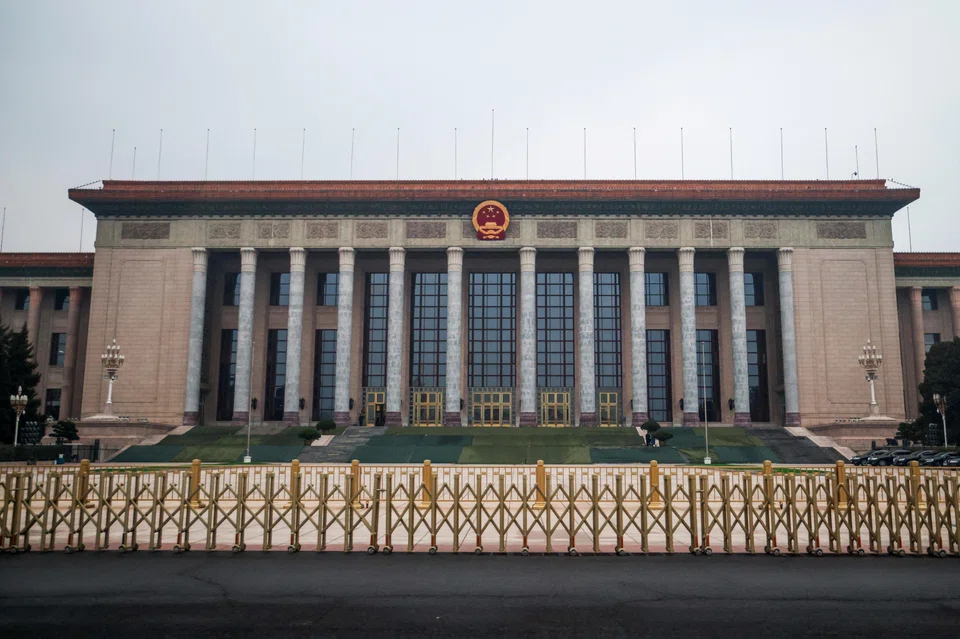
[BEIJING] On Thursday (Mar 5), China will outline its plans to push forward with the next phase of its tech race with the West, and convert a wave of high-profile breakthroughs in artificial intelligence (AI), space and robotics into industrial scale and capital-market momentum.
The country’s top leadership will publish its annual government work report and budgetary plans at the opening session of the National People’s Congress (NPC), China’s rubber-stamp parliament.
It will also outline its 15th five-year plan for 2026 to 2030, a sweeping blueprint that sets priorities for industrial policy.
The reports spell out Beijing’s priorities – and indicate which industries it will favour with generous funding and policy support.
In 2025, AI models received a mention for the first time; embodied intelligence – the tech that powers humanoid robots – was also highlighted.
AI after the ‘shock’
The opening session will happen weeks before a planned meeting between Chinese President Xi Jinping and US President Donald Trump from Mar 31 to Apr 2, when tech controls and supply chains are expected to figure prominently in their discussions.
It also marks a year since Chinese AI developers drew global attention for sudden leaps in capability, despite tight US restrictions on access to advanced chips and chipmaking equipment.
DeepSeek, the Chinese startup, is widely expected to roll out a next-generation model in the coming days. DeepSeek released an AI model in 2025 that went viral and triggered a global tech share sell-off and reshaped assumptions for China’s tech competitiveness against the US.
“The shock is over,” said Alfredo Montufar-Helu, a managing director at Ankura Consulting in Beijing. “Now, an expectation exists of what China can come up with next.”
The challenge for Beijing is turning individual breakthroughs into systematic, large-scale gains across manufacturing, logistics and energy.
Shujing He, a senior analyst at advisory company Plenum China, said policymakers are likely to push “AI-plus manufacturing” by using large state-owned enterprises as anchor adopters, pulling startups and specialised suppliers into real-world deployment.
That strategy, however, is also expected to reshape China’s industrial structure.
Shin Nakamura, the president of Japanese manufacturer Daiwa Steel Tube Industries, said China’s AI push is likely to favour large, capital-intensive producers which are able to absorb the cost of deployment, while smaller companies face structural constraints.
“The gap between large enterprises and small and medium-sized enterprises in China will widen, and consolidation will accelerate,” he said.
Humanoids and space
The five-year blueprint is also expected to double down on embodied intelligence.
The country showcased advances it made in the arena in February by putting Chinese-made humanoid robots dancing and performing martial arts centre stage on China’s most-watched TV show, China Central Television’s annual Spring Festival Gala.
Big leaps in hardware tech underpin China’s confidence in robotics.
“Mechatronics – especially balance, motor control and dynamic locomotion – has improved dramatically over the past 12 months,” said Mike Nielsen, an executive at computer-vision business RealSense, which has worked closely with leading Chinese robotics company Unitree.
“China has shown major momentum, with early-stage platforms now demonstrating much higher agility and stability.”
But Chinese regulators are also warning about the low differentiation among more than 150 domestic humanoid-robot developers, and analysts say consolidation is likely to arrive faster than in earlier strategic sectors such as electric vehicles.
Space is another test case for Beijing’s drive to translate research into industrial strength.
Private launch company LandSpace said it plans another recovery attempt this year for its reusable Zhuque-3 rocket, after becoming the first Chinese company to conduct a full test of an orbital-class reusable launcher in December.
Despite the hype, China’s emerging industries will not generate sufficient investment to power 5 per cent of gross domestic product growth in the coming years, US research company Rhodium Group said in a January report.
It suggested that Beijing will continue relying on exports to prop up its economy.
This also means the country will prioritise sectors with more immediate commercial impact like autonomous driving, Plenum’s He said.
Supply chains and leverage
Analysts say the five-year plan will also be scrutinised for the way Beijing intends to protect the industrial foundations beneath its tech push, as supply chains themselves become instruments of geopolitical pressure.
Over the past year, China has expanded its use of export controls into rare earths and low-end semiconductors, disrupting global supply chains and underscoring Beijing’s economic leverage.
Its State Council and industry ministry did not respond to requests for comments.
Other supply chains crucial to the global economy are vulnerable to China dependencies, said Doug Friedman, CEO of US biomanufacturing institute BioMADE.
“What we see happening with rare earths is also happening in the industrial chemicals industry,” he said.
As Beijing lays out its next five-year industrial strategy, he said the stakes are becoming clearer.
“Right now, we’re neck and neck,” he said, referring to the US and China. “Whoever doubles down over the next three to five years is going to gain a real lead.” REUTERS
Decoding Asia newsletter: your guide to navigating Asia in a new global order. Sign up here to get Decoding Asia newsletter. Delivered to your inbox. Free.
Share with us your feedback on BT's products and services






