

China’s car sales unexpectedly contract in October after eight-month expansion
The final results are far below CPCA’s preliminary data, released last week
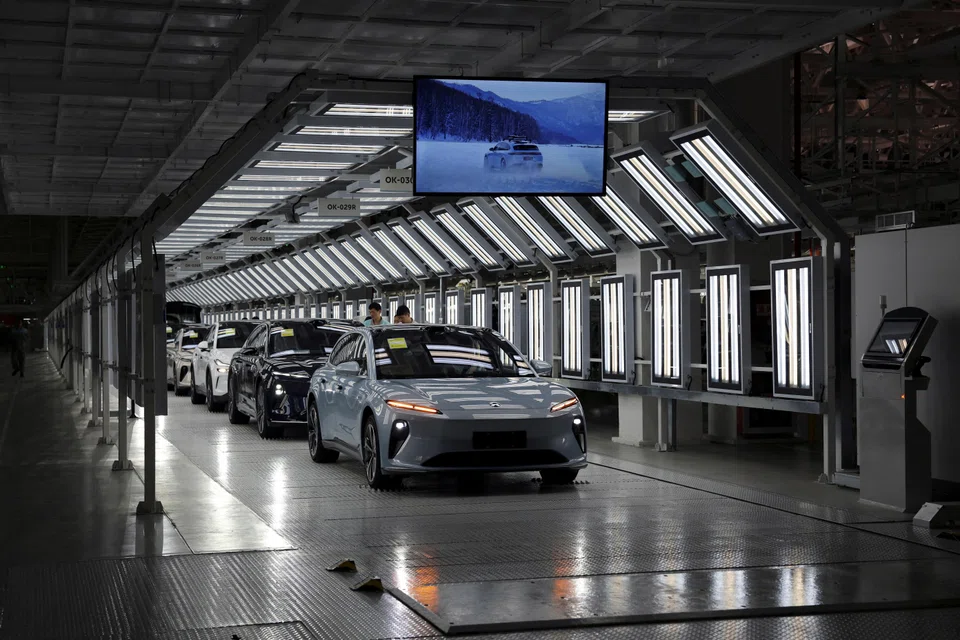
[BEIJING] China’s car sales fell unexpectedly in October from a year earlier, snapping an eight-month growth streak, as consumer sentiment weakened amid reduced tax exemptions and government subsidies.
Car sales edged down by 0.8 per cent to 2.27 million units last month, versus a 6.6 per cent increase in September, data from the China Passenger Car Association (CPCA) showed on Monday (Nov 10).
Growth in sales of electric vehicles (EVs) and plug-in hybrid electric vehicles (PHEVs) slowed to 7.3 per cent, down from a 15.5 per cent gain in September.
The final results were far below CPCA’s preliminary data released last week, which expected 6 per cent sales growth year on year, and a 17 per cent rise in so-called new-energy vehicle sales.
Cui Dongshu, secretary-general at the association, said: “Cars sold wholesale (to dealerships) beat expectations in the last week of October and the preliminary numbers were compiled based on the assumption that retail sales should be close to wholesales, which turned out to be adding inventories.”
With purchase tax breaks of up to 30,000 yuan (S$5,489.51) for EVs and PHEVs due to halve from 2026, an increasing number of carmakers, including Xiaomi, Nio and Li Auto, have offered subsidies of up to 15,000 yuan to encourage orders to be delivered next year.
Meanwhile, government subsidies that spurred more than 12 million car trade-ins this year are dwindling, as the consumer subsidy scheme draws to a close at year-end.
Nearly 20 provinces and cities have suspended or tightened subsidised car trade-ins, dampening consumers’ buying activity, Cui said.
Young people not keen on buying a car also resulted in a dearth of first-time car buyers, he added.
Tepid demand only intensified competition in the world’s largest car market.
Local EV bellwether BYD extended a sales decline last month, while Geely and Leapmotor both refreshed sales records, leading a challenge against BYD in the budget segment.
One model that could compete with BYD’s cheapest EV offering, Dolphin, is the Aion UT super EV.
With a 500 km driving range and Contemporary Amperex Technology Co Limited’s (CATL) battery-swapping technology, the new car is competitively priced from 49,900 yuan.
With strong overseas shipments from BYD, and others to diversify beyond the home turf, China’s car export growth quickened to 27.7 per cent from 20.7 per cent in September, CPCA data showed. REUTERS
Decoding Asia newsletter: your guide to navigating Asia in a new global order. Sign up here to get Decoding Asia newsletter. Delivered to your inbox. Free.
Share with us your feedback on BT's products and services
TRENDING NOW
Companies still in search of AI use cases with worthwhile ROI, says Broadcom’s CEO

Malaysian king buys stake in Singapore-listed mining firm expanding into rare earths

Once staunchly pro-China, Malaysian Chinese businesses are now distancing themselves from Beijing

Singapore’s wealth management success should extend to everyday families

