China's economy rebounds strongly in second quarter
But analysts say challenges remain with unemployment and consumer spending still major concerns
Beijing
CHINA'S economy rebounded in the second quarter as stimulus measures avoided a recession, with most of the country reopening successfully after nearly two months of lockdown due to the Covid-19 pandemic.
However, figures published on Thursday by the National Bureau of Statistics (NBS) point to an uneven recovery with consumption lagging behind supply.
China's gross domestic product (GDP) grew a better-than-expected 3.2 per cent in the second quarter, after a drop of 6.8 per cent in the first three months of the year, its worst quarterly growth on record.
In the first half, GDP contracted 1.6 per cent. Most analysts say the world's second largest economy will finish the year above zero.
"The year-on-year expansion of China's GDP in the second quarter underscores the robust recovery China's economy is going through after the historic contraction in the first quarter," said Louis Kuijs, head of Asia economics at Oxford Economics.
"We expect the upturn in China's economy to continue in the second half of the year, supported by improved sentiment after the successful containment of Covid-19 and significant fiscal and monetary policy easing."
Industrial production, a gauge of manufacturing, mining and utilities, rose by 4.8 per cent in June after growing 4.4 per cent in May.
Meanwhile, fixed asset investment, a gauge of expenditures on infrastructure property, machinery and equipment, fell 3.1 per cent in the first six months of the year, up from the 6.3 per cent decline registered in the first five months.
The quarterly data is in line with a manufacturing gauge and trade figures published earlier this month which also fared better than expected.
China was the first country to be hit by the Covid-19 virus and the first to restart its economy.
Stimulus measures have focused on restarting its vast industrial sector and boosting infrastructure spending.
The government loosened its monetary policy, pouring liquidity into the markets with the goal of supporting SMEs, mostly in the service sector which struggled to retain workers as consumers stayed away from shops and restaurants.
Factories started reopening in February and gradually the rest of the economy followed. With little or no new cases nationwide, schools welcomed back its first students in May and cinemas are expected to reopen on July 20. A small rebound in cases last month in Beijing was quickly dealt with by the local government, a sign that future clusters will not cause major disruptions.
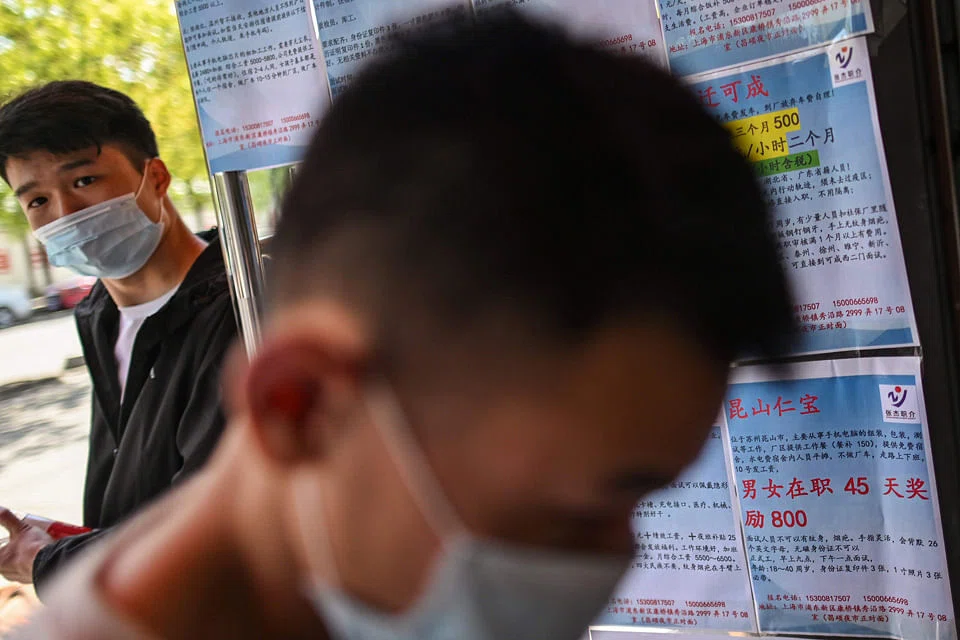
However, analysts say challenges remain with unemployment and consumer spending still major concerns for the government.
Retail sales, a key measurement of consumption fell 1.8 per cent in June, better than the 2.8 per cent decline in May but remaining in contraction.
While businesses have reopened, consumers are still shy of going out as recent tourism statistics showed. As massive unemployment looms, many are keeping a tight lid on their spending.
"China implemented supply side measures which led to lower taxes, investment in infrastructure but those do little to address the demand shock", said Micheal Pettis, a professor of finance at Peking University.
Although some of the initial unemployment has been resorbed, it remains high enough for the government to install employment quotas for new graduates coming into the market.
The official unemployment rate in June was 5.7 per cent, compared with figure of 5.9 per cent in May. The figure does not take into account migrant and rural workers, many of whom were forced out of jobs in January and February.
"In terms of accumulated growth rate in the first half, no matter the GDP, industrial output, service sector, investment or retail sales, most economic indicators were still in negative territory, so we judge the rebound (in the second quarter) as restorative growth," said NBS spokeswoman Liu Aihua on Thursday.
"There's still a way to go for fully making up the loss of the pandemic. (The recovery in the first half) showed that the impact of the pandemic is controllable," she added.
The rebound is expected to slow in the coming months with pent up demand to lose steam. Exports will also lose some momentum as demand for Chinese medical equipment slows.
China's economy will also have to face uncertainties linked to a potential second wave of the pandemic and the ongoing trade tensions with the United States.