China’s industrial profits jump as Middle East war casts long shadow
Computer, communication and other electronic equipment manufacturing had the fastest profit growth
[BEIJING] China’s industrial firms reported stronger profit growth early in the year, reinforcing recovery signals in the world’s second-largest economy even as the Middle East war threatens global growth.
Business margins remain squeezed as rising input costs and fierce competition bite across sectors, while trade and geopolitical tensions cloud the outlook for exports - a key engine of economic growth.
Industrial profits grew 15.2 per cent in the first two months over the same period last year, following a 0.6 per cent increase for the whole of last year, data from the National Bureau of Statistics showed on Friday.
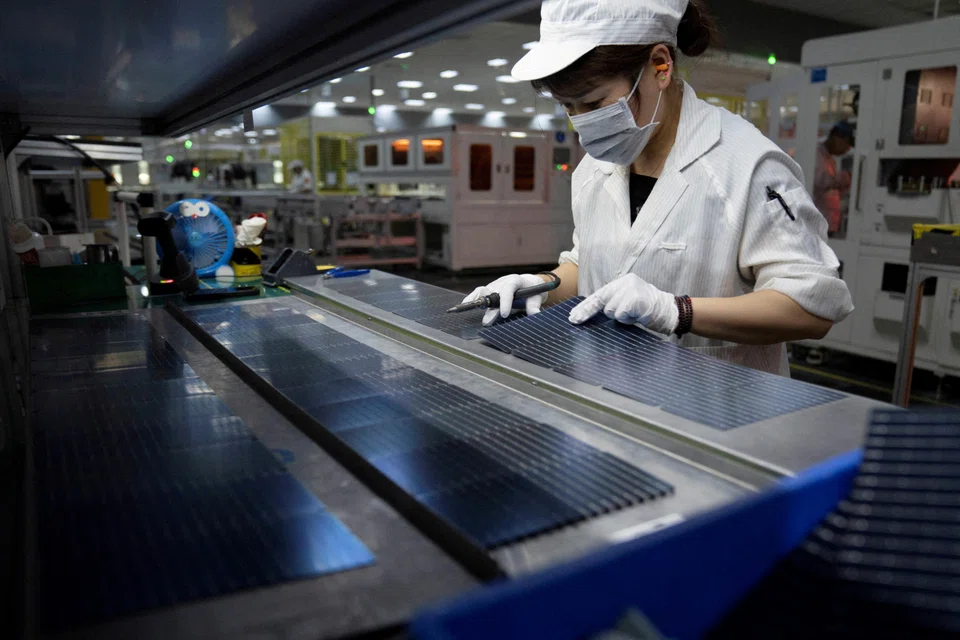
Among the sectors reporting the fastest profit growth were computer, communication and other electronic equipment manufacturing with a 200 per cent rise during the period, while non-ferrous metal smelting and rolling processing industry posted a 150 per cent increase.
“Policy support is feeding through into both production and earnings, rather than producing only a short-lived sentiment bounce,” said Hao Zhou, a Hong Kong-based analyst of Guotai Haitong Securities.
The economy started the year on a firmer footing with a surge in exports driven by AI-related technology demand, quickening industrial output, and a rebound in retail sales and investment, although the US-Israeli strikes on Iran have rattled global trade and energy markets.
Geopolitics risks to growth heighten
The economic fallout from the Middle East crisis is likely to surface in coming months, with markets watching US President Donald Trump’s delayed China trip, his first in eight years, for clues on global growth.
“If energy prices stay elevated, transport-intensive and feedstock-sensitive industries could face renewed cost pressure, especially where downstream pass-through capacity is limited,” Zhao said, adding that “earnings recovery would likely slow in selected sectors.”



While consumer inflation ticked up on China’s longest nine-day Lunar New Year holiday, producer deflation has yet to run its course, pointing to still weak domestic demand that has toughened competition in sectors such as autos and solar panels.
Rising component costs, especially memory chips, could further eat into profitability.
Some companies may “face big losses or even go bust” in such a long cycle of rising costs, Xiaomi president Lu Weibing warned on Tuesday.
Industrial profit figures cover firms with annual revenue of at least 20 million yuan (S$3.7 million) from their main operations. REUTERS
Decoding Asia newsletter: your guide to navigating Asia in a new global order. Sign up here to get Decoding Asia newsletter. Delivered to your inbox. Free.
Share with us your feedback on BT's products and services