

China’s robot makers ready for Chinese New Year entertainment spotlight
This year’s gala will include the participation of four humanoid robot startups – Unitree, Galbot, Noetix and MagicLab
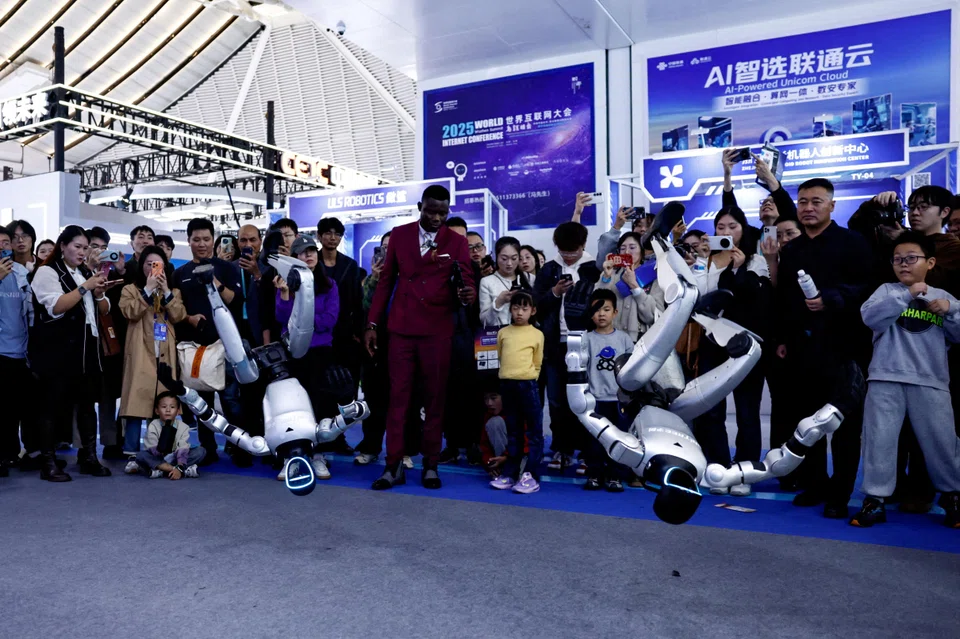
[BEIJING] In China, humanoid robots are serving as Chinese New Year entertainment, with their manufacturers pitching their song-and-dance skills to the general public as well as potential customers, investors and government officials.
On Sunday (Feb 8), Shanghai-based robotics startup Agibot live-streamed an hour-long variety show. It featured its robots dancing, performing acrobatics and magic, lip-syncing ballads and comedy sketches. Its other humanoid robots waved from an audience section.
An estimated 1.4 million people watched the show on the Chinese streaming platform Douyin. Agibot, which called the promotional stunt “the world’s first robot-powered gala”, did not have an immediate estimate for its total viewership.
The show ran a week ahead of China’s annual Spring Festival Gala, which will be aired by state television. The event has become an important – if unlikely – venue for Chinese robot makers to show off their successes.
A squad of 16 full-size humanoids from Unitree joined human dancers in performing at the China Central Television (CCTV) 2025 gala, drawing stunned accolades from millions of viewers.
Less than three weeks later, Unitree’s founder was invited to a high-profile symposium chaired by Chinese President Xi Jinping. The Hangzhou-based robotics firm has since been preparing for a potential initial public offering (IPO).
This year’s CCTV gala will include the participation of four humanoid robot startups, which are Unitree, Galbot, Noetix and MagicLab, the companies and broadcaster have said.
Agibot’s gala had over 200 robots. It was streamed on the social media platforms RedNote, Sina Weibo, TikTok and its Chinese version Douyin. Chinese-language television networks HTTV and iCiTi TV also broadcast the performance.
Ma Hongyun, a photographer and writer with 4.8 million followers on Weibo, said: “When robots begin to understand Chinese New Year and begin to have a sense of humour, the human-computer interaction may come faster than we think.”
Agibot says that its humanoid robots are designed for a range of applications, including in education, entertainment and factories. It plans to launch an IPO in Hong Kong, it was reported.
State-run Securities Times said that Agibot had opted out of the CCTV gala in order to focus its funding on research and development. The company did not respond to a request for comment.
It demonstrated two of its robots to Xi in April 2025.
US billionaire Elon Musk, who has pivoted automaker Tesla towards a focus on artificial intelligence and the Optimus humanoid robot, has said that the only competitive threat he faces in robotics is from Chinese firms.
Like those rivals, he has also used stunts to promote Optimus, such as rolling out human-directed robots as bartenders at an event in 2024. REUTERS
Decoding Asia newsletter: your guide to navigating Asia in a new global order. Sign up here to get Decoding Asia newsletter. Delivered to your inbox. Free.
Share with us your feedback on BT's products and services
TRENDING NOW

The only common thing in S-E Asia is that we all eat rice: Cisco’s Asean president
‘How many will survive?’: Bubble fears arise as China’s humanoid robotics face reality check

Green fuels, autonomous ships: How Singapore is future-proofing its shipping industry

Could stablecoins be the future of money?

