
China's Xi and Russia's Putin dominate the G7
Foreign ministers also discuss situation in Hong Kong, the Xinjiang region and Taiwan Strait
 Add BT as a preferred source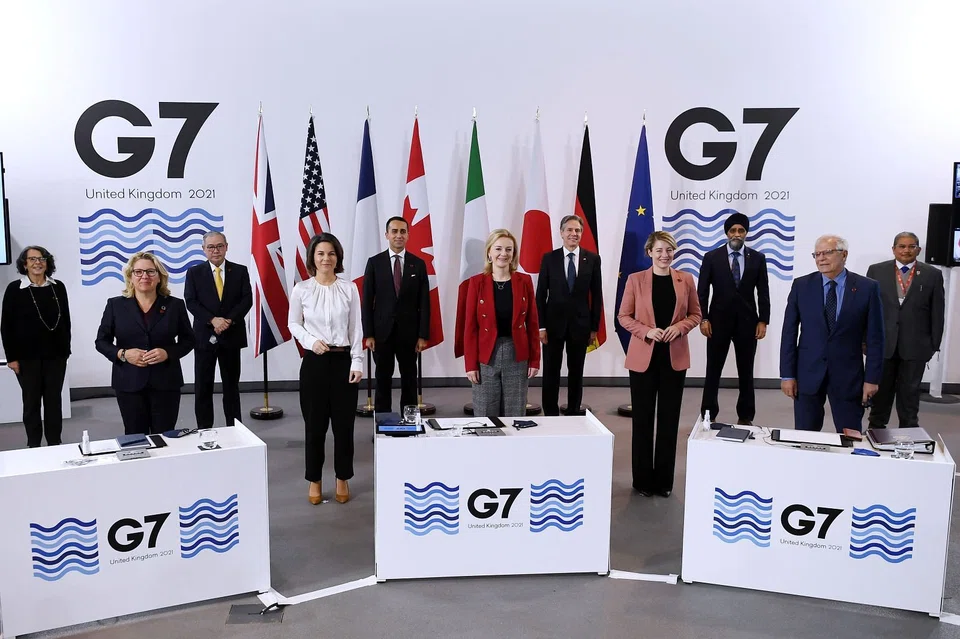
Liverpool
WHILE Russian President Vladimir Putin keeps the West guessing over Ukraine, it was the might of Chinese President Xi Jinping that garnered the long-term strategic focus when the diplomats from the Group of Seven richest democracies met this weekend.
The United States and its other G7 allies are searching for a coherent response to Xi's growing assertiveness after China's spectacular economic and military rise over the past 40 years.
Putin was the immediate tactical focus at talks in the English city of Liverpool between US Secretary of State Antony Blinken and his counterparts. There was support for President Joe Biden's attempt to support Ukraine and deter Putin with a clear warning of severe economic sanctions.
On Sunday, the G7 warned Russia of massive consequences and severe costs if Putin attacks Ukraine, according to a draft statement seen by Reuters.
US intelligence assesses that Russia could be planning a multi-front offensive on Ukraine as early as next year, involving up to 175,000 troops.
Navigate Asia in
a new global order
Get the insights delivered to your inbox.
The Kremlin denies that it plans to invade and says the West is gripped by Russophobia. Moscow says the expansion of Nato threatens Russia and has contravened assurances given to it as the Soviet Union collapsed in 1991.
Concerns were raised about alleged Russian disinformation campaigns but there was no clear agreement on, for example, whether or not to slap penalties on the Nord Stream 2 pipeline, according to sources with knowledge of the discussions.
If Putin, 69, was the short-term concern, Xi's China was the strategic puzzle on everyone's lips.
There were "very, very intense discussions especially on China", said one official who attended the talks.
The re-emergence of China as a leading global power is considered to be one of the most significant geopolitical events of recent times, alongside the 1991 fall of the Soviet Union that ended the Cold War.
China in 1979 had an economy that was smaller than Italy's, but after opening to foreign investment and introducing market reforms, it has become the world's second-largest economy and is a global leader in a range of new technologies.
"It's tremendous that there's such a focus on the Indo-Pacific here," said a State Department official.
Another State Department official said that foreign ministers discussed the situation in Hong Kong, the Xinjiang region and the importance of peace in the Taiwan Strait.
The need to support Lithuania was also discussed. China downgraded its diplomatic ties with the Baltic state and suspended consular services after the Taiwanese Representative Office in Lithuania opened on Nov 18.
"We have been clear at this meeting this weekend that we are concerned about the coercive economic policies of China," British Foreign Secretary Liz Truss told reporters.
The G7 wants to act together over Beijing but without seeming to be an anti-China club.
Western officials point out that the G7 combined still packs a powerful punch: it has about US$40 trillion in economic clout and includes 3 of the world's 5 official nuclear powers.
There was serious discussion about G7 coordinated action to counter China over disinformation and to support countries snared in what critics cast as China's global debt-trap web, officials said. REUTERS
Decoding Asia newsletter: your guide to navigating Asia in a new global order. Sign up here to get Decoding Asia newsletter. Delivered to your inbox. Free.
Share with us your feedback on BT's products and services

