

Chinese factory deflation eases again but consumer prices cool
The country’s economy remains in the grip of deflation that’s eating away at income and profits
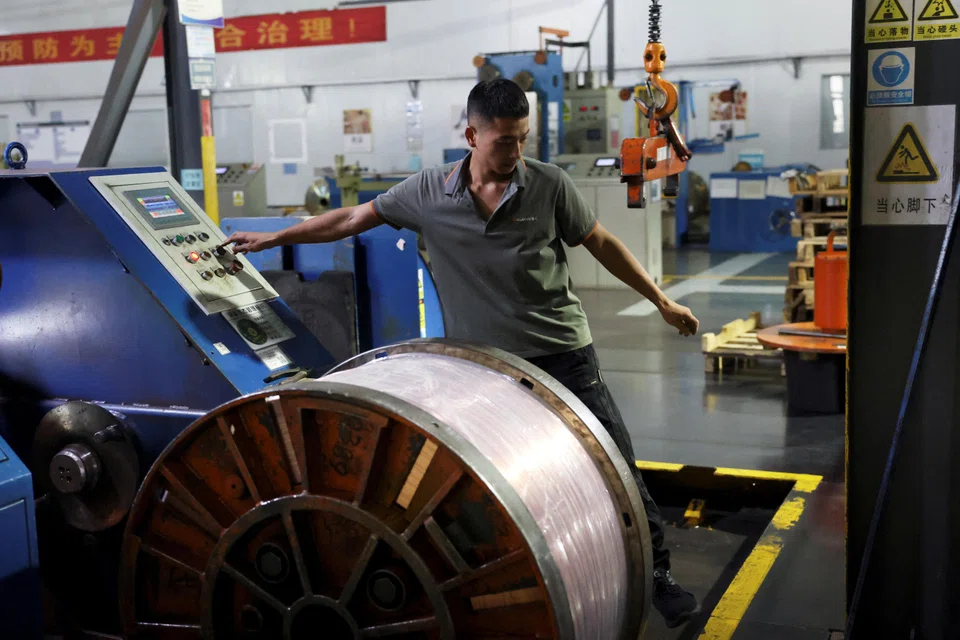
CHINA’S factory deflation eased more than expected in January, as downward pressure on prices moderates thanks to higher commodity costs and a crackdown on excessive competition among companies.
Producer prices fell 1.4 per cent last month from a year earlier, their smallest decline since July 2024, according to data released by the National Bureau of Statistics (NBS) on Wednesday (Feb 11).
The median forecast of economists surveyed by Bloomberg was for a decrease of 1.5 per cent.
After dropping for 40 straight months, the improvement in PPI “could be a positive signal for the market if we suddenly see the light at the end of the tunnel of these deflationary pressures on the production side of the economy”, said Alicia Garcia Herrero, chief economist for Asia-Pacific at Natixis, before the data release.
The consumer-price index (CPI) rose just 0.2 per cent in January from a year earlier, a slowdown caused largely by base effects, after a 0.8 per cent rise in December. Core CPI, which excludes volatile items such as food and energy, climbed 0.8 per cent, its lowest level in six months.
China remains in the grip of deflation that’s eating away at income and profits. The country’s gross domestic product deflator declined for the third straight year in 2025, the longest streak since China transitioned towards a market economy in the late 1970s.
NBS statistician Dong Lijuan attributed the slower increase in CPI partly to the effect of a high base last year and said fluctuations in global oil prices contributed to a drop in domestic energy costs.
The Chinese New Year, which tends to drive up spending by households, is a moving holiday that ran from Jan 28 to Feb 4 in 2025 but will fall entirely in February of this year.
Deflationary pressures have been present since the end of the pandemic, in large part as a consequence of a prolonged slump in housing and weak consumer demand.



A glut of production capacity in some industries has also led to oversupply, pushing firms to cut prices to survive.
In response, the government has moved to curb cut-throat competition among companies – a campaign dubbed “anti-involution”, to stamp out the price wars that have been eroding corporate earnings in industries from electric vehicles to food delivery.
Authorities are making some headway in containing deflationary pressure. Major restaurant and beverage chains in China, including KFC and Cotti Coffee, are raising prices on food delivery platforms, retreating from years of discounting after regulators launched a probe into subsidies in the sector.
In monthly terms, producer prices have been rising since October, their longest streak since early 2022. That reflects a combination of factors, including the global rally in metals prices, government efforts to curb competition, as well as increased demand in electronics related to artificial intelligence, NBS’ Dong said.
Prices of non-ferrous metal materials surged 16.1 per cent in January from a year ago, and the output price of non-ferrous metals mining and processing industry soared 22.7 per cent.
Bloomberg Economics expects China’s economy to start to reflate as soon as in mid-2026, thanks to subsidies to spur consumption and policies to curb involution-style competition.
Chinese officials have signalled that maintaining a “reasonable recovery in prices” has become a key consideration for monetary policy in 2026, with the central bank suggesting it has room to further reduce interest rates and reserve requirements for lenders.
The inflation reading for the full calendar year of 2025 was zero, the lowest since 2009 and far below the official aim of around 2 per cent.
The January figures are based on updated baskets of goods and services for CPI and PPI. The NBS refreshes the composition of those indexes every five years.
The latest revision for the CPI basket increased the weighting of dining out, transportation and communication, education and entertainment, health services as well as other goods and services. The share of clothing, housing and household services dropped, according to the NBS.
Decoding Asia newsletter: your guide to navigating Asia in a new global order. Sign up here to get Decoding Asia newsletter. Delivered to your inbox. Free.
Share with us your feedback on BT's products and services
TRENDING NOW

Britain’s mansion tax shows the difficulty of targeting wealth

Once staunchly pro-China, Malaysian Chinese businesses are now distancing themselves from Beijing

The only common thing in S-E Asia is that we all eat rice: Cisco’s Asean president

Singapore data centre operator DayOne opts for US IPO at likely US$20 billion valuation

