

Christmas comes early for Tories in historic win
Johnson now under pressure to deliver on his election promises, including withdrawal from the EU.
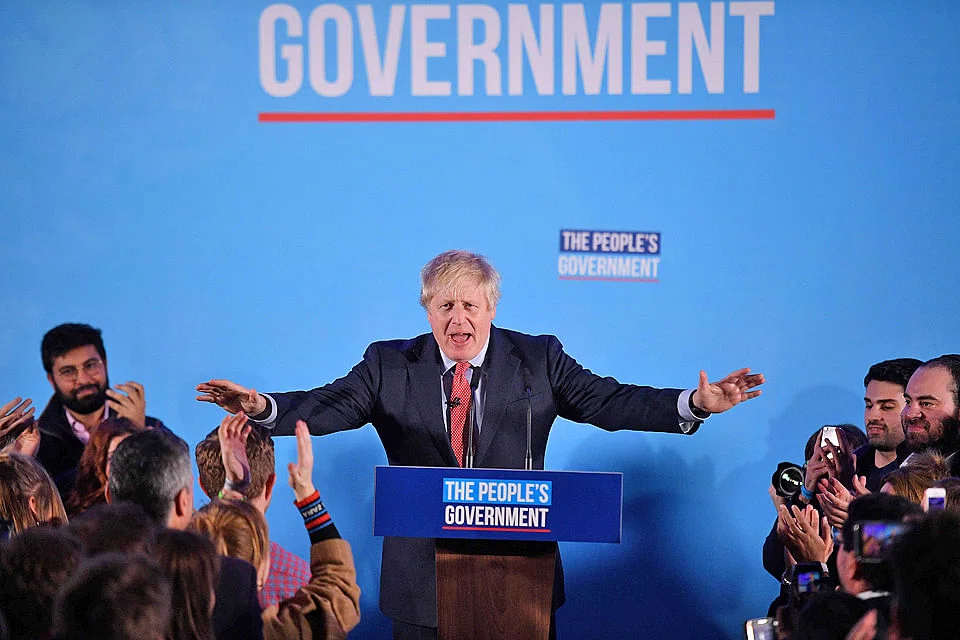
THE Conservatives became on Friday the first party to win an increased number of seats in a fourth straight term of office since the 19th century, buoying financial markets. Yet, while the result is a personal triumph for Boris Johnson, he is now under intense pressure to deliver on his election promises, including withdrawal from the European Union (EU) - which is now likely in early 2020.
The election result is not a monumental surprise inasmuch as the Conservatives were long forecast to emerge as the largest single group in the House of Commons. Yet, in an era of high political volatility and tactical voting, the result was never certain. This was especially so with polls tightening since the campaign began when some forecasters had predicted an even larger majority than what materialised on Friday.
As the British Election Survey (BES) - which is perhaps the most authoritative survey of UK voting behaviour - highlighted in October, traditional partisan voting patterns are eroding faster with the UK's 2015 and 2017 General Elections seeing more people change their voting intentions than ever before in the post-war era. Remarkably, nearly half the country (49 per cent) voted for different parties across the three elections from 2010-17 according to BES.
Dynamic context
Thursday's Tories electoral victory comes in this dynamic context and stems from multiple factors, including the decision of Nigel Farage's Brexit Party not to stand candidates in seats won by Conservatives at the 2017 election. This factor consolidated the Leave vote from 2016's referendum.
A second reason for Mr Johnson's apparent success is that he ran a comparatively "safety-first" campaign seeking to avoid as many big mistakes as Theresa May committed in 2017 when she lost a double-digit lead in the second half of that election. While the prime minister's caution caused some controversy, including skipping TV debates and interviews, it nevertheless appears to have paid off overall.
While Mr Johnson's personal popularity has fallen during the campaign, with voter concerns about his trustworthiness growing, he will nonetheless take personal pride in the Conservative victory. His elevation to prime minister last summer was a clear turning point in the polls with the Tories holding a lead since Labour held the Tories to more-or-less level-pegging from summer 2017 to summer 2019.
Another key element in this safety-first approach was the Tory manifesto offer designed to try to maintain a polling lead. This includes proposals for an increase in day-to-day public spending of around £3 billion (S$5.4 billion) which, while dwarfed by Labour's fiscal proposals, represents the largest proposed increase in relative terms of any Tory prime minister since Harold MacMillan in the late 1950s and early 1960s.
Moreover, the Conservatives had very strong message discipline around their core campaign slogan of "getting Brexit done". In this sense, Mr Johnson was successful in framing the election around the UK's departure of the EU.
This is ironic given that this core message is, in fact, extremely misleading. If Mr Johnson succeeds in enabling the UK to leave the EU in early 2020 - as is now very likely - potentially years of further negotiations will ensue with Brussels over the terms of any final, comprehensive trade deal.
The Tory success in superceding this fundamental reality underlines the political salience and emotional appeal of Europe/EU as an election issue in recent UK elections, fuelling the erosion of the classical left-right dichotomy in distinguishing Conservative from Labour voters. Indeed, October's BES study asserts that, for the first time in modern UK history, the 2017 election saw issues including Europe/EU at least equally as important in determining overall voting behaviour as traditional right-left party allegiances with the highest levels of switching between the Conservatives and Labour since the BES started its research in 1964.
While Mr Johnson will celebrate his success, his honeymoon may yet be brief given the immediate pressure to deliver, especially on EU withdrawal. To this end, his government is planning to try to push through his Brexit deal at a fast pace.
In the likely event that this now gets through Parliament in early 2020, the UK will enter a transition period from then till at least Dec 31, 2020. And negotiations will move away from the three core Article 50 issues - the UK's financial settlement for departure from the EU; citizen rights; and the Irish border - to a full spectrum of topics from transport and fisheries to financial services and data transfer which will collectively represent a new order of complexity.
The current transition phase proposed of less than a year is not likely to be nearly long enough to get more than what chief EU negotiator Michel Barnier has called a "bare bones" agreement. The reasons why timeframes could be so tight is that Brussels is not allowed by law to conduct formal negotiations on a new trade deal until after the UK has ratified a withdrawal deal, and the EU-27 then has to approve a joint negotiating mandate. That latter process could take weeks - meaning that formal EU-UK discussions may not begin till March at the earliest and, because a deal would need to be ratified, negotiations realistically need to be completed by autumn, if not late summer.
Threat of no-deal Brexit
Yet few in London nor Brussels are prepared (for now) to talk openly about the need for a transition extension, threatening what Mr Farage called on Wednesday the likelihood of a new Brexit "crisis" next year. For his part, Mr Johnson has made it a central election pledge not to extend the end-2020 deadline given that many of his Brexiteer allies are opposed to making significant continuing payments to the EU regardless of the benefits.
This threatens a new cliff edge in negotiations and what would, in effect, be the threat of a no-deal Brexit raising its head again in the second half of 2020. Thus, rather than the Tories bringing their promised stability to the nation, post-election, 2020 could yet see a resurgence of some of the political and economic uncertainties of this year.






