

CJ Menon unveils plans to strengthen Singapore judiciary
They include setting up of network connecting courts of key global commercial centres
Singapore
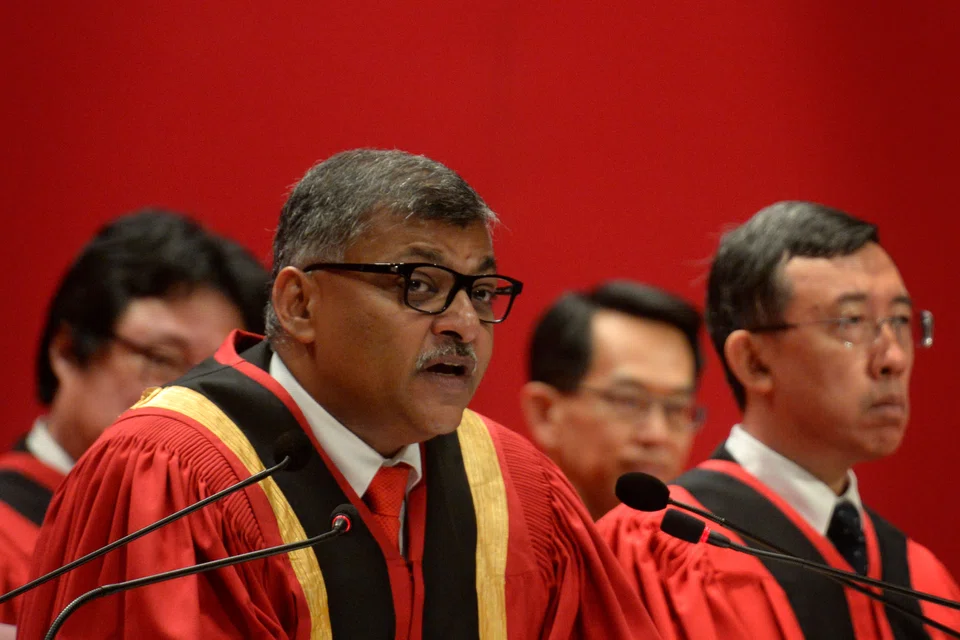
SINGAPORE'S judiciary has moved to lay the foundation for a legal system of the future through various proposals announced at the opening of the legal year.
Among the plans shared by Chief Justice Sundaresh Menon on Monday is the setting up of a network that connects courts of key commercial centres on a multilateral and bilateral basis, particularly relating to cross-border insolvency.
With globalisation, firms now operate in multiple countries and CJ Menon pointed to the need for courts of the various jurisdictions to develop guidelines on "the nature and extent" of collaboration and communication.
To provide greater clarity in practical aspects of criminal proceedings, the establishment of a new body - the Criminal Procedures Rules Committee - that could make rules governing matters such as bail procedures, subpoena of witnesses or the discovery of documents was raised in a discussion between the Law Minister, the Attorney-General (AG) and CJ Menon.
"We will continue to study the experiences of other jurisdictions, such as England, Hong Kong and New South Wales, which have similar arrangements in place, before reaching a final decision on the remaining details. The minister has informed me that he hopes to introduce the required legislation in due course," the CJ said.
And there are plans to raise the District Court's civil monetary jurisdictional limit, which now stands at S$250,000. The last revision for this was in 1997. The judiciary is also exploring the feasibility of increasing the existing threshold of S$10,000 of the Small Claims Tribunal.
One other key development in civil justice is in the area of medical litigation.
The judiciary is now evaluating adoption of three overlapping measures: using mediation as a primary step for cases relating to medical malpractice; a move towards a judge-led process that is less adversarial; and allowing medical assessors to assist judges.
"A standing panel of medical assessors comprising senior doctors nominated by the Singapore Medical Council (SMC) will be established. On our part, a medical litigation list of judges will be set up in the High Court and the State Courts to handle these cases. The Singapore Judicial College will work with the SMC to provide training for the judges as well as for the medical assessors and we'll also examine areas for procedural refinements," the CJ said.
With technology playing a greater role in society, the judiciary also started working with the Infocomm Development Authority last year to explore tech-driven initiatives.
A "Courts of the Future Taskforce" led by Justice Lee Seiu Kin to anticipate future needs of court users has gathered many suggestions, including the possible use of artificial intelligence and natural language technology to make information more accessible, and automation of certain applications that would remove the need for physical attendance in court. The taskforce hopes to complete its final report and recommendations this year.
In wrapping up his speech, CJ Menon also announced the appointment of professor Ng-Loy Wee Loon as Senior Counsel.
Separately, AG VK Rajah said in his speech that Parliament has led the way in creating a framework for community sentences under the Criminal Procedure Code so that an offender can make amends for his crime as an alternative to punishment, but he noted that this option has been "under-utilised".
"As we gain more experience with such sentences, perhaps Parliament can consider extending this option to other less serious crimes. It is also worthwhile to consider introducing the concept of suspended sentences, which will incentivise offenders to turn over a new leaf," said Mr Rajah, who added that the prosecution would continue to "come down hard" on offenders of serious crimes.
Lawyer Edmund Kronenburg of Braddell Brothers welcomed the suggestions on medical litigation, but he stressed that medical assessors who are part of a close-knit community must not only be independent but also seen to be so.
Sunil Sudheesan, acting president of the Association of Criminal Lawyers, noted that the suggestions on medical litigation would carry the legal system towards a specialised area that he finds necessary, as evidence in medical cases is highly specific.
He also welcomed the proposal to set up a Criminal Procedures Rules Committee, adding that this would help lawyers entering criminal law. But he said the rules drawn up by the body should continue to provide the same kind of flexibility that exists currently within the courts.






