

Closed-door trial of Aung San Suu Kyi and Win Myint begins
 Add BT as a preferred source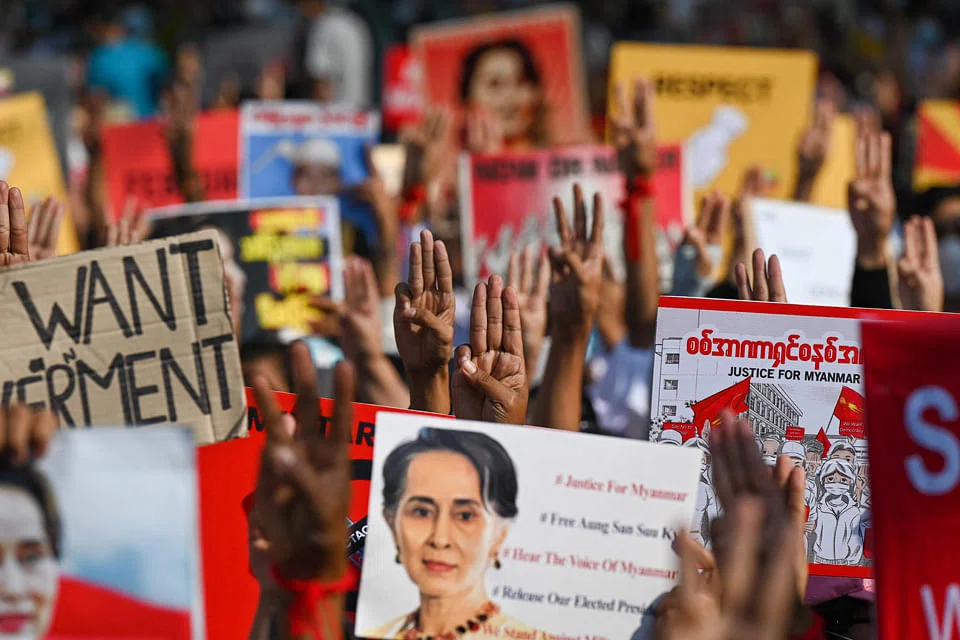
Yangon
THE trial of Aung San Suu Kyi, Myanmar's civilian leader who was ousted in a military coup two weeks ago, and Win Myint, the deposed president, began on Tuesday.
The closed-door trial began in secret, with the two defendants appearing by video. The defence attorney was not even aware what was happening. By the time he rushed to the court on Tuesday afternoon, it was all over, in less than an hour.
Khin Maung Zaw, Ms Suu Kyi's lawyer, was originally told that the court proceedings would begin on Monday. Then he was led to believe it would be Wednesday. At 11am on Tuesday, he was suddenly notified that his client was appearing via video conference in a court in Naypyitaw, the capital. "The timing seems like they don't want public attention in this case," said Mr Khin Maung Zaw, a veteran human rights lawyer.
He has been told that the next trial session will be on March 1, and that the trial could last for six months to a year.
Ms Suu Kyi is accused of violating import restrictions after walkie-talkies and other foreign equipment were found in her villa compound. She was also charged with contravening a natural disaster management law by interacting with a crowd during the coronavirus pandemic, a charge that had not been disclosed publicly before. Mr Win Myint has been charged with breaching the natural disaster restrictions.
The first day of the trial of Myanmar's elected leaders capped a dizzying two weeks in which the military, which ruled the country for nearly half a century before sharing some power with a civilian government, locked up hundreds of people, stripped away civil liberties for the entire population and steadfastly ignored the millions of protesters who have risen up against their seizure of power.
The military junta guaranteed on Tuesday that it would hold an election and hand over power, denied its ouster of an elected government was a coup or that its leaders were detained, and accused protesters of violence and intimidation.
"Our objective is to hold an election and hand power to the winning party," Zaw Min Tun, spokesman for the ruling council, told the junta's first news conference since overthrowing Ms Suu Kyi's government.
The military has not given a date for a new election but has imposed a state of emergency for one year.
Brigadier General Zaw Min Tun said the military would not hold power for long. "We guarantee . . . that the election will be held," he told the nearly two-hour news conference, which the military broadcast from the capital, Naypyitaw, live over Facebook, a platform it has banned.
When asked about the detention of Nobel prize winner Ms Suu Kyi and the president, he dismissed the suggestion they were in detention, saying they were in their homes for their security while the law took its course.
He also said Myanmar's foreign policy would not change, it remained open for business and deals would be upheld.
China's ambassador to Myanmar said on Tuesday that the current political situation was "absolutely not what China wants to see", and dismissed social media rumours of Chinese involvement in the Feb 1 military coup as "completely nonsense".
In an interview with local media posted on the Chinese embassy Facebook page, ambassador Chen Hai said China maintained "friendly relations" with both the army and the former ruling civilian government. He said China was "not informed in advance of the political change in Myanmar".
These developments came as the country's generals imposed a second straight overnight Internet shutdown into Tuesday, ignoring international condemnation as they worked to grind down a popular uprising against their coup.
In the two weeks since troops ousted Ms Suu Kyi and took the civilian leader into custody, big urban centres and isolated village communities alike have been in open revolt.
Security forces have used increasing force to quell huge nationwide street protests and a disobedience campaign encouraging civil servants to strike.
Troops have fanned out around the country in recent days and fired rubber bullets to disperse one rally in Mandalay, hours before authorities again cut Internet gateways.
"They shut down the Internet because they want to do bad things," said 44-year-old Win Tun, a resident of commercial capital Yangon. "We didn't sleep the whole night so we could see what would happen."
The shutdown came after another day of protests in Yangon, in defiance of armoured vehicles and troop convoys stationed around key sections of the city - although turnout was smaller than in recent days.
Mandalay, the country's second largest city, saw a clash that left at least six injured after police used slingshots against protesters and fired rubber bullets into the crowd.
Demonstrators retaliated by throwing bricks, according to a medic at the scene, while journalists said police had beaten them in the melee.
Crowds returned to the streets of Yangon and other locations around the country on Tuesday morning.
"I want more people to join the protests, we don't want to be seen as weak," said Thwe Ei Sann, a university student in the city.
A large crowd blocked railway tracks outside the port city of Mawlamyine to prevent a Yangon-bound train from leaving the port city.
Many of the country's locomotive drivers have joined the anti-coup work boycotts and have frustrated junta efforts to restart the national railway network after a Covid-19 shutdown.
Yangon residents had on the weekend used tree trunks to block police vehicles sent to bring striking rail workers back to their stations. NYTIMES, REUTERS, AFP
Decoding Asia newsletter: your guide to navigating Asia in a new global order. Sign up here to get Decoding Asia newsletter. Delivered to your inbox. Free.
Share with us your feedback on BT's products and services
TRENDING NOW

Singapore Kitchen CEO, senior manager charged with alleged fraud, falsifying accounts; both to stay in jobs for now

Profit with purpose: Kim Choo Kueh Chang’s pivot from public listing to protecting heritage
Who would buy Vietnam’s state-owned stakes – when Hanoi is ready to sell?
HSBC, AIA, Prudential shares slide after report of Hong Kong bank account curbs

