

Construction, facilities management sectors expected to collaborate to optimise resources: BCA
 Add BT as a preferred source
Yong Jun Yuan
THE construction and facilities management sectors will be expected to collaborate more effectively to optimise resources throughout a building’s life cycle, the Building and Construction Authority (BCA) said on Tuesday (Sep 6).
In its media release marking the start of the International Built Environment Week (IBEW) 2022, the authority said that it would focus on helping project stakeholders work better together, and on increasing the use of automation in the built environment industry.
This will happen through a refreshed Built Environment Industry Transformation Map (ITM), which will cover the planning and design, construction as well as operations and maintenance stages of a building’s life cycle.
The refreshed transformation map amalgamates the construction and real estate (facilities management) ITMs which were previously launched in 2017 and 2018 respectively.
A key transformation area will be in Integrated Planning and Design (IPD). BCA will encourage the industry to move towards collaborative contracting, where builders, facilities management firms and other contracting parties work together towards shared project goals at the start of a project.
This sort of contracting will take some key principles into account, such as having structured dispute avoidance and resolution mechanisms in place, as well as ensuring fair and sustainable allocation of risk and alignment of project participants’ interests based on project needs.
These principles are intended to help reduce the costs associated with disputes, prevent disputes from escalating and preserve the relationship between parties and allow for the sharing of risk among different parties, among other benefits.
The authority said that 9 upcoming projects have been identified by 7 government procuring agencies to pilot collaborative contracting.
“Contract Management consultants such as Turner & Townsend, WT Partnership, AECOM and Threesixty are also supporting this effort by providing advisory services to private sector clients,” BCA said.

In addition, BCA will also work to strengthen collaboration between project stakeholders to ensure that design considerations for the building’s entire life cycle, including facilities management, are factored in at the design stage.
This will be done through BCA’s existing efforts for integrated digital delivery (IDD), where stakeholders collaborate with one another through digital platforms.
BCA said it expects IDD adoption rate by gross floor area (GFA) for new developments to rise to 70 per cent by 2025, from 34 per cent today.
Another key transformation area will be in advanced manufacturing and assembly (AMA) to help firms reduce their reliance on foreign manpower and raise productivity.
The authority has set a target to increase design for manufacturing and assembly (DfMA) adoption rate by GFA to 70 per cent by 2025, from 44 per cent today.
“By improving the quality of work and working environments, including at the construction site, the industry hopes to attract and retain talent in the sector.
“The shift from a project-based building approach to a modular, product-based one also enables industry firms to reap greater economies of scale,” BCA said.
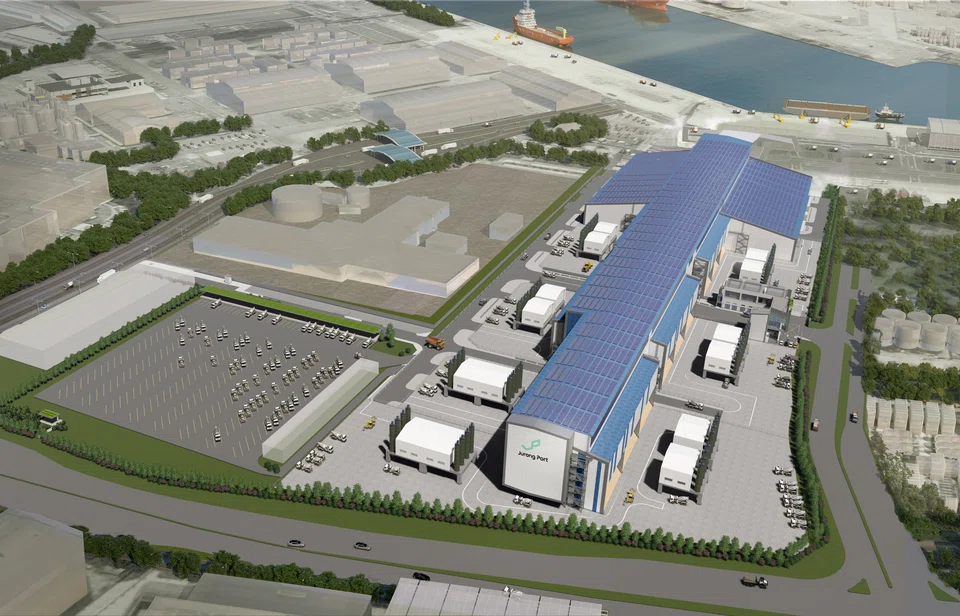
As part of its push towards further collaboration, BCA will also work with stakeholders to establish new Integrated Construction Parks (ICPs), the first of which will be located at Jurong Port and progressively begin its operations later this year.
The site will host facilities such as aggregate terminals, aggregate storage yards, ready-mix concrete batching plants and precast plants in one location for greater synergy across the construction supply chain.
A third area of transformation in Sustainable Urban Systems (SUS) will look to ramp up decarbonisation efforts of the built environment industry.
BCA said that it will aim for an ambitious target of 80 per cent of public buildings adopting smart facilities management by 2030 and set a new target for 40 per cent of private buildings by gross floor area to adopt smart facilities management by 2030.
Smart facilities management leverages technology to enhance the productivity of such services.
Companies will also be able to apply for a S$30 million integrated facilities management and aggregated facilities management grant to adopt such solutions.
In recognition of projects that embody the transformation goals of the refreshed built environment ITM, the newly-launched Built Environment Transformation Award will also be awarded to firms and industry practitioners who have honed their capabilities in areas like productivity, digitalisation and sustainability.
Winners include Eunoia Junior College, JTC’s 1 and 7 North Coast developments located in Woodlands North Coast, PSA Livable City and The Tapestry, a condominium in Tampines.
Liam Wee Sin, Future Economy Council (FEC) Urban Systems (US) cluster co-chair, said that the ITM refresh is a timely one as it recognises the need for different stakeholders in the industry to collaborate more.
The ITM also recognises the shifts that have been made in different technological advancements, sustainability efforts and longer-term structural trends, he said.
Decoding Asia newsletter: your guide to navigating Asia in a new global order. Sign up here to get Decoding Asia newsletter. Delivered to your inbox. Free.
Copyright SPH Media. All rights reserved.
TRENDING NOW
Think twice about rebuilding that old landed property into a super-big house to max out GFA
More retrenched white-collar workers in Singapore seeking unions’ help

SpaceX’s US$1.75 trillion IPO: How retail investors, including those in Singapore, can buy shares

DBS Research and UOBKH eye Singtel, Venture as top picks for June

