Cutting emissions isn't enough; the world needs to move to a circular economy

Singapore
THIS year's United Nations climate summit, COP26 - held over for a year due to the Covid-19 pandemic - has seen parties make up for lost time; governments, corporations and community groups alike have made bold pledges to cut their greenhouse gas (GHG) emissions, in a bid to reduce global warming and avert a deepening of the climate crisis.
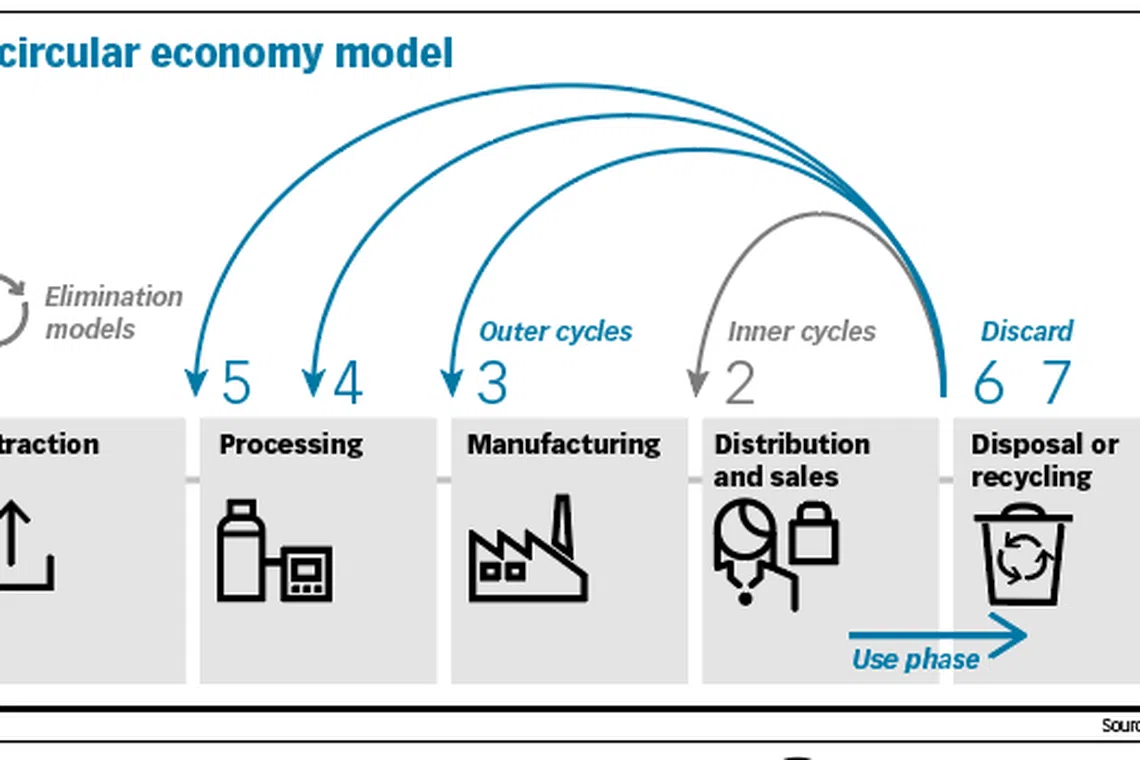
But, while laudable, emissions cuts will only bring about part of the change that's needed: a more complete transformation of the economy will have to come about - from the traditional take-make-waste model, to a circular one in which waste is reduced and resources are re-used.
Why a circular model?
The current response to the global climate crisis, mainly in the form of cutting carbon emissions, "represents an incomplete picture", according to the Ellen MacArthur Foundation, a charity committed to creating a circular economy.
Its research, published in a much-cited paper, showed that the world's transition to renewable energy can address only 55 per cent of emissions. The remaining 45 per cent comes from producing cars, clothes, food and everyday products.
Applying circular economy strategies in just 5 key areas - cement, aluminium, steel, plastics and food - it demonstrated that this can eliminate almost half of the remaining emissions from the production of goods, or the same as cutting emissions from all transport to zero.
A circular economy also has the potential to increase resilience to the physical effects of climate change - in keeping materials in use, for example, businesses can decouple economic activity from the consumption of raw materials vulnerable to climate risks, and therefore build greater flexibility, it said.
Why now?
Chua Soon Ghee, senior partner at global management consulting firm Kearney, told The Business Times that such a transformation is critical.
"The world is currently staring down the twin barrels of a resource scarcity crisis and waste management problem, with over 100 billion tonnes of material processed globally every year and 91 billion tonnes of this being newly extracted from the ground. We simply cannot keep this pace up.
"At the same time, humanity produces 50 million tonnes of waste every year just from our discarded electric devices, and total global solid waste is predicted to balloon to 3.4 billion tonnes by 2050.
"A circular economy closes the loop on these linear material cycles, using end-of-life materials as raw input for new product cycles," Chua noted.
Expressing the sentiment in similar terms was Jessica Long, managing director and chief strategy officer of Closed Loop Partners, a US-based investment firm on building the circular economy.
"Today, we are using about 1.6 earths; meaning we're using about 60 per cent more of the earth's resources than it can regenerate every year. By 2050, with an increased global population and a resulting rise in consumption, that 'overshoot' could get to 3-4 earths, which is clearly unsustainable.
"The circular economy tackles some of our greatest social and environmental challenges while unlocking US$4.5 trillion in economic value by 2030," she said in a recent World Economic Forum piece.
Singapore's plan
Economies and businesses around the world are coming round to embracing this systemic change.
Singapore recently launched its Zero Waste Masterplan, which maps out its key strategies "to build a sustainable, resource-efficient and climate-resilient nation, (which) includes adopting a circular economy approach to waste and resource management practices, and shifting towards more sustainable production and consumption".
It pointed to the fact that the amount of waste disposed of in Singapore has increased 7-fold over the last 40 years - and that, at this rate, Semakau Landfill, the country's only landfill, will run out of space by 2035.
Its masterplan will focus on closing the resource loops of 3 priority waste streams: food, electrical and electronic equipment, and packaging, including plastics.
Key targets have been set: to reduce the amount of waste per capita that is sent to landfill by 30 per cent by 2030, which is on top of its existing target to achieve a 70 per cent overall recycling rate by 2030.
The government also introduced the landmark Resource Sustainability Act to impose regulatory measures upstream.
Regulatory change to promote the transition to a circular economy has been happening elsewhere, as well. For example, the European Commission in 2015 introduced the Circular Economy Package, "with measures covering the whole cycle: from production and consumption to waste management and the market for secondary raw materials".
But not all governments have supported such efforts through regulatory change. Jurisdictions have also yet to come together to coordinate their policy shifts, while criticisms have emerged of inconsistencies between rules and legislation drawn up within jurisdictions themselves.
"So far, there has been a lack of regulatory governance globally incentivising businesses to collaborate," Chua said, "and we urgently need governments to formulate and formalise a global regulatory framework for companies to innovate and raise investment."
Investment opportunities
French asset management company Amundi Asset Management says that harmonised regulations can also scale up investments in this area, and that "investors need standardised definitions and metrics for circular economy investments".
Circular economy investment opportunities can be diverse and offer attractive returns, and there are several ways for investors to get involved, it added.
"First, investors can turn to private markets to finance circular economy companies. They can also choose to actively invest in public markets by favouring corporates that have good circular economy performances. Some investors have also turned to passive investing, reproducing the performance of indices focused on circular economy leaders."
Kearney's Chua believes "the entire sector around recycling will be of interest to investors".
"This is the value chain from collection of waste to sortation and then treatment and recovery of end-products. In many countries, the waste companies that engage in such activities can be of investor interest if the local economics of waste recovery improve as a result of stricter government regulations on waste disposal and recovery, as well as supportive consumer sentiment towards recycling.
"The technologies that support the circular economy will also be interesting - these can include companies that make the process of recycling easier or more lucrative. Examples include companies that make microbes that break down food waste into compost, or that converts waste into usable energy."
The mobilisation of capital will play an important part in the world's efforts to transition to a circular economy, and complement the efforts made by governments and businesses. As more come to understand the necessity of the changes needed to build a more sustainable economy and planet, the greater and more concerted the efforts can be.
READ MORE:
- Chasm opens between COP26 words and climate action
- Success of global fight against climate change rests on developing nations: EIU
- Climate on track to devastate world's poorest economies: study