Defending and developing Singapore's coasts

Janice Heng
Singapore
SINGAPORE is studying various options for defending its coast against rising sea levels, from polders to a reclaimed chain of islands, said Prime Minister Lee Hsien Loong in his National Day Rally speech.
Though it may seem "abstract and distant", climate change is one of the gravest challenges facing the world, he pointed out. Its risks include new diseases, more frequent pandemics, and food shortages. As a low-lying island, Singapore is especially vulnerable to rising sea levels.
Singapore must understand, mitigate, and adapt to climate change, he said. The Centre for Climate Research Singapore has been set up, and Singapore has joined global efforts to reduce carbon dioxide emissions.
As for adapting, new developments are now required to be built at least four metres above mean sea level, up from three metres before.
Critical infrastructure such as Changi Airport Terminal Five and the Tuas port will be built at least five metres above mean sea level.
But such local measures will not suffice, said Mr Lee. Singapore's low-lying areas must be protected as a whole via coastal defences. In the city area, this has been done with the Marina Reservoir and Marina Barrage.
For the eastern coastline, Singapore has studied the Netherlands, where a quarter of the land is under sea level. Known as polders, these areas are reclaimed by building a seawall and pumping out the water behind it. Singapore is building a small polder at Pulau Tekong to gain experience operating one, added Mr Lee.
Another alternative is to reclaim a series of islands offshore from Marina East to Changi, connect them with barrages, and create a reservoir, similar to Marina Reservoir.
"We will examine all the options carefully, and when the time comes, we will decide what is the best way to do it," said Mr Lee.
It may cost S$100 billion or even more, over a hundred years, for Singapore to protect itself against rising sea levels, he noted.
If Singapore only had 10 years, it would not have the time or resources to tackle the problem. "But because this is a 50- to 100-year problem, we can implement a 50- to 100-year solution to this problem."
Treating climate change defences like military defence, Singapore must maintain a stable budget, and work on them over generations, he said.
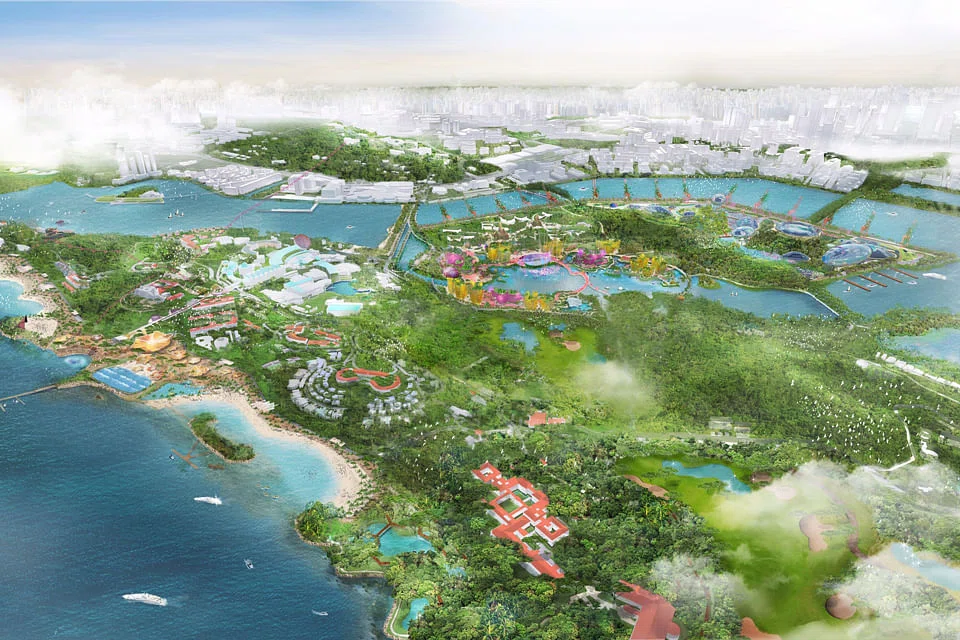
On the topic of renewing Singapore for the next century, Mr Lee turned from coastal defences to coastal developments, sharing plans for the Greater Southern Waterfront which comprises 30 km of the southern coast and 2,000 hectares of land.
With its lease expiring in two years, Keppel Club will be one of the first developments there, he said, noting that it has enough land for 9,000 public and private housing units.
More office space will be developed. As for recreation, the two old power stations in Pasir Panjang will be redeveloped, followed by Pulau Brani - after Brani Terminal moves out - together with Sentosa.
Land will be set aside for the labour movement to build a resort, probably on Pulau Brani. The Greater Southern Waterfront will be linked up with surrounding green areas from West Coast Park to East Coast Park, as well as the Rail Corridor and Sentosa.
"Our city today comprises multiple layers and the imprints of different eras," said Mr Lee. "The Greater Southern Waterfront will add yet more layers to the city."
READ MORE: