

Defiant yet jubilant rallies flood US cities after Trump inauguration
Washington
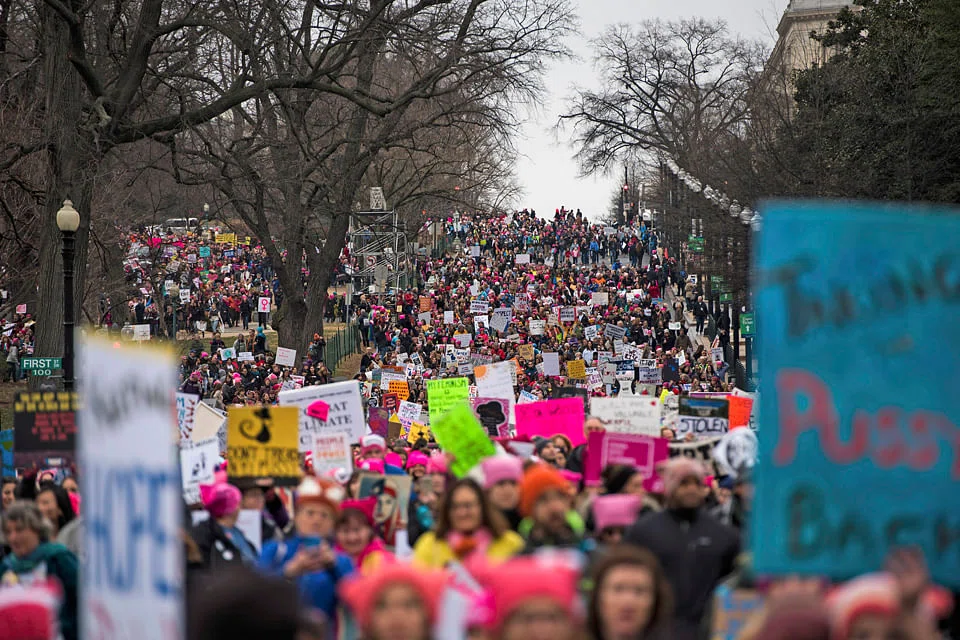
THE day after what many had assumed would be the inauguration of the first female president, hundreds of thousands of women flooded the streets of Washington, and many more marched in cities across the country, in defiant, jubilant rallies against the man who defeated her.
Protesters jammed the streets near the Capitol for the main demonstration, packed so tightly at times that they could barely move. In Chicago, the size of a rally so quickly outgrew early estimates that the march that was scheduled to follow was cancelled for safety, although many paraded through downtown anyway.
In Manhattan, Fifth Avenue became a tide of signs and symbolic pink hats, while in downtown Los Angeles, shouts of "love trumps hate" echoed along a one-mile route leading to City Hall, with many demonstrators spilling over into adjacent streets in a huge, festival-like atmosphere.
The marches were the kickoff for what their leaders hope will be a sustained campaign of protest in a polarised nation, riven by an election that raised unsettling questions about US values, out-of-touch elites and barriers to women's ambitions.
On successive days, two parallel and separate Americas were on display in virtually the same location. First there was President Donald Trump's inauguration, his message of an ailing society he would restore to greatness aimed at the triumphant supporters who thronged Washington on Friday.
Then on Saturday, in what amounted to a counter-inauguration, the speakers, performers and marchers proclaimed allegiance to a profoundly different vision of the nation. They voiced determination to protect a wide array of rights that they believe Mr Trump threatens and that they thought only recently were secure.
"Thank you for understanding that sometimes we must put our bodies where our beliefs are," Gloria Steinem, the feminist icon and an honorary chairwoman of the march, told the throngs gathered in Washington. "Pressing 'send' is not enough."
To mobilise a progressive movement reeling from Hillary Clinton's defeat, organisers broadened the platform beyond long-standing women's issues such as abortion, equal pay and sexual assault to include immigrant rights, police brutality, mass incarceration, voter suppression and environmental protection.
But the march's origins were in the outrage and despair of many women after an election that placed gender in the spotlight as never before.
Mrs Clinton assertively claimed the mantle of history, offering herself as the champion of women and families, and calling out her opponent for boasting of forcing himself on women in a recording that prompted a national conversation about sexual assault. In a sly allusion to the crude remarks Mr Trump made on the tape, many marchers, women and men alike, wore pink "pussy hats" sporting cat ears.
In Washington, demonstrators old and young pushed strollers and hoisted children onto their shoulders or guided elderly parents through the milling crowds. They waved handmade signs: "Hate Does Not Make America Great", "I Will Not Go Back Quietly to the 1950s", and "I'm 17 - Fear Me!" They chanted, "This is what democracy looks like."
Emma Wendt, 13, came with a large group of family and schoolmates from Kensington, Maryland, for a simple reason: "being part of history".
The marchers were confronting a president who has appointed just a handful of women to his Cabinet and inner circle, and who has pledged to nominate a Supreme Court justice who opposes abortion rights and dismantle a healthcare act that covers contraception. His appointees have track records of voting to cut funding for domestic violence, opposing increases in the minimum wage and restructuring Medicaid - moves that disproportionately affect women and minorities.
Crowd estimates were not available in some locations, but a city official in Washington said that participation there likely surpassed half a million, according to The Associated Press.
Added to the more than 400,000 that mayor Bill de Blasio's office said had marched in New York City, hundreds of thousands more in Chicago and Los Angeles, and those who showed up at many other marches nationwide, the total attendance easily surpassed one million in the United States. Marches also took place in a number of cities abroad, including Berlin, Paris, Rome, Amsterdam and Cape Town.
In Boston, where the crowd swelled to 175,000, Senator Elizabeth Warren looked out at the admiring throngs and conjured up the image of Mr Trump's being sworn in the day before.
"The sight is now burned into my eyes forever," she said, adding, "We will use that vision to fight harder."
Yet women did not protest - or vote - as a bloc. About 53 per cent of white women voted for Trump, according to exit polls, and many said his demeaning comments about women mattered less to them than their belief that he had the independence and business experience to bring about change, restore well-paying jobs and protect US borders.
"The women's march clearly doesn't represent all women," Alex Smith, the national chairwoman of the College Republicans, said in an email. She noted the exclusion of anti-abortion women's groups from the event. "It is precisely this type of dogmatic intransigence that voters rejected."
The marches came a day after confrontations between anti-Trump protesters and police led to more than 200 arrests in Washington. But Saturday's demonstrations were peaceful, and counter-protests were few. In St Paul, Minnesota, one man was arrested after marchers reported he had "sprayed irritants" into the crowd, police said.
By mid-afternoon, the target of the protests had not said anything about the marchers, verbally or on Twitter. Although the Washington march ended within sight of the White House, and some demonstrators passed by his recently opened hotel, Mr Trump did not cross paths with the crowd.
The march had strong echoes of Mrs Clinton's campaign events, with some of the celebrities, performers and slogans. Toward the end of Madonna's speech, she said: "I have thought a lot about blowing up the White House. But I know that this will not change anything." (The Secret Service declined to comment on the remark, although an investigation seemed unlikely.) After attending the inauguration on Friday, Mrs Clinton herself was not seen at the march. She did, however, acknowledge the moment on Twitter.
"Thanks for standing, speaking & marching for our values @womensmarch," she wrote.
The marches captured the potential and the perils for the progressive movement - whether it can frame its message to appeal to new generations and whether it can translate protests into action locally and nationally.
Plans for Saturday's march in Washington began as Facebook posts just after the election by a retired lawyer in Hawaii and a fashion designer in New York, both of whom are white and had no experience organising protests. Soon, protests flooded the feeds urging them to diversify. In the end, a triumvirate of African-American, Latina and Muslim women joined the leadership team. NYTIMES






