

Developments in China’s economy now have a bigger impact on EU: ECB
The Asian nation is now competing in sectors that Europe has long invested in

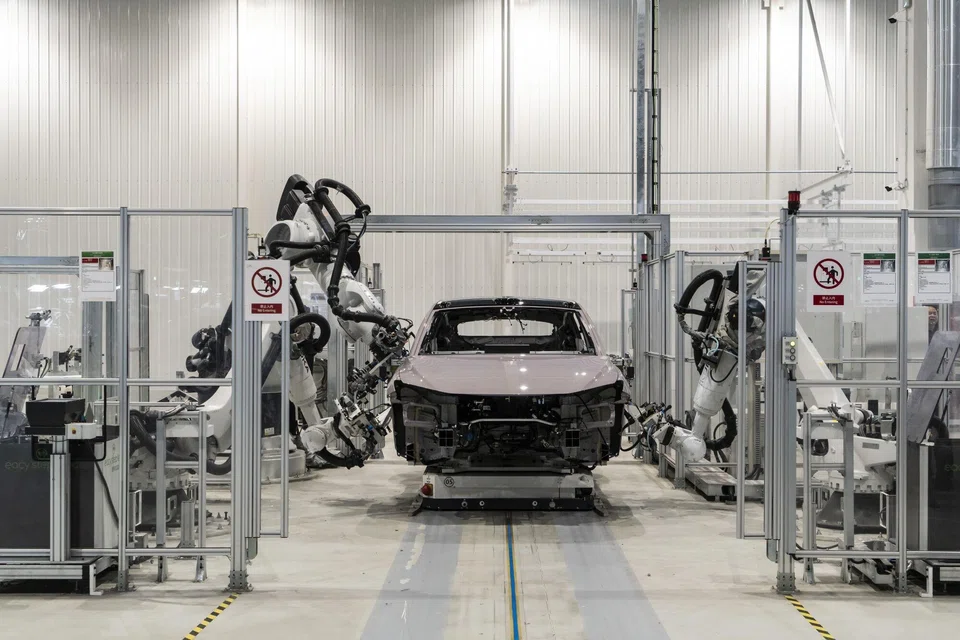
[SINGAPORE] The export of goods from European firms to China has steadily fallen in recent years, data from the United Nations’ Comtrade database shows, with annual declines from the US$261 billion logged in 2021.
That trend was noted by the European Central Bank’s (ECB) chief economist Philip Lane in a speech on Friday (May 22) at the 13th Asian Monetary Policy Forum in Singapore.
He also noted that the decline in European exports is happening at the same time European imports from China and Asia are growing. “Maybe the other side of this... is the very visible success of Chinese firms, Asian firms in the European markets.”
Dr Lane’s speech was part of a larger address published by the ECB that studies Europe’s relationship with the world economy.
While conventional thinking for the past decades has been a global economy driven by the United States, the central bank’s address argued that Asia has become an important factor for the European Union’s outlook.
“Asia matters substantially more for the euro area now than it did a decade ago,” he said in a published address. “Asian macroeconomic shocks have sizeable spillovers, and their effect on euro area gross domestic product is close to that of US shocks.”
Asia’s purchasing power was similar to that of the euro area when it was formed in 1999, but China today commands nearly twice the purchasing power of the eurozone; the rest of Asia matches that of China.
Asia’s rise over the last two decades, driven by China, has sometimes come at the expense of some European firms.
China absorbed production capacity from other economies when it started with low-cost manufacturing and production assembly. Now, companies out of the country have moved up the value chain and are competing with European firms in areas where the EU has historically excelled in. These include automotives and renewable energy.

Chinese electric vehicle brands dominate in China, the world’s largest EV market. However, these brands are also increasingly making inroads in Europe, sometimes at the expense of European carmakers. Chinese companies also dominate the global solar panel market and are deeply entrenched in the solar supply chain.
“The EU is increasingly competing with China in industries that were traditionally its own core areas of industrial strength,” explained Dr Lane. “This is affecting Europe on three fronts: in third markets, in China and inside the European market itself.”
He also argued that relatively subdued import prices from China have helped contain inflation in the EU, an effect that has strengthened in recent years. This is particularly as Europe dealt with external events such as the energy shock from the Ukraine conflict.
China offering competitively priced exports has exerted downward pressure on producers in other countries, encouraging them to keep their own export prices competitive in order to maintain market share in the EU.
EU producers sourcing cheaper complementary inputs from Chinese advanced manufacturers can also lead to an increase in production for EU firms.
But while there are benefits for the EU in the near term, the long-term outlook for trade between it and China is also complex.
For example, while lower import prices from China could help raise the euro area’s real income and reduce inflationary pressures, cheaper Chinese goods could also trigger a move away from eurozone products. This would lead to a weakening of exports from the EU and hurt the bloc’s GDP.
Decoding Asia newsletter: your guide to navigating Asia in a new global order. Sign up here to get Decoding Asia newsletter. Delivered to your inbox. Free.
Copyright SPH Media. All rights reserved.
TRENDING NOW

Once staunchly pro-China, Malaysian Chinese businesses are now distancing themselves from Beijing

Britain’s mansion tax shows the difficulty of targeting wealth

Three hats, one goal: How Ng Kian Swan runs sustainability at NUHS

COE review: The gap between luxury and mass-market cars isn’t the only one worth bridging

