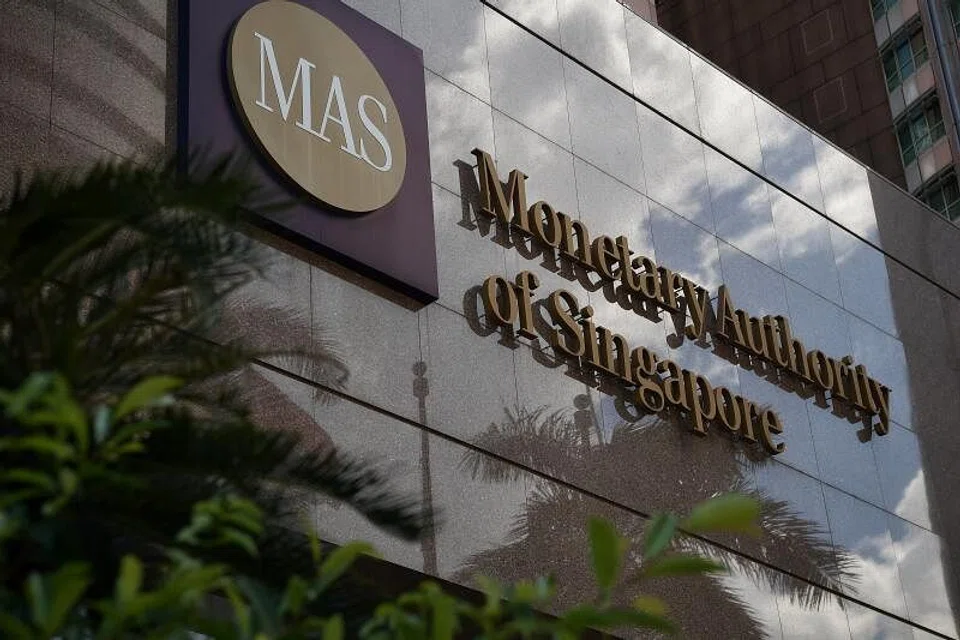
Economists not ruling out further tightening by MAS in April despite surprise off-cycle move

Janice Heng
Sharon See
Published Tue, Jan 25, 2022 · 10:24 AM

    AFTER a surprise off-cycle policy tightening on Tuesday (Jan 25), the Monetary Authority of Singapore (MAS) could still make further moves in April, say economists - not least as it has also raised its inflation estimates for 2022.

    Most economists had expected some form of tightening after Monday's news that December's core inflation had reached a 7-year high. What they did not expect was that the central bank would swing to action the very next day.

    An hour before the market opened, MAS made a "pre-emptive adjustment" to slightly steepen the Singapore dollar nominal exchange rate (S$NEER) band, allowing faster appreciation to contain inflationary pressures. A strong Singapore dollar (SGD) makes imports cheaper, and dampens demand for exports by making them more expensive.

    With monetary policy statements typically issued twice a year in April and October, this was the first off-cycle change since 2015.

    This rattled the market, with the benchmark Straits Times Index (STI) sliding 0.6 per cent within a minute of the start of trading. The index continued its downward slide, losing 1.3 per cent or 43.38 points to close at 3,239.97.

    Terence Wong, founder and chief executive of Azure Capital, attributed this to the timing: "Anything that's outside the ordinary, like MAS doing it out of the normal April-October cycle, would be deemed negative by the market."

    But OCBC chief economist Selena Ling noted: "After the rather cryptic inflation statement that MAS-MTI (Ministry of Trade and Industry) were reviewing their 2022 headline and core inflation forecasts yesterday, maybe it should not really have surprised the market that an interim-meeting move was lurking backstage."

    Meanwhile, the SGD rose to a 3-month high against the US dollar at 1.3438. Noting that the USD had been strengthening ahead of the Federal Open Market Committee (FOMC) meeting on Wednesday, DBS analysts said "one cannot help but be alert to similar surprises by the Fed too".

    "Nonetheless, the tighter S$NEER policy should increase the SGD's resilience to the USD's uptrend as witnessed in 2018-2019. Hence, we forecast USD/SGD to peak at 1.37 instead of 1.39 in Q3," said the DBS team.

    As to whether imported goods would be cheaper in the near term, Ling said this could be so in theory, but added that is still early days yet and much depends on what happens to the USD based on the FOMC policy decision.

    Wong said consumers may only start to feel the impact 3 to 6 months down the road, given that prices of imported goods would have been locked in from before.

    Tuesday's move follows an earlier tightening in October that restored the S$NEER to an appreciation path, after it had been set flat early in the Covid-19 pandemic.

    MAS said it decided to move now because "there has been a further upward shift in Singapore's inflation outlook, reflecting both global and domestic factors".

    It also raised its forecast ranges for 2022 on Tuesday. Core inflation is expected to be 2-3 per cent, up from the earlier range of 1-2 per cent.

    Headline inflation is expected to be 2.5-3.5 per cent, up from 1.5-2.5 per cent.

    Factors driving external inflation late last year, such as recovering demand and supply chain disruptions, "are likely to remain in play for a period"; domestic inflation is affected by these pressures and by a tight labour market.

    Core inflation is thus forecast "to pick up further in the near term, and could reach 3 per cent by the middle of the year before moderating", said the MAS.

    In both October and Tuesday's move, the policy band's width and the level at which it is centred were unchanged. But economists see the possibility of further moves in April, including recentring.

    If the off-cycle move "is meant to front-load" calibrated tightening, then the default is for the MAS to hold steady in April, said Mizuho Bank head of economics and strategy Vishnu Varathan. But if inflation continues to surprise on the upside significantly, then the MAS could tighten further, he added.

    Others expect further tightening in April regardless. Noting that Tuesday's steepening was "slight", OCBC's Ling sees further steepening, possibly to a 2 per cent appreciation path.

    "Given the 'slight' adjustment in slope today, we expect another 50 basis points increase in the slope to 1.5 per cent in the April policy meeting," said Bank of America's Asia and Asean economist Mohamed Faiz Nagutha, based on his estimate of the current slope.

    But re-centring the policy band is not his baseline expectation, as long as inflation is forecast to moderate in the second half of 2022 and into 2023, he added.

    Barclays economist Brian Tan has the opposite view: an upward re-centring in August, but a further slope increase only in October.

    Meanwhile, Citi economists Kit Wei Zheng and Ang Kai Wei expect both further steepening and an upward recentring in April, with the latter needed so that the S$NEER path stays within the policy band.

    Maybank analysts Chua Hak Bin and Lee Ju Ye expect recentring first, with a chance of steepening, since Tuesday's move "may not be sufficient to reduce imported inflation, as the S$NEER is already trading near the top side of the band".

    Given the higher-than-expected inflation and MAS' surprise move to curb it, one question is whether the upcoming goods and services tax (GST) hike might be delayed.

    But Nagutha does not expect so: "The potential hike in GST, expected to be announced in the February Budget and likely to take effect from July, will have no direct implications for monetary policy in our view."

    READ MORE: