

Economists warn of inflationary concerns and social costs behind ‘net zero by 2050’ ambition

Wong Pei Ting
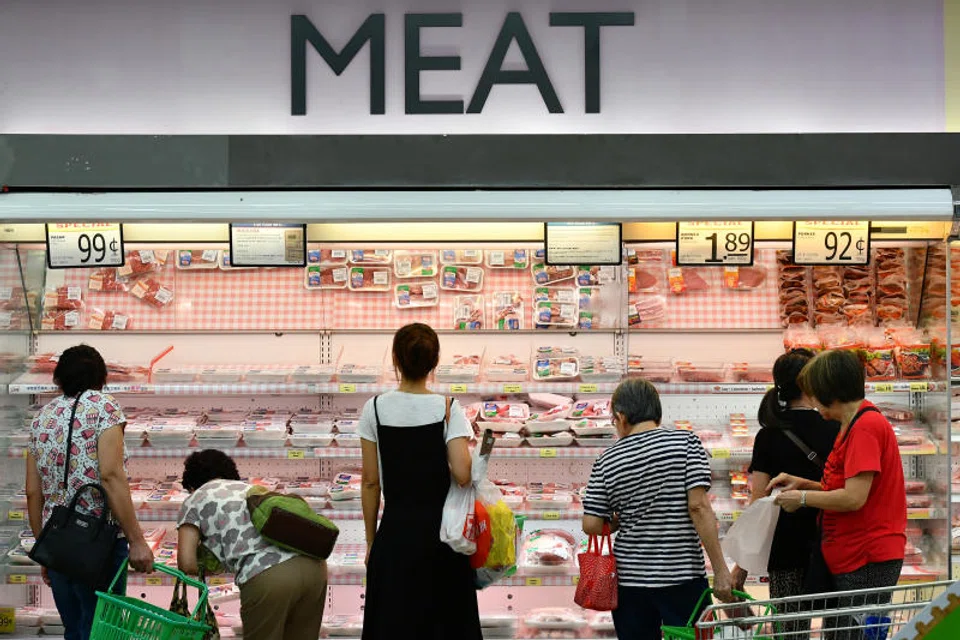
FOOD, fuel and utilities, the very areas causing inflation in Singapore to surge to its highest in 14 years in recent months, will soon test the country’s resolve to decarbonise – even as it entertains the idea of cutting wriggle room for itself to reach net-zero emissions by 2050.
Economists said the type of policies that are likely necessary to hit this target will require considerable adjustments in the prices of all goods and services, which will in essence reflect the true, if not truer, price of the carbon embedded within Singapore’s consumption.
Much of this is unpriced at the moment, said Christopher Gee, head of the governance and economy department of National University of Singapore think-tank, Institute of Policy Studies. “We are largely free-loading on the environment.”
Euston Quah, the Albert Winsemius chair professor of economics at Nanyang Technological University, said rising costs of living and inflation are to be expected, unless future technology makes it easier and cheaper to access green energy.
For starters, estimates already suggest that when the carbon tax rate eventually rises to S$25 per tonne of greenhouse gas emissions in 2024 and 2025, from S$5 currently, there will be an increase of about 0.8 cents per kilowatt-hour for end-consumers.
Goh Jing Rong, assistant professor of economics at the Singapore Management University, said this represents a monthly electricity bill increase of approximately S$3 for HDB flats, S$5 for private condominiums and S$10 for landed properties.
At the same time, consumption costs are likely to increase as a result of higher utilities charged to retailers, who may pass on a part of their costs to consumers, Goh pointed out. “The proportion of costs passed on depends on the elasticity of the goods,” he said. He noted that consumers are likely to feel the pinch from 2024.
In this year’s budget, the government announced that the carbon tax would be further raised to S$45 in 2026 and 2027, with a view to reaching S$50 to S$80 by 2030. Market observers have raised the possibility of further rate increases if Singapore adopts the more ambitious target to reach net zero by 2050 (instead of the current “by or around mid-century”), or a tiered approach covering a wider range of emitters, not just the heavy-polluting ones.
The National Climate Change Secretariat under the Prime Minister’s Office opened a public consultation to discuss the topic on Monday (Sep 5), in the lead-up to its preparations for a formal revision to the country’s long-term low-emissions development strategy to be submitted to a United Nations body before the year ends.
The consultation’s opening text said that personal and business tradeoffs required to achieve the target will be “much starker” than what most other countries face because of Singapore’s limited number of alternative energy sources.
“Individuals will need to change their personal habits – they need to consume and waste less, reduce energy consumption at home… and take cleaner forms of transport such as by embracing a walk, cycle and ride lifestyle,” it added.
A possible social cohesion issue
Breaking this down further, Walter Theseira, associate professor of economics at the Singapore University of Social Sciences, said while this might lead to the formulation of “win-win” policies, such as energy-efficiency standards that can help households save on utilities, unpopular choice-limiting policies might be in store.
Raising the issue of food as an example, he said: “The long supply chains of many imported foods is quite carbon intensive, and some food products such as meat and dairy also have significant sustainability impacts.
“Would it be sufficient just to price in these impacts, or – as some are starting to suggest – should there be outright regulations on some kinds of meat or food products to restrict their consumption?”
He went on to question: “Nobody really needs a high-performance car, so should we ban private vehicles with power outputs exceeding a certain amount?”
These regulatory options are due for consideration, because, although carbon taxes and other price-based policies may have their effects, they don’t hurt the “haves” in society enough to stop them from consuming far more than they should in terms of carbon, he noted.
“They essentially allow those who are willing and able to pay the price to consume far more than the typical amount of carbon. This in turn would probably harm social cohesion if some hard choices had to be made around carbon use,” Theseira said.
Simply maintaining policies on prices without regulation, he added, would effectively mean that people would see that only the rich would be able to afford to live “as usual”, while everyone else would have to cut back significantly on a lifestyle that they, or their parents, would have been used to. “I don’t see how many societies could actually cope with that kind of gap in consumption standards,” he concluded.
First-world problems
The issue of social cohesion aside, Theseira believes the real problem comes from the expectations people have today. For Singaporeans, he said, this means having access to what is really a “global upper-middle class lifestyle” – being able to fly anywhere we want, consume food flown or shipped in from across the planet, and to use energy quite liberally.
Rolling back this standard of living to a time when a trip overseas would have been considered a rare and costly event will be a challenge for governments everywhere, he said.
“Of course, our grandparents would not have known the difference. They didn’t grow up eating, you know, wagyu beef flown in from Japan or expecting to take a flight to Bali for the weekend. But we will know the difference, and that’s the problem,” he quipped.
Before greener alternatives get cheaper with wider adoption, the economists agree that lower-income households and vulnerable groups will feel the brunt of the drive to decarbonise every corner of the economy. However, market observers believe the government would step in with schemes to cushion the impact.
Pointing out that it is possible to redistribute the carbon taxes raised to provide financial assistance to vulnerable families, Gee said schemes akin to the GST Voucher scheme could be developed, with lowest-income households receiving the most help.
OCBC chief economist Selena Ling said that households are already facing higher electricity bills due to external global factors leading to high global oil and gas prices. “It is important that people adopt sustainable lifestyles, alongside Singapore’s push towards greener energy sources, to tackle soaring electricity bills,” she added.
While much of the focus is on cost, Alberto Salvo, an associate professor of economics at the National University of Singapore, said he tends to see the 2050 push differently.
The more definitive target, he said, is about a “rich responsible nation like Singapore” signalling its ambition to double down on its goal to decisively shift away from the oil and gas industry, both as a consumer and as a producer.
“This moment of heightened awareness of the climate crisis, ahead of COP27, obviously calls for ambition. To hit net-zero just over 25 years from now, carbon emissions today need to be declining, not rising, in the rich world at least,” he added.
Stressing that the tropics are warming up fast, and that food security and future livelihoods are on the line, Salvo said: “There is no question that we need to transition to a low-carbon future ... Singapore’s leadership in developing carbon markets, which includes carbon disclosure and carbon pricing, matters way beyond Singapore.”






