
'Enough's enough': Tight US job market triggers strikes for more pay
 Add BT as a preferred source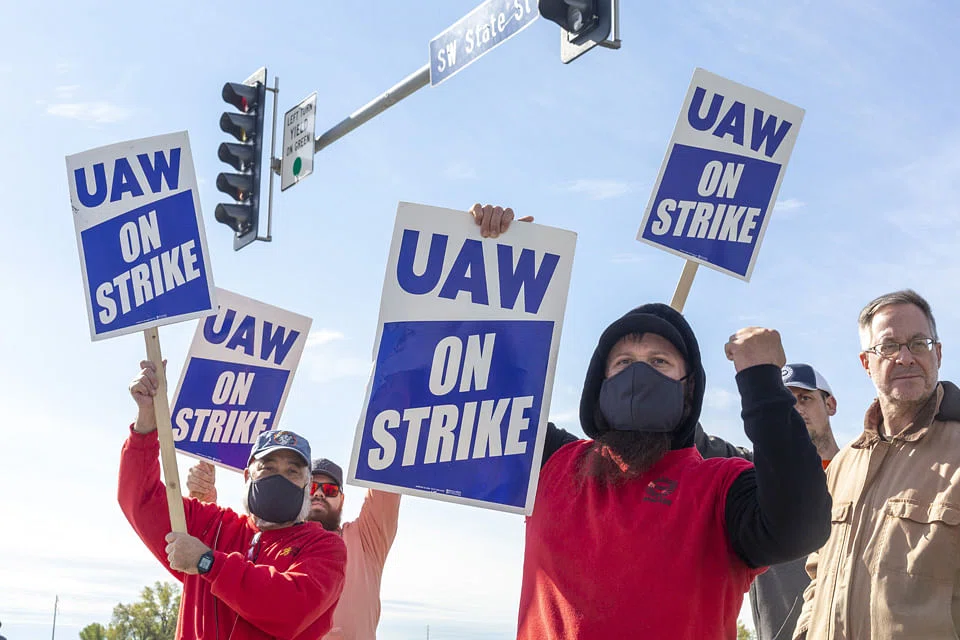
Detroit
THOUSANDS of workers remain on strike across the United States demanding higher pay and better conditions despite Hollywood make-up artists and camera operators reaching a deal over the weekend to avoid a walkout, and the tight jobs market has only emboldened them.
Kevin Bradshaw is an employee at Kellogg's cereal plant in Memphis, Tennessee, where most of North America's Frosted Flakes are made. He feels anything but great about cuts to healthcare coverage, retirement benefits and vacation time that union officials say the company is pushing for from about 1,400 workers on strike since Oct 5 at plants in Michigan, Nebraska, Pennsylvania and Tennessee.
"Enough is enough," said Bradshaw, vice-president of Bakery, Confectionary, Tobacco Workers and Grain Millers International Union Local 252G at the Memphis plant. "We can't afford to keep giving away things to a company that financially has made record-breaking returns."
Some 60,000 behind-the-scenes workers on movies and TV shows on Saturday avoided joining the Kellogg strikers, but the near-walkout was the latest demonstration of force by union members who say they are fed up with meagre or no raises and other givebacks. Kellogg officials could not be reached for comment but have said the company's compensation is among the industry's best.
Labour activists complain that while many of their members were deemed essential during the Covid-19 crisis, that has not been reflected in how they are treated by employers. With an administration in the White House that they see as sympathetic and a job market that saw a record number of Americans quitting in August, unions are ready to test companies' resolve.
Navigate Asia in
a new global order
Get the insights delivered to your inbox.
So far, at least 176 strikes have been launched this year, including 17 in October, said Cornell University's Labor Action Tracker.
"Workers are on strike for a better deal and a better life," Liz Shuler, president of the American Federation of Labor and Congress of Industrial Organizations, the nation's biggest labour federation, said last week at a Society of American Business Editors and Writers journalism conference.
"The pandemic really did lay bare the inequities of our system, and working people are refusing to return to crappy jobs that put their health at risk," she added, noting that the term #Striketober was trending on Twitter.
Despite some setbacks, including a failed organising drive earlier this year at an Amazon facility outside Birmingham, Alabama, union leaders feel the stars are aligned for them to make gains.
"We have entered a new era in labour relations," said Harley Shaiken, professor emeritus of labour at the University of California Berkeley. "Workers feel they're in the driver's seat and there's plenty of lost ground to make up. What we're seeing is a fight to return or at least stay in the middle class."
Union membership has been declining steadily in recent decades, falling to under 11 per cent of employed Americans in 2020 from 20 per cent in 1983, said the US Bureau of Labor Statistics.
However, 68 per cent of Americans now approve of unions, the highest proportion since 1965, showed a Gallup poll in August - and that rate climbs to almost 78 per cent for those aged 18 to 29.
Helping fuel the hopes of union leaders is the widespread view among organisers that President Joe Biden is the most pro-union president in modern times. In April, the Democrat created a task force to promote labour organising. Two months earlier, he defended workers' rights to form unions in the run-up to the unsuccessful push to organise Amazon workers in Alabama.
Other setbacks for unions have included in Beaumont, Texas, where Exxon Mobil locked out 650 workers from its refinery and an adjacent plant in May after a local United Steelworkers union refused to submit a contract proposal. Union leaders have scheduled a vote on the contract for Tuesday, but have urged members to reject it.
Exxon said the lockout was necessary to avoid the disruption of a possible strike and the changes to seniority it wants to impose were needed to ensure profitability. Meanwhile, some union members have moved to decertify the union.
In some sectors the discontent has been striking: 90 per cent of Deere & Co's hourly workers, represented by the United Auto Workers (UAW) union, rejected the company's contract offer last week and went on strike. The largest farm-equipment maker's 10,000 workers are seeking higher wages and retirement benefits, or as UAW Region 8 director Mitchell Smith said, "a better share of the pie".
Deere declined to comment, but after UAW members voted to go on strike the company said it wanted to maintain its employees' position as the highest paid in the industry.
The behind-the-scenes workers in Hollywood, represented by the International Alliance of Theatrical Stage Employees (IATSE), had sought reduced working hours, more rest periods, meal breaks and pay increases for those at the bottom of the wage scale. While the Hollywood workers avoided a strike, the picket lines could still become more crowded.
More than 28,000 healthcare workers at 13 Southern California Kaiser Permanente hospitals and hundreds of medical centres voted overwhelmingly earlier this month to authorise a strike. They want more pay and higher levels of staffing to reduce burnout worsened by the pandemic.
That demand is echoed by nearly 2,000 healthcare workers who have been on strike since Oct 1 in Buffalo, New York. "We've been working short at Mercy for five years," Kathy Kelly, who has been a nurse for 38 years at the Catholic Health System's Mercy Hospital, said while on break from picketing. "Enough's enough. We can only give so much." REUTERS
Decoding Asia newsletter: your guide to navigating Asia in a new global order. Sign up here to get Decoding Asia newsletter. Delivered to your inbox. Free.
Share with us your feedback on BT's products and services

