

EU chief executive lays out plan to make bloc more independent
She highlights defence and global trade, urges others to ramp up climate fight
 Add BT as a preferred source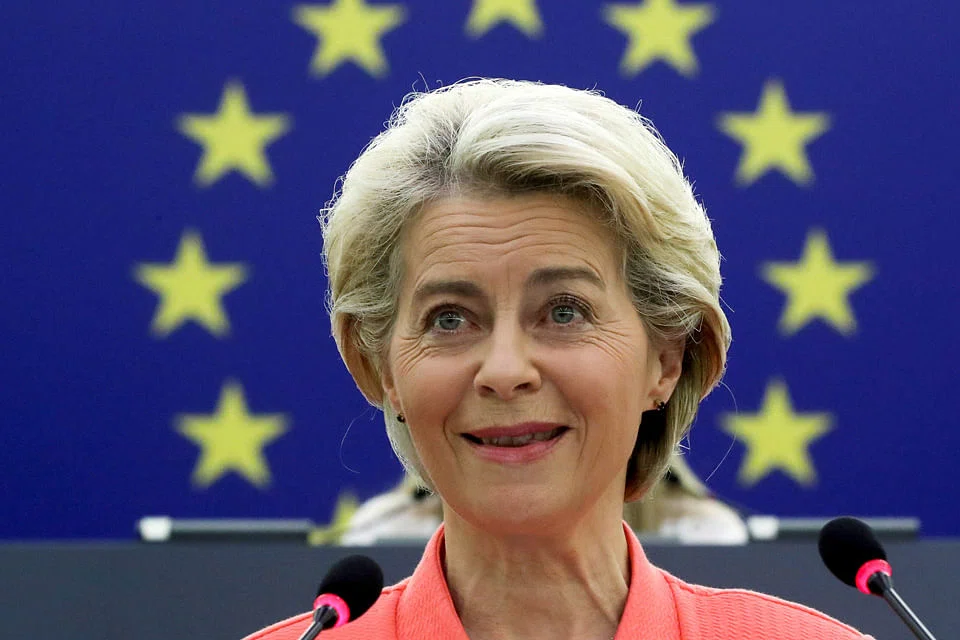
DeeperDive is a beta AI feature. Refer to full articles for the facts.
Strasbourg
THE European Union's (EU) chief executive set out plans on Wednesday to make the 27-nation bloc more independent in areas from defence to global trade, and urged other countries to join it in accelerating the fight against climate change.
European Commission (EC) president Ursula von der Leyen proposed the EU agree on a "Chips Act" to ensure semiconductor self-sufficiency, counter China's global infrastructure push, and find the political will to intervene militarily around the world without the United States.
"Europe can and clearly should be able and willing to do more on its own," she told the European Parliament in Strasbourg in her annual state of the union speech. Seeking to draw inspiration from Beatrice Vio, an Italian Paralympic champion who joined her in the assembly, she quoted her motto: "If it seems impossible - then it can be done."
During Mrs von der Leyen's two years as EC president, the EU's resilience has been tested by the coronavirus pandemic, a related economic downturn, strains over Britain's departure and weakening rule of law in some eastern member states.
Critics say she and her team have not carried out promises to make the Commission more "geopolitical" as the EU struggles to assert its influence in foreign affairs and global trade.
Navigate Asia in
a new global order
Get the insights delivered to your inbox.
A "make-or-break issue" is digital independence, Mrs von der Leyen said, following a global semiconductor shortage which showed the economic risk of relying on Asian and US suppliers. The proposal to ensure EU semiconductor self-sufficiency follows a CHIPS for America Act in the US, aimed at boosting US capacity to compete with Chinese technology.
Mrs von der Leyen also announced a plan for Europe to establish partnerships in infrastructure through a Global Gateway to counter China's Belt and Road Initiative. "We're pretty good at financing roads, but it doesn't make any sense for Europe if we build a perfect road between a Chinese copper mine and a harbour that's Chinese-owned," she said. "We are entering a new era of hyper-competitiveness, an era in which some stop at nothing to gain influence."
One month after the Taliban took control in Afghanistan, Mrs von der Leyen called on EU states to build forces that can intervene militarily abroad without US support.
"What has held us back until now is not just shortfalls of capacity, it is a lack of political will," said the former German defence minister, whose country has been reluctant to deploy troops into combat around the world.
While the US-led North Atlantic Treaty Organization (Nato) has long shouldered the military burden in Europe, China's rise, a more aggressive Russia, and US calls for Europe to do more for its own security are pushing the EU to develop a more forceful foreign policy.
Echoing calls by predecessor Jean-Claude Juncker, Mrs von der Leyen said the EU needed a "defence union" that would cement joint military action, going beyond its traditional soft power as the world's largest trading bloc. She proposed waiving value-added tax on weapons developed and sold in the bloc by EU governments, establishing a joint situational awareness centre to improve intelligence-sharing, and better defences against cyber attacks.
She also pledged to increase financial support to help poorer countries fight climate change and adapt to its impacts by an additional 4 billion euros (S$6.34 billion) until 2027.
Urging others also to do more, she said: "Closing the climate finance gap together, the US and the European Union, would be such a strong signal for global climate leadership."
Warning against "a pandemic of the unvaccinated", she said the pace of Covid-19 vaccination must be quickened. About 70 per cent of the EU's adult population has been fully vaccinated, but there are big differences among member states.
She also announced a donation of 200 million vaccine doses for third countries by mid-2022, on top of a previous commitment for 250 million shots. REUTERS
Decoding Asia newsletter: your guide to navigating Asia in a new global order. Sign up here to get Decoding Asia newsletter. Delivered to your inbox. Free.
Share with us your feedback on BT's products and services
TRENDING NOW
Ministry of Home Affairs Permanent Secretary Pang Kin Keong to retire
Shelving S$5 billion office redevelopment plan proved ‘wise’ as geopolitical risks mount: OCBC chairman
Richard Eu on how core values, customers keep Singapore’s TCM chain Eu Yan Sang relevant

China pips the US if Asean is forced to choose, but analysts warn against reading it like a sports result

