

Europe’s era of agitation heralds more clashes on spoils of work
 Add BT as a preferred source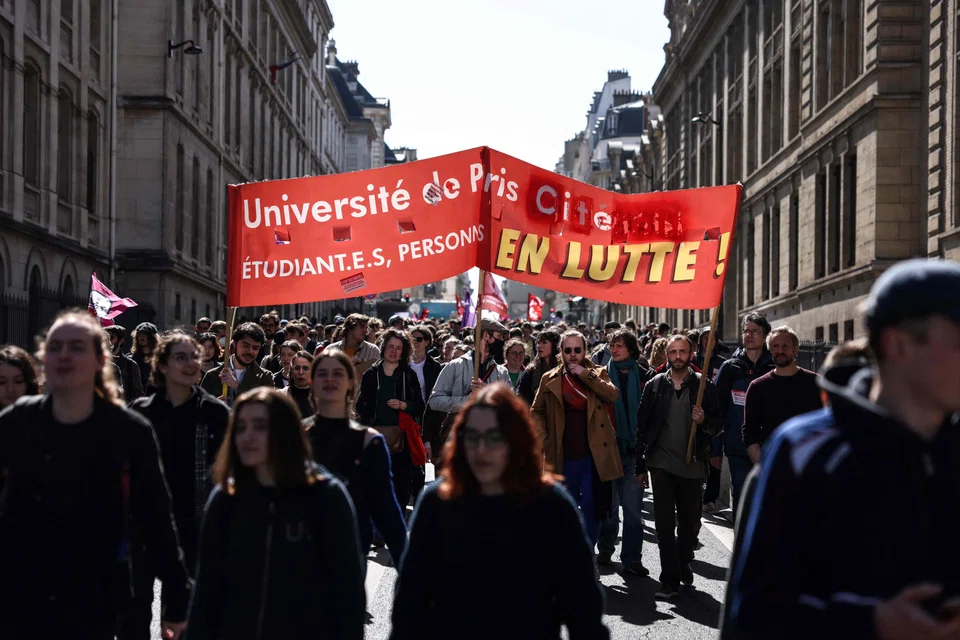
DeeperDive is a beta AI feature. Refer to full articles for the facts.
FROM London to Berlin and Paris, a new era of agitation over the spoils of capitalism is revealing itself in piles of uncollected garbage, shuttered transit systems, and mass protests.
Rampant public-service strikes in Britain, Germany and France, which has also suffered eruptions of street chaos, may point to the most concerted fightback yet seen after decades when employees suffered declining proceeds from countries’ national incomes.
Incited by a once-in-a-generation cost-of-living crisis, the mood in the region’s major economies, among workers with the leverage to do so, is shifting towards confrontation to defend the value of current or future labour entitlements, against governments struggling with fraying public finances.
That manifests itself in wage demands enforced by targeting services for citizens, as seen in Britain’s health-system gridlock or Germany’s transport shutdowns, with the threat there of more travel disruption to come this summer. France is additionally enduring thronged resistance against attempts to raise the retirement age.
In every case, the fight centres on the hearts, minds and wallets of citizens in their roles as voters and taxpayers. It affects them as consumers too, since wage deals can stoke inflation – and any echoes of such fiscal fights spilling into private-sector bargaining at a time of labour shortages can add to that threat.
For Marcel Fratzscher, head of the Berlin-based German Institute for Economic Research and a former European Central Bank official, the shifting dynamics may augur years of charged disputes throughout the region’s economies.
Navigate Asia in
a new global order
Get the insights delivered to your inbox.
“The times of an employer market in which employers could more or less dictate wages and working conditions seem to be over,” he said.
The backdrop to that change is two-fold. Firstly, labour lost out to capital in recent decades with real wages increasingly squeezed in many countries since the 2008 financial crisis, fuelling populism on both sides of the Atlantic.
Workers’ share of national output through compensation tumbled 7.6 per cent in the US between 1980 and 2018, and slipped roughly 12 per cent in Germany and France, analysis by the Resolution Foundation shows. The UK share held up better by only falling 2.6 per cent, though some argue the underlying picture there is worse.

“There are a lot of reasons that are behind this decline: one of them is of course globalisation, another is technological shift,” said Rosalia Vazquez-Alvarez, a wage specialist at the International Labour Organization in Geneva. “Clearly the bargaining power of workers has also declined.”
Secondly, the most recent catalyst towards agitation has been double-digit inflation in both the UK and across the euro region. Emboldening confrontation, fewer workers driven by shifting demographics have tightened employment markets, amplified in Britain by its exit from the European Union, which cut off a supply of cheap labour.
“Demand is still high and the talent shortage is still quite extreme,” said Chris Gray, director at recruitment giant Manpower UK.
It’s no surprise that the backlash is most focused on public services, since they agglomerate squeezed lower-paid employees performing pivotal functions who tend to be more unionised than in the private sector, and can take on every country’s deepest pockets: the government.
Greg Thwaites, research director at the Resolution Foundation, reckons that even if that were to repeat itself in wage talks at companies, the outcome may still not mean workers get a bigger share of the pie.
“Firms often just respond with higher prices,” he said, speaking on the UK in particular. “I don’t expect labour-market tightness to have much of an effect on the labour share. It hasn’t much over the past.”
In France, President Emmanuel Macron has attempted to address the labour-share matter head-on in a bid to defuse anger over his move to raise the pension age by decree. He is working on ways to force companies carrying out share buybacks to distribute more of their profits to workers.
That might turn out to be futile, however: Statistics on a previous such measure now show it turned into a boon for business, while still keeping pay raises in check.
What’s clear is that the fight for a greater share of income in major European economies is gaining momentum at present. Union membership is growing in the UK and in striking sectors in Germany, where the portion of workers enrolled in a union had shrunk to 16 per cent before the pandemic from 30 per cent at the turn of the century.
Public support seems to be amenable too, driven by widespread voter concerns over economic inequality.
Even in the UK, a country where scepticism towards unions is historically greater, a February Ipsos poll found a majority of voters were supportive of strike action. Public sympathy for strikers there ranges from 63 per cent in support of nurses to 36 per cent and 30 per cent for train drivers and barristers respectively, according to YouGov.
While Germany was brought to a standstill by travel strikes last Monday (Mar 27), a majority of voters polled expressed some sympathy.
That country’s transport standoff is likely to continue to showcase one of many fronts in the fight between labour and capital.
Aviation is one part of that. Deutsche Lufthansa, Europe’s biggest airline, already saw disruption last year, and a walkout of airport staff led to 1,300 cancelled flights in February. With a no-strike deal with pilots running out in June, it faces the spectre of more trouble during its busy summer travel season.
Meanwhile, the one-day train standstill that German railroad workers’ union EVG recently co-orchestrated was its response to a push for higher productivity.
Labour representatives counter that many managers trying to achieve that are non-specialised in railway services and out of touch with the needs of workers who barely can make a living.
“Our colleagues are now much more confident in standing up for their demands,” the union said in a statement, observing that more of its members are willing to take part in negotiations. “The worker’s movement is regaining strength.” BLOOMBERG
Decoding Asia newsletter: your guide to navigating Asia in a new global order. Sign up here to get Decoding Asia newsletter. Delivered to your inbox. Free.
Share with us your feedback on BT's products and services
TRENDING NOW
Air India asks Tata, Singapore Airlines for funds after US$2.4 billion loss

Beijing’s calculated silence on the Iran war

China pips the US if Asean is forced to choose, but analysts warn against reading it like a sports result

Richard Eu on how core values, customers keep Singapore’s TCM chain Eu Yan Sang relevant

