

Faster room rate recovery fuels industry cheer despite ongoing labour shortages

Annabeth Leow
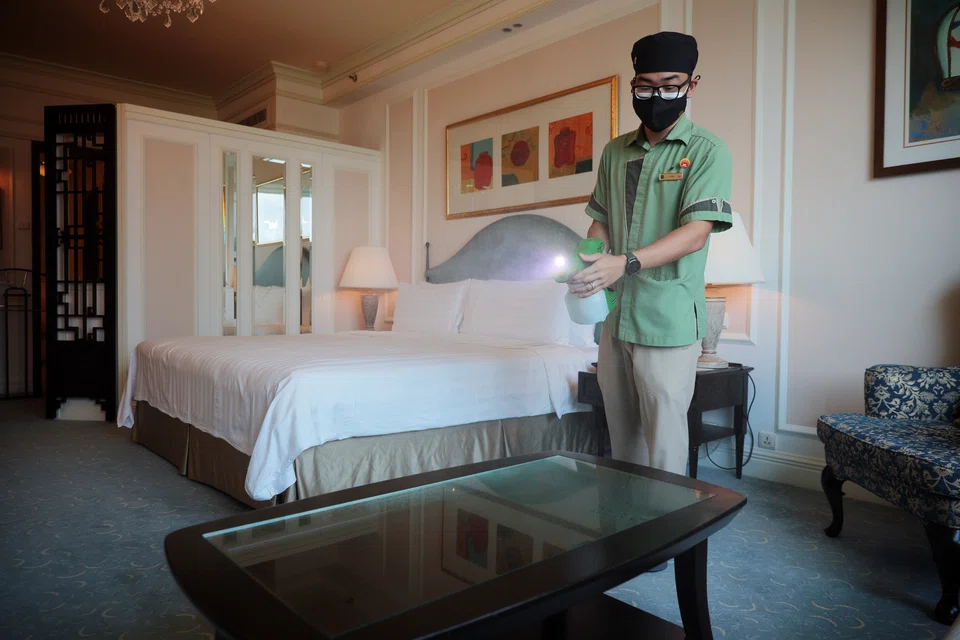
HOTELIERS in Singapore have been counting their blessings as room rates creep towards pre-pandemic levels, with some observers expecting a full recovery by the year’s end.
The latest rates rebound “bodes well for hotel owners and operators as they look ahead at the rest of 2022”, ahead of the mid-year peak period, Ananth Ramchandran, head of advisory and strategic transactions for Asia hotels and hospitality at CBRE, told The Business Times (BT).
“For the first time in 3 years, hotels will be able to push occupancy and ARR (average room rates) based on growing inbound travel, rather than relying heavily on quarantine and staycation demand,” he said.
Occupancy will have to gain much more ground, however, before revenue per available room (RevPAR) – and thus industry revenues – can fully recover, industry observers said.
That’s as rates are also being driven up by inflation and a staff crunch. The latter is also capping properties’ operating capacity.
“With the reopening of the borders last month, all the locals are now flocking overseas for their vacation, and that has impacted the little domestic demand that (Singapore) has… There is this concern about filling the rooms vacated by the government quarantine contracts,” Kim Ong, regional director for South-east Asia at industry research firm STR, told a recent briefing.
Yet STR has observed that hotel rates in popular tourist areas – such as Orchard, Sentosa, Marina Bay, and River Valley – are already at or near pre-pandemic levels, which Ong called “very encouraging” and supportive of the expectation that rates could recover fully by end-2022.
Singapore hotel occupancy averaged 62 per cent in the first 4 months of 2022, against 49 per cent in the year-ago period. ARR for the period rose to S$191.24, from S$149.47 before.
But, despite marked strength in the rate recovery for the higher-end upscale and luxury segments, industry metrics still trail pre-pandemic levels. Singapore saw occupancy of 85.7 per cent and ARR of S$217.38 in the first 4 months of 2019, before the global Covid-19 outbreak.
Indeed, the increase in room rates also comes on the back of underlying industry problems.
“Compared to a year ago, accommodation-related prices have, in general, risen due to several factors, including a tight labour market,” said a spokesperson for Trip.com. The booking platform has seen average price growth of 5 per cent year on year here for the January-to-April period.
Marcus Hanna, managing director of the Swissôtel The Stamford and Fairmont Singapore, told BT that “many hotels in Singapore are capping their occupancy” amid an industrywide staff shortage – which is driving room rates higher. The Singapore Hotel Association recently reported vacancies of up to 80 per cent for critical frontline roles such as housekeepers.
Sashi Rajan, executive vice-president of advisory and asset management for Asia at JLL, said: “Seventy per cent is the new 100 per cent occupancy in the short term for many hotels.”
Elevated rates are thus an attempt to maintain business viability, Rajan noted. He listed a host of challenges, such as higher cost of utilities and fresh produce for hotel restaurants; logistical difficulties in shipping of goods; and labour market pressure in attracting and keeping staff.
Rajan also stressed that elevated rates alone are not enough to support industry revenues: “We’ll need occupancy to return to pre-Covid RevPAR levels,” he said, adding that “there’s still some catching up to do” to hit the occupancy levels seen in 2019.
Singapore hotels’ RevPAR stood at S$118.64 in the first 4 months of 2022, up by 62.1 per cent year on year but still a far cry from S$186.23 in the first 4 months of 2019. Overall room revenue for the industry came to S$538.3 million, against S$1.32 billion in early 2019.
But Fairmont Singapore’s Hanna said rates could start to normalise if the labour crunch eases “in the coming months”. And that’s as other market pressures, namely demand, are also in play when it comes to the outlook for room rates.
Speaking on his hotel’s business strategy, Conrad Centennial general manager Mike Williamson told BT: “The focus for mid-2022 is to offer a competitive rate in light of the increase in travel.”
Ramchandran of CBRE added: “There is no clear consensus on when the industry will achieve RevPAR levels seen in 2019, although most forecasters expect this to be between 2024 and 2025.
“If we continue to see Singapore keep its entry requirements minimal, key source markets like China allowing residents to travel internationally freely, airlines and airports ramp up capacity swiftly, then RevPAR growth should see a robust uptick during 2022 and 2023.”
TRENDING NOW

Things to know about DBS’ incoming chairman Anthony Lim

DBS eyes prime brokerage business as Q3 profit falls 5% on weaker trading income

Royal Group and Sunset Hospitality abandon plans to open Casa Mett hotel off Orchard Road

George Yeo adds 100,000 Wilmar shares at S$2.97 apiece, taking stake to over 1 million shares

