

Fed's Bullard says high inflation may warrant 2022 liftoff
 Add BT as a preferred source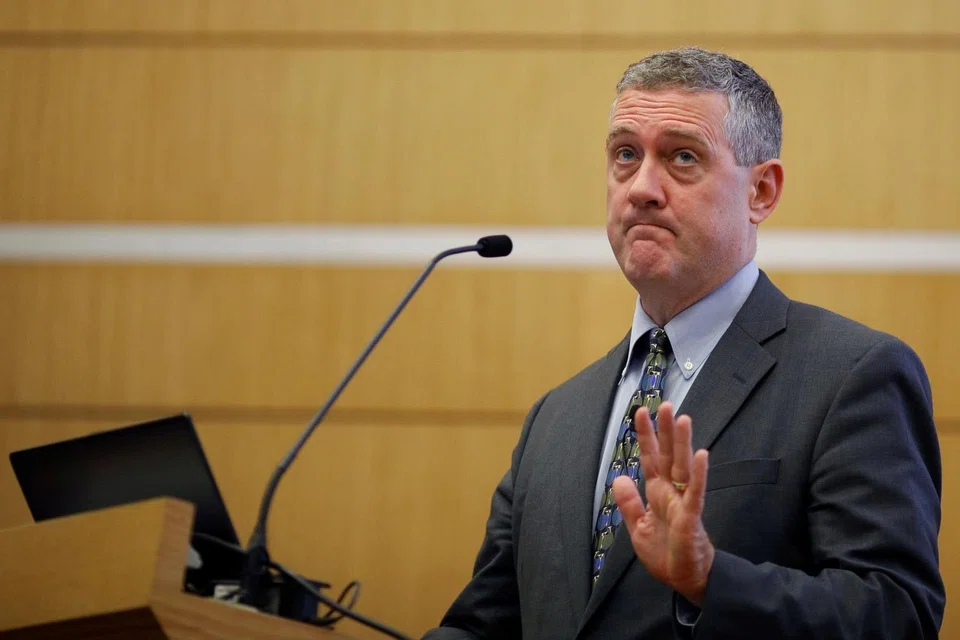
DeeperDive is a beta AI feature. Refer to full articles for the facts.
[NEW YORK] Inflation risks may warrant the Federal Reserve beginning raising interest rates next year, St Louis Fed President James Bullard said, backing an even-earlier liftoff than penciled in by many of his colleagues.
"I put us starting in late 2022," Mr Bullard said Friday during a TV interview on CNBC, referring to interest-rate projections published Wednesday by the US central bank after a two-day policy meeting.
"But you do have to have the idea that these are related to what the forecast is. So, my forecast said 3 per cent inflation in 2021 - core PCE inflation - and 2.5 per cent core PCE inflation in 2022," he said. "If that's what you think is going to happen, then by the time you get to the end of 2022, you'd already have two years of 2.5-3 per cent inflation."
Mr Bullard's remarks are the first in public by a Fed official since Chair Jerome Powell concluded his post-meeting press conference.
Yields on shorter-term Treasuries rose Friday following Mr Bullard's comments.
The Fed on Wednesday published economic projections showing 13 of 18 participants on the policy-setting Federal Open Market Committee (FOMC) thought it would probably be appropriate to begin raising interest rates from their current near-zero levels by the end of 2023. That marked an increase from just seven participants who thought such a timeline for rate hikes would be appropriate back in March, the last time updated projections were published.
Navigate Asia in
a new global order
Get the insights delivered to your inbox.
Minneapolis Fed President Neel Kashkari, in an interview with Reuters later on Friday, said that he was among the five officials who favoured keeping rates on hold at least through 2023.
In the new forecasts, seven participants penciled in a 2022 liftoff - up from four in March. Mr Bullard sits on the FOMC but does not vote on committee decisions this year.
The updated forecasts followed two months of Labor Department reports on consumer prices that showed hotter-than-expected inflationary pressures in April and May. While Fed officials have largely maintained that the price pressures in recent months are associated with the reopening of the economy and will therefore be transitory, forecasts for inflation published alongside the rate predictions revealed that many officials see a risk that the higher inflation will be somewhat persistent.
"This is very much a debate about what's going to happen in 2022. Is the inflation that we're seeing in 2021 going to persist into 2022 or not?" Mr Bullard said.
For those on the FOMC who don't currently anticipate beginning to raise rates next year, "they're most likely associated with a forecast that says that the inflation will go back down below 2 per cent during that year, and then the committee wouldn't be oriented toward raising rates at that point," he said.
The projections published Wednesday showed FOMC participants saw core inflation in 2022 ranging from 1.7 per cent to 2.5 per cent. Mr Bullard's comments revealed that his inflation projection for that year is at the top of the range.
Mr Powell told the press conference that the committee didn't discuss a liftoff date during its meeting and called such an assessment "highly premature".
TAPER TALK
"The focus of the committee is the current state of the economy. But in terms of our tools, it's about asset purchases. That's what we're thinking about. Liftoff is well into the future," Mr Powell said.
The FOMC maintained monthly purchases of US$80 billion in Treasuries and US$40 billion in mortgage-backed securities purchases, and Mr Powell said that the debate on scaling those back was getting underway. Mr Powell repeatedly declined to say when the taper would start but promised that markets would be given ample warning.
"The chair officially opened the discussion at this past meeting and now we'll have a chance to have more in depth discussions coming ahead," said Mr Bullard, noting that it was a complicated debate and it would take "several meetings" to iron out the various components involved.
These include deciding the timing and pace of the taper, whether it should be placed on an automatic pilot or be adjusted as economic conditions shift, as well as the balance between Treasuries and MBS.
"I'm leaning a little bit toward the idea that maybe we don't need to be in mortgage backed securities with a booming housing market," Mr Bullard said. "I would be a little bit concerned about feeding into the housing froth that seems to be developing."
BLOOMBERG
Decoding Asia newsletter: your guide to navigating Asia in a new global order. Sign up here to get Decoding Asia newsletter. Delivered to your inbox. Free.
Share with us your feedback on BT's products and services
TRENDING NOW

Ministry of Home Affairs Permanent Secretary Pang Kin Keong to retire
Shelving S$5 billion office redevelopment plan proved ‘wise’ as geopolitical risks mount: OCBC chairman

Richard Eu on how core values, customers keep Singapore’s TCM chain Eu Yan Sang relevant

China pips the US if Asean is forced to choose, but analysts warn against reading it like a sports result

