Ford teams up with Renault on producing affordable EVs in Europe
Automakers in Europe want to become more competitive as the likes of BYD expand in the region
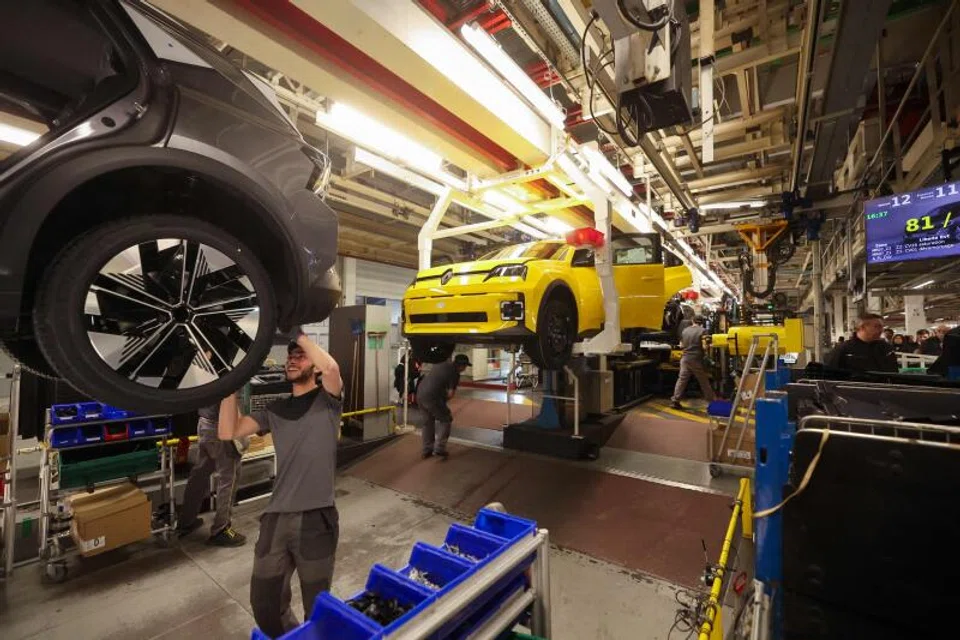
[NEW YORK] Ford Motor is turning to Renault to make affordable electric cars in Europe as both manufacturers come under rising pressure from Chinese manufacturers expanding in the region.
Renault will help develop and produce two Ford-branded models in northern France, with the first vehicle expected to reach showrooms in early 2028, the companies said on Tuesday (Dec 9). They also agreed to explore jointly making vans.
“The reality of the car business is it takes capital, and you have to be competitive on cost,” Ford chief executive officer Jim Farley told reporters during a briefing in Paris. “These are just building blocks to make a successful business in Europe.”
Automakers in Europe are trying to become more competitive as the likes of BYD expand in the region with low-cost electric and hybrid models. At the same time, they’re tapping Chinese technology expertise to move faster for less. Renault has relied on its Shanghai R&D center to develop the electric Twingo, which will be available for below US$23,299 by next summer.
For Ford, the move may signal a further reduction of its own production footprint in Europe as the company cuts output and staff in a region that has long lagged its North American arm.
At its plant in Cologne, Germany, where Ford makes EVs based on a Volkswagen platform, the automaker is letting go hundreds of workers and plans to move to a single production line, from the current two, beginning in 2026, it said in September. It’s already stopped making cars at a German factory in Saarlouis.
Instead, Ford is turning to partnerships to share costs and production for what it promises will be a “new product offensive” in Europe. Farley said the American automaker will not be a full-line manufacturer, as it has been in the past, but instead focus on car categories where it believes it has a competitive advantage. “We will select where we compete very carefully,” the CEO said.
Manufacturers are rethinking EV strategies after their initial efforts stumbled because of a dearth in charging infrastructure and models that proved too expensive. After intense industry lobbying, the European Union may walk back its de-facto ban of combustion-engine car sales slated for 2035 due to a slower-than-expected shift to EVs. An update from Brussels is expected for later this month.
“The approach to regulation – mandate it, and they will buy it – has failed,” Farley said on Monday in a commentary published by the Financial Times. At the same time, “we face a flood of state-subsidized EV imports from China, structurally designed to undercut European labour and manufacturing.”

Meanwhile, automakers are trying to correct their mistakes by offering cheaper EVs. Stellantis in November said it boosted output of Citroëns due to strong demand for the affordable C3 city car. VW is preparing budget EVs including the ID. Polo, which is expected to be priced below 25,000 euros when it goes on sale next year.
Aside from cooperating on EVs, Ford and Renault intend to work together also on developing and producing vans for both brands.
“There is no other choice than to share resources,” Renault CEO Francois Provost said at the same briefing, adding that Europe’s light commercial vehicle market is “core” for both partners. BLOOMBERG
Decoding Asia newsletter: your guide to navigating Asia in a new global order. Sign up here to get Decoding Asia newsletter. Delivered to your inbox. Free.
Share with us your feedback on BT's products and services