

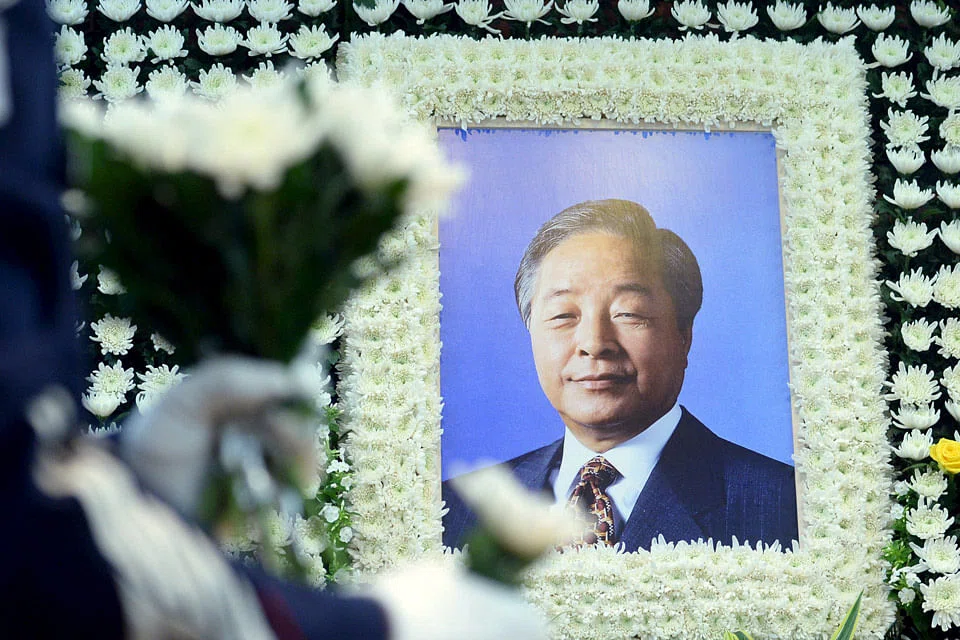
Former South Korean president Kim Young-sam dies at 87
Seoul
KIM Young-sam, the former president of South Korea who replaced the last of the country's military leaders, purged politicised generals and introduced a landmark reform aimed at transparency in financial transactions, died on Sunday. He was 87.
Mr Kim, who was president from 1993 to 1998, died of septicemia and heart failure, said Oh Byung-hee, chief of Seoul National University Hospital, where Mr Kim was admitted with a fever on Friday. He had been treated for a series of strokes and pneumonia in recent years.
Mr Kim, an outspoken critic of military dictators from the 1960s through the 1980s, was one of the "three Kims" - the others were former president Kim Dae-jung and former prime minister Kim Jong-pil - who played major roles, often relying on regional support from their home provinces, during South Korea's turbulent transition from dictatorship to democracy.
Mr Kim was born in 1927, a son of a rich anchovy fisherman on Geoje Island, off the south-east coast of South Korea, during a time when all of the Korean Peninsula was a Japanese colony. He was elected to Parliament at age 26 and developed a following as an opposition leader famed for his daring criticism of Park Chung-hee, who seized power in a coup in 1961 and tortured and imprisoned dissidents before his assassination in 1979.
Mr Kim beat fellow opposition leader Kim Dae-jung in the 1992 election to become the first civilian leader in South Korea in more than three decades.
Although he won the election with the support of the military-backed party, Mr Kim did not forget his roots. He purged a clique of politically ambitious army officers who went by the name Hanahoe, which roughly meant "an association of one-for-all, all-for-one". Bound by their regional prejudices and sponsored by the military dictators, the members of the group were so powerful they blackmailed - and even beat up - members of Parliament. The officers were forced to retire.
Mr Kim also barred South Koreans from owning bank accounts under pseudonyms. That change is considered one of the most important landmarks in South Korea's long-running campaign against corruption; bank accounts under borrowed names had been widely used by politicians and businessmen to hide slush funds.
But Mr Kim's time in office was also marked by missed opportunities.In his memoir, Mr Kim said he persuaded President Bill Clinton to cancel the United States' plan to bomb North Korea's nuclear facilities in 1994 for fear of war.
"Looking back," Mr Kim said in an interview in 2009, "I think the North Koreans think they can say whatever they want because no matter what they do, the Americans will never attack them." The 1994 nuclear crisis was defused when former president Jimmy Carter met the North Korean leader at the time, Kim Il Sung, in Pyongyang, the North's capital, and brokered what would have been the first summit meeting between the leaders of the two Koreas. But Kim Il Sung died of heart failure in July 1994, two weeks before the meeting was scheduled to take place. "Fate played a trick on me," Mr Kim said. "If I had met Kim Il Sung, I would have changed the nation's history."
By the time Kim Young-sam ended his five-year term in early 1998, he was a sad, disgraced lame duck.
In 1997, South Korea's proud economy swallowed the humiliation of a US$58 billion bailout from the International Monetary Fund during the Asian financial crisis. Mr Kim was criticized for failing to prevent the crisis by overhauling the country's powerful family-run conglomerates, which had expanded on reckless borrowing and with cozy ties to the government.
Mr Kim's reputation was further tarnished with the arrest of a son on corruption charges. His governing party was so unpopular that South Koreans were ready to hand over power to the opposition for the first time, as they did with the election of Kim Dae-jung in late 1997. NYT
TRENDING NOW
Could Jensen Huang work for Elon Musk? It would be ‘a titanic ego death match’, says biographer
As Indonesia picks new vice-president to succeed Gibran, investors see risks and opportunities
Beyond the greenback, Vietnam’s big borrowers turn to Asian-currency bonds

Shareholders sue Alibaba for allegedly hiding ties to Alice Huang, the suspected spy in Nvidia scandal

