

Fourth desalination plant to shore up Singapore's water supply
PUB to time design-build-own-operate tender for Marina East plant on same day tender for third plant in Tuas closes
Singapore
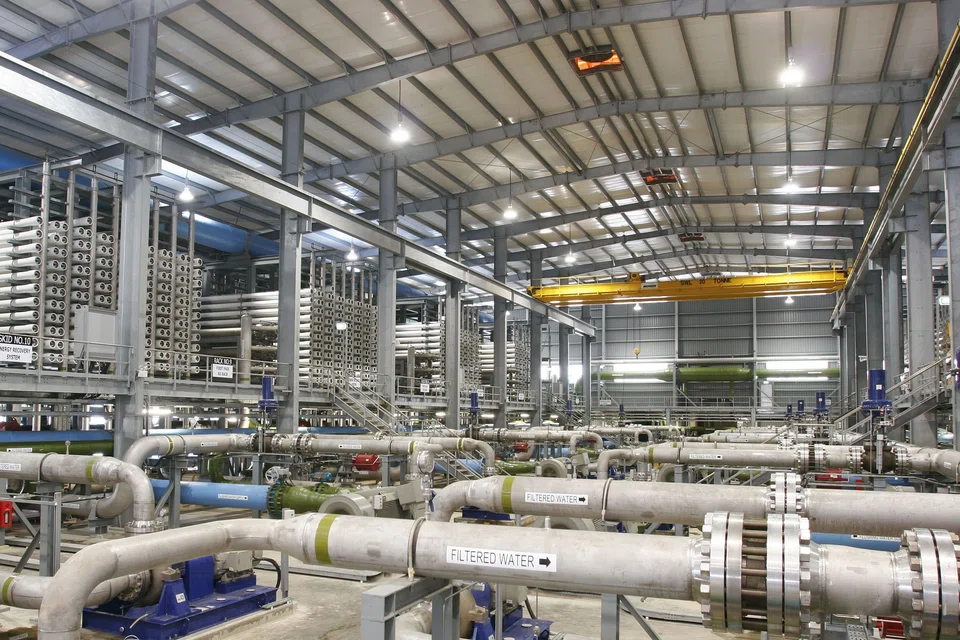
SINGAPORE is set to increase its desalination capacity by 60 per cent in the next few years, with a fourth desalination plant to be built in Marina East, it was announced on Thursday.
National water agency PUB said it would call a design-build-own-operate tender for this plant - on the same day that the tender for the third plant in Tuas closed.
PUB deputy chief executive Chua Soon Guan said in a statement: "PUB has been making investments to build up and diversify our water supply sources in order to strengthen our water security.
"During dry weather in recent years, we have been able to ensure supply by increasing the production of NEWater and desalinated water. Building up weather-resilient water sources will help us be better prepared for possible prolonged periods of dry spells in future."
The third and fourth plants are planned with capacities of 30 million imperial gallons a day each.
Once built, they will combine with the capacity of the first two desalination plants - the 30-million-gallon-a-day SingSpring and the 70-million-gallon-a-day Tuaspring plants - to provide 160 million gallons daily.
News of the two new plants, coming amid growing concerns about a drought and potential tax hikes in Johor, throw the spotlight on Singapore's focus on water security.
Lee Poh Onn, senior fellow at the Iseas-Yusof Ishak Institute, noted that developing desalination and NEWater wastewater recycling will provide a backup - not just for Johor water, but also Singapore's domestic reservoirs in times of drought.
"To ensure water security, it is essential for a country to be able to obtain supplies from as many sources as possible, and to increase its potential supplies, especially of its domestic sources," he said.
"In the event of drought affecting water supplies from our own reservoirs and reservoirs in Johor, it makes sense for us to increase our water production capabilities from recycling (NEWater) and desalination as a buffer against shortfalls from our domestic reservoirs and also water from Johor."
The fourth plant is aimed at meeting future water demand in the city area, by treating fresh water from Marina Reservoir.
Desalination now provides about 25 per cent of Singapore's current water consumption of about 400 million gallons per day; NEWater now provides about 30 per cent, but is to rise to meet 50 per cent of the demand by 2060.
SingSpring and Tuaspring were built by consortiums that included Singapore-listed company Hyflux, which will continue to operate those plants for the next couple of decades.
Maybank Kim Eng analyst Wei Bin said Hyflux remains the frontrunner for the new plants.
"From a technology point of view, a desalination pant is not very simple," he said, adding that he did not expect Hyflux to be constrained by operational bandwidth. "Not everybody can build a plant, so the government will have to account for their history, track record and their technology. That's why I think from this perspective, Hyflux definitely qualifies."
He noted, however, that Hyflux has more rivals today than it did when it bid and won the tenders for SingSpring and Tuaspring.
Mr Wei said: "Now the competition in this sector is higher than in the past few years. The other players include Sembcorp Industries, Keppel Corp and foreign companies like (Hong Kong-listed) Beijing Enterprises Water Group. If the government will open the market to foreign players, there will be a lot of competition."
Hyflux shares gained 1.6 per cent or one cent, to close at 63 Singapore cents on Thursday.
TRENDING NOW

South-east Asia has lost Nvidia’s best salesman

Demand, tech capabilities position Apac and AI as Skyscanner’s next growth frontiers: CEO Bryan Batista
Peter Kwee’s Ridley Park bungalow on the market with S$100 million asking price

Beyond the greenback, Vietnam’s big borrowers turn to Asian-currency bonds

