

George Shultz, who led US' Cold War diplomacy, dies at 100
 Add BT as a preferred source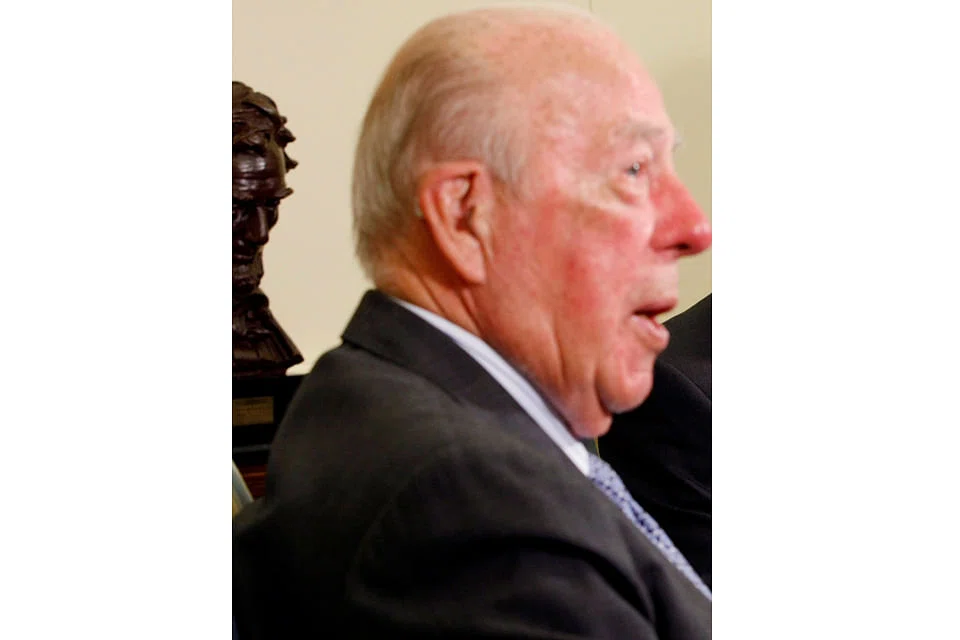
Washington
GEORGE Shultz, who oversaw the decoupling of the US dollar from the gold standard in the early 70s and kept the gears of diplomacy running under the din of Cold War rhetoric as Ronald Reagan's secretary of state a decade later, has died at 100.
He died on Saturday at his home on the Stanford University campus, Stanford's Hoover Institution announced. He had been the Thomas W. and Susan B. Ford Distinguished Fellow at Hoover after leaving office.
An Ivy League-educated economist, Mr Shultz moved seamlessly from academia to government to business. He served as labour secretary, director of the Office of Management and Budget and Treasury secretary under President Richard Nixon. In the Reagan administration, he clashed with more ideological members of the president's team in his efforts to craft a gradualist, consensus-based foreign policy.
He became President Reagan's second secretary of state, and the nation's 60th, in July 1982, following the resignation of Alexander Haig, and served through the end of Mr Reagan's second term in January 1989.
Condoleezza Rice, secretary of State for President George W. Bush and current director of the Hoover Institution, said: "Our colleague was a great American statesman and a true patriot in every sense of the word. He will be remembered in history as a man who made the world a better place."
Hillary Clinton, America's top diplomat during the Obama administration, tweeted that "we have lost a giant", while the latest US Secretary of State called Mr Shultz a legend.
Antony Blinken said in a statement: "He negotiated landmark arms control agreements with the Soviet Union and, after leaving office, continued to fight for a world free of nuclear weapons. He also urged serious action on the climate crisis at a time when too few leaders took that position. He was a visionary."
The low-key statesman battled with the Pentagon, particularly Defence Secretary Caspar Weinberger, over arms control, the appropriate use of military power, how to deal with the Nicaraguan Sandinistas and US policy in the Middle East. Mr Shultz led a pragmatic faction that promoted "realism" in foreign policy, including direct bargaining with the Soviet Union, said Reagan biographer Lou Cannon.
In President Reagan: The Role of a Lifetime, Mr Cannon wrote of Mr Shultz: "His bland and Buddha-like demeanour and somewhat professorial manner concealed a smoldering temperament that occasionally erupted in volcanic outbursts and a probing intellect that he devoted to understanding Ronald Reagan."
As Treasury secretary beginning in 1972, he played a role in untying the US dollar from the price of gold, a response to a growing US balance-of-payments deficit. Ending the gold standard meant the demise of fixed-currency exchange rates and the breakdown of the Bretton Woods system that had governed post-World War II economic relations among the big industrial nations.
George Pratt Shultz was born in New York on Dec 13, 1920, grew up in Englewood, New Jersey, and attended the Loomis Chaffee School in Windsor, Connecticut.
An only child of parents he described as highly attentive, he excelled in school and loved playing football. His father, Birl, was dean of the New York Stock Exchange's investor-education programme.
After graduating from Princeton University in 1942 with a degree in economics, Mr Shultz served in the US Marine Corps until 1945. A captain, he was stationed in Hawaii during World War II. There he met his first wife, Helena O'Brien, known as O'Bie, who was a first lieutenant in the Army Nurses Corps. They were married in 1946 and had three daughters and two sons. She died of pancreatic cancer in 1995.
Mr Shultz's second marriage, in 1997, was to Charlotte Mailliard Swig, then the chief of protocol and director of special events for the city of San Francisco.
Following his military service, Mr Shultz earned a PhD in industrial economics from Massachusetts Institute of Technology. He worked on MIT's faculty from 1946 to 1957, spending 1955 in Washington as senior staff economist on President Dwight Eisenhower's Council of Economic Advisers. He then became a professor of industrial relations and dean of the Graduate School of Business at the University of Chicago.
In December 2020, shortly before his centennial birthday, he wrote an opinion piece for The Washington Post, entitled, "The 10 Most Important Things I've Learned About Trust Over My 100 Years". "There is one lesson I learned early and then relearned over and over: Trust is the coin of the realm. When trust was in the room, whatever room that was - the family room, the school room, the locker room, the office room, the government room or the military room - good things happened," he wrote.
"When trust was not in the room, good things did not happen. Everything else is details." BLOOMBERG
Decoding Asia newsletter: your guide to navigating Asia in a new global order. Sign up here to get Decoding Asia newsletter. Delivered to your inbox. Free.
Share with us your feedback on BT's products and services
TRENDING NOW

Oiltek, Marco Polo Marine, Nam Cheong, OKP – Singapore boutique fund bets big on SGX small caps

CDL, Hong Realty trump 3 other bidders with S$542.4 million offer at S$1,865 psf ppr for Peck Hay plot

‘I felt like dying’: Thai Singha beer scion speaks up after disclosure of alleged sexual abuse

SpaceX IPO raises US$75 billion in biggest debut of all time, firm valued at US$1.77 billion

