German firm Syntellix opens first overseas facility in Singapore
The orthopaedic implant maker projects that overall investment will reach S$200 million by 2024, with a potential cumulative revenue of S$500 million by then

Sharon See
Singapore
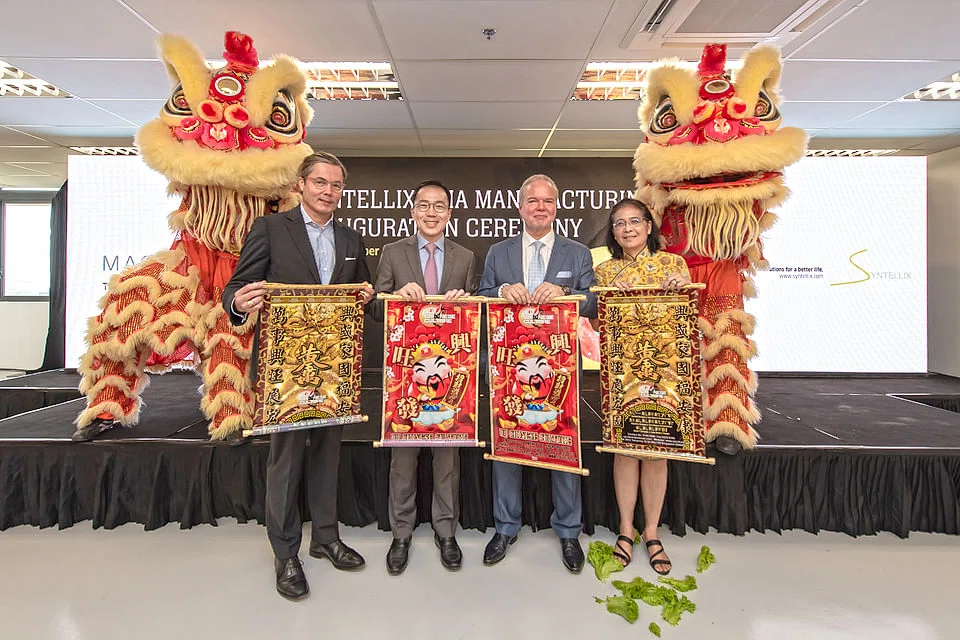
SYNTELLIX, a German firm that pioneered the use of bioabsorbable bone implants, opened its first overseas production site in Singapore on Tuesday, amid expectations of strong growth in the medical technology industry in this region.
While initial investment in the facility falls within an undisclosed "single-digit" million dollars, Syntellix founder, CEO and executive chairman Utz Claassen projected overall investment to reach S$200 million by 2024, with a potential cumulative revenue of S$500 million by then.
This would involve having about 50 staff and 16 production modules, up from the current staff strength of over 10 and just one module.
"We are at the phase of entering exponential growth; we are having triple-digit growth rates. Our January to August revenues have increased by 415 per cent over the previous year, and if we maintain that speed, it would be rather fast," Prof Claassen told The Business Times following the launch.
Eventually, the Singapore plant is expected to produce a product portfolio comparable with that in Germany to serve the Asian market, he added.
Last week, the firm signed an agreement with Chinese orthopaedic implant supplier Beijing Chunlizhengda Medical Instruments, with a minimum purchase quantity of over S$160 million. China has the world's second largest medical device market, behind the United States.
Syntellix's Magnezix implants, which are made from a patented magnesium alloy, dissolve completely in the bone, the firm said in a statement.
Unlike conventional metal implants, the patient does not have to undergo a second surgery to remove them as they are converted into bone tissue which aid the healing process.
The implants have product registrations in 56 countries, including Singapore, where they are being used in hospitals like National University Hospital (NUH), Singapore General Hospital and Gleneagles.
German Ambassador to Singapore Ulrich Sante and Economic Development Board of Singapore chairman Beh Swan Gin were present at the official opening of the production facility.
Prof Claassen said: "We are aware Singapore is theoretically a high cost location but in our business, the production is very capital intensive and highly automated.
"What is key is the high qualification of the staff. The great advantage that Singapore can offer is that it has very highly qualified people and highly specialised people as we need them, so for us, Singapore is actually a very good production place to be."
Dr Chee Yu Han, a trauma surgeon at NUH, has used the Magnezix implants in some 30 to 40 cases of surgeries involving fractures.
He said: "I found that these screws work as well as stainless steel and titanium screws but with the added benefit that as it dissolves, the metal is replaced by good healthy bone and also it reduces any infection."