

German public-sector deal sees pay rise for 2.5 million workers
 Add BT as a preferred source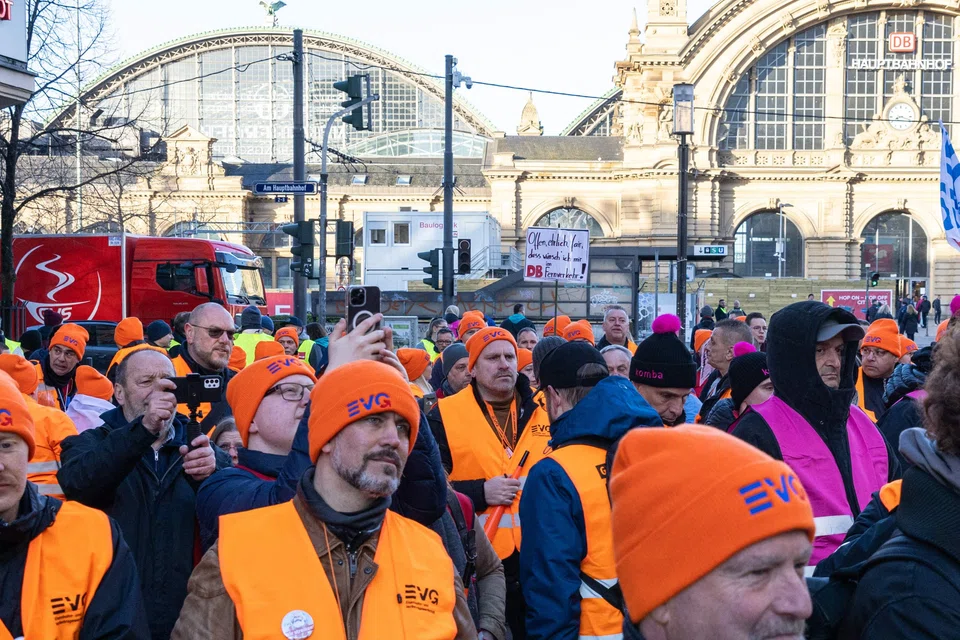
GERMAN public-sector workers struck a wage deal with employers, capping a confrontational series of negotiations that saw repeated strikes in Europe’s largest economy.
Staff will receive staggered one-time payments totalling 3,000 euros (S$4,444) through February 2024. After that, salaries will rise by 200 euros on a permanent basis, and then be increased by 5.5 per cent.
The agreement covers about 2.5 million employees in the German public sector and comes after three rounds of talks failed to produce a result. An arbitration commission then proposed a compromise, which is the basis for the deal struck this weekend in Potsdam.
“We have wrestled hard with each other in four rounds of negotiations and in the arbitration process,” Germany’s Interior Minister Nancy Faeser said. “This wage settlement brings tangible relief for employees.”
Wages in the euro area have become a key focus for central bankers who are worried that strong increases will make it harder to return inflation to their 2 per cent target.
European Central Bank President Christine Lagarde has called on companies and their staff to share the burden of higher energy costs to avoid a “feedback mechanism between higher profit margins, wages and prices.”
After the arbitration committee published its compromise proposal, economists said it would be a strong outcome for employees. But JPMorgan analyst Greg Fuzesi also noted that its structure “allows for significant moderation into 2024.”
Verdi’s agreement comes after the IG Metall union secured one for industrial workers last year that’ll see their salaries rise by 5.2 per cent in 2023 and 3.3 per cent in 2024.
Workers at Deutsche Post meanwhile clinched a deal that’ll see their pay rise by 11.5 per cent on average over two years.
The robust pay demands – and bigger willingness to strike – are fuelled by the fastest inflation in decades, whose underlying forces are proving stubborn despite a recent drop in energy costs. Salaries in Germany fell more than 3 per cent last year if adjusted for gains in consumer prices, according to the statistics office.
Workers are meanwhile in a strong negotiating position as employers are having increasing difficulties in attracting staff.
The labour market has been resilient to the fallout of war in Ukraine, with the main impact being an influx of refugees from the country who’re slowly integrating into the labour force. BLOOMBERG
Decoding Asia newsletter: your guide to navigating Asia in a new global order. Sign up here to get Decoding Asia newsletter. Delivered to your inbox. Free.
Share with us your feedback on BT's products and services
TRENDING NOW

Xi Jinping has just rewritten the rules of US-China rivalry

High Court raps UOB over inconsistent legal positions on late mortgage payment charges

‘Whole deck of cards just toppled’: FoodXervices’ Nichol Ng on how a 92-year-old family business unravelled – and what’s next

China’s Huawei reveals chip design breakthrough amid US sanctions

