

Germany approves aid package for flood recovery
The 400 million-euro package will be financed from the current budget, says finance minister
Berlin
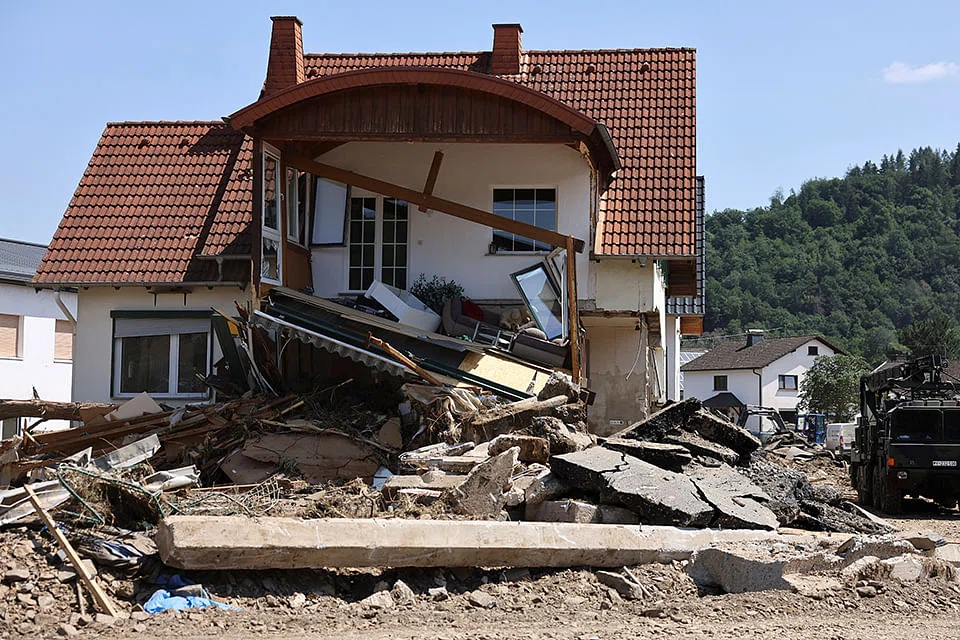
CHANCELLOR Angela Merkel's cabinet approved a 400 million-euro (S$644 million) flood-relief package to help devastated regions in western Germany.
The federal government will make half the funds available, with the rest coming from the hard-hit states, including North Rhine-Westphalia (NRW) and Rhineland-Palatinate, Finance Minister Olaf Scholz said on Wednesday.
The funds will be financed from the current budget, and the money will be made available to the people affected as quickly as possible, he said.
"We can do this; we have the conditions," he said at a press conference in Berlin. "It can move forward right away."
The flooding has shown initial signs of shaking up the campaign to lead Europe's largest economy. Dr Merkel's Christian Democratic-led bloc saw its lead over the Greens narrow to nine percentage points after the group's backing fell two points to 28 per cent in a Forsa poll - the first to partially take in the impact of last week's flooding.
Armin Laschet, the NRW state premier and the conservatives' candidate, was pilloried over the weekend for laughing in the background as the German president solemnly offered condolences for the flood's victims.
"Even after his appearances in the areas affected by the flood disaster, he remains largely devoid of contour and color," Manfred Guellner, head of the Forsa polling institute, said. "The candidate's weakness has led to a renewed decline in sympathy for his party."
After touring a flood-ravaged town near Bonn with Mr Laschet, Dr Merkel promised prompt financial support for rebuilding efforts. Mr Laschet said his state would double the amount.
While the catastrophe put climate change at the top of the public agenda, political party the Greens have so far failed to capitalise, with support steady at 19 per cent. The Social Democrats picked up one point to 16 per cent.
For the poll, Forsa surveyed 2,503 people between July 13 and July 19. The floods started on July 14.
Dr Merkel vowed on a visit to the badly hit medieval town of Bad Muenstereifel on Tuesday that Berlin would come through to help in the short and long term.
"This was flooding that surpassed our imagination when you see the destruction it wrought," she told reporters after touring what the Bild daily called the "apocalyptic" wreckage of the 17,000-strong community in NRW state.
She said she had met local victims "left with nothing but the clothes on their backs".
She was joined on the visit by NRW premier Armin Laschet, head of her Christian Democratic Union and the frontrunner in the race to succeed her as chancellor after a general election on Sept 26.
Mr Laschet called for the rescue funds to reach victims "unbureaucratically and as fast as possible", pledging to double Berlin's assistance with a cash injection from his own state budget. He warned it could take "months if not years to rebuild".
A total of 121 people are now confirmed to have died in the flooding in Rhineland-Palatinate state, with at least 48 victims in NRW and one in Bavaria.
At least 31 people also died in Belgium, and later torrential rain caused havoc in southern Germany and several other neighbouring countries.
"We are still looking for missing people as we clear roads and pump out cellars," the vice-president of Germany's THW civil protection agency, Sabine Lackner, said. "However by now it is unfortunately very likely that we will only be able to recover victims, not rescue them."
Mr Scholz, the chancellor candidate for the Social Democrats, said that Europe's top economy would pass a "billions-strong rebuilding programme" in addition to the direct aid to victims "so that things will quickly start looking up".
"What's crucial for me is that there are consequences from what's happened," he said, including plans to improve Germany's disaster prevention systems, as well as climate protection measures.
The damage caused by devastating floods is likely to cost the insurance industry up to five billion euros, the GDV insurance industry association said on Wednesday.
"We are currently expecting insured losses of four to five billion euros," Joerg Asmussen, chief executive of the GDV, said in a statement, calling the disaster "one of the most devastating storms in recent history".
Annalena Baerbock, the Greens' flag bearer for the election, called for a more coordinated approach to warning citizens while stressing the country must prepare better for extreme weather events due to global warming.
"Germany has been fortunate for decades in suffering relatively few natural catastrophes," she said.
"But that's meant that the disaster protection measures haven't been sufficiently developed, although experts have been warning for years about climate-driven extreme weather events."
Dr Merkel, who is retiring this year after 16 years in power, on Tuesday defended Germany's preparations for deadly disasters, saying even experts had been taken by surprise by the sheer brutal force and speed of last week's rains, which left many stricken towns looking like war zones.
"Now we've got to look at what worked and what didn't work, without forgetting that this was flooding as we haven't seen in a long, long time," she said. BLOOMBERG, REUTERS, AFP
Decoding Asia newsletter: your guide to navigating Asia in a new global order. Sign up here to get Decoding Asia newsletter. Delivered to your inbox. Free.
Share with us your feedback on BT's products and services
TRENDING NOW

KKR founders among investors buying 42% of Peter Lim’s Valencia; club valued at US$1.4 billion

Singapore’s central gas buyer affirms Indonesia’s role as ‘important partner’ amid export review warning

Why the biggest business decision about AI isn’t which model to choose

NEA issues notices to 10 Singapore-based companies, including Wilmar and APP, over haze

