Global economy risks hangover as growth over-reliant on AI boom: India chief economic adviser
He stressed the need to prepare for a potential post-bubble fallout

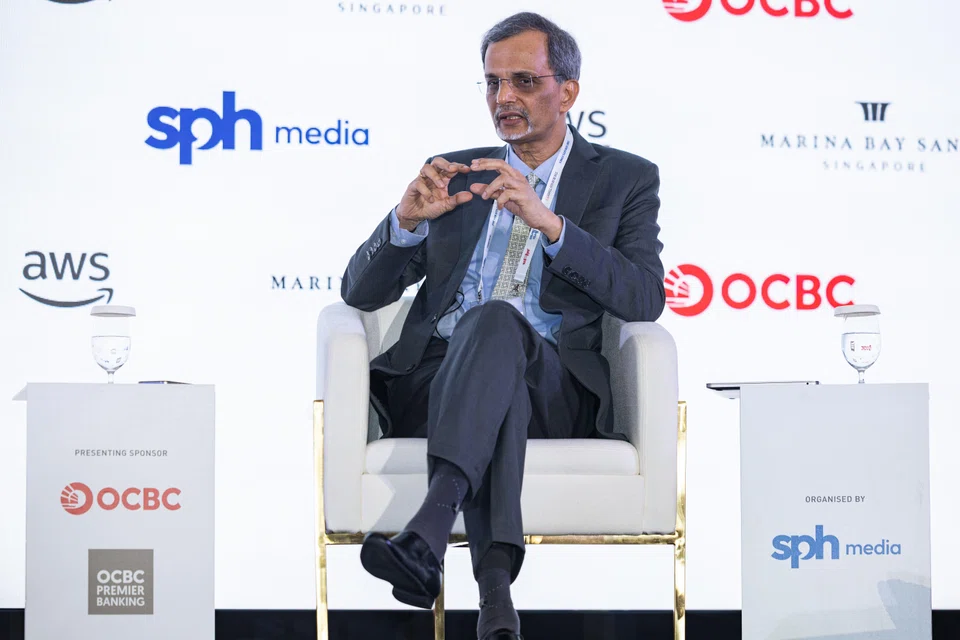
[SINGAPORE] The global economy may be posting strong headline growth, but much of it perches atop the pinnacle of artificial intelligence – a bubble that may already have well begun to deflate.
Speaking at the Asia Future Summit on Friday (Nov 27), the chief economic adviser to the Indian government, Anantha Nageswaran, cautioned against taking post-pandemic economic resilience for granted.
“There is a sense of fragility attached to these growth numbers because they have been somewhat disproportionately reliant on one particular sector and all the capital expenditure associated with that,” he said.
“(Growth) has not necessarily percolated down to vast segments of the population… and there are also financial system vulnerabilities that are built up,” he added, and stressed the need to prepare for a potential post-bubble fallout.
He made the remarks during a panel discussion at SPH Media’s annual thought leadership conference, which returned for its fifth edition this year.
For the first time, it was jointly presented by the media organisation’s key news titles: The Straits Times, The Business Times, Lianhe Zaobao, Berita Harian and Tamil Murasu.

OCBC is the presenting sponsor, with Marina Bay Sands as the official venue partner and Amazon Web Services as the official cloud partner.
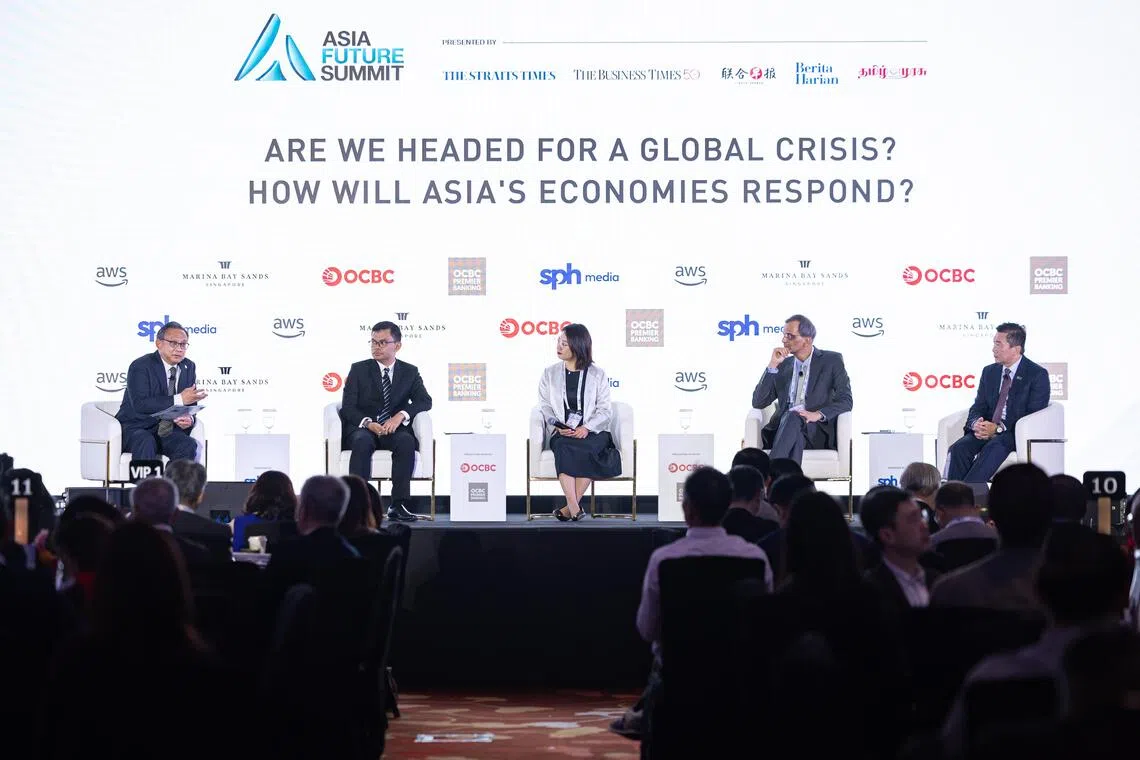
Nageswaran was part of a panel discussion, moderated by BT senior correspondent Ben Paul, titled “Are we headed for a global crisis? How will Asia’s economies respond?”
The other three panellists were: Akmal Nasir, Malaysia’s Minister of Economy; Guo Shan, partner at Hutong Research; and Loh Boon Chye, Singapore Exchange (SGX) group CEO.
SEE ALSO




Asked about AI’s long-term impacts on productivity, Nageswaran replied that the real question was not just whether such gains accrue, but also to whom they do.
“If the productivity gains accrue predominantly to owners of capital – but not to owners of labour – and if there is widespread labour displacement that happens… then it will not be an enduring productivity gain,” he said.
Pointing to the risks of financial destabilisation arising from the web of interwoven financing that characterises today’s AI sector, he added that a more important question was how to calculate productivity gains that are adjusted for the potential risks unleashed by AI models.
Diversify risks, not just portfolios
The risks of overconcentration were also highlighted by SGX’s Loh, who cautioned that a diversified portfolio did not necessarily translate into diversified risks.

Loh framed the AI debate around three questions:
- whether it fundamentally changes the economy and lives;
- whether investor capital generates adequate returns; and
- who benefits from the potential returns.
Acknowledging that the US remains the biggest market and an enduring one, he added that opportunities abound around Asia as well.
But while opportunity can create economic value, it does not necessarily lead to investment returns, he cautioned, noting that risk could increase with continued geographical concentration.
Still, he maintained that he was not seeing signs that investors were oblivious to their overall AI exposure or the concentration risks in their portfolios.
Of chips and China
Turning to China, Guo said that the latest developments surrounding US restriction on AI chips could accelerate an adjustment in the sector, bringing forward the expected demand-supply rebalancing to next year, ahead of the previously anticipated 2028.

The restrictions could affect up to 30 per cent of the demand in the chip industry, she said, as many of China’s hyperscalers rely on overseas data centres. This would also prompt China to accelerate its domestic production, she added.
Guo does not expect Beijing to respond with another round of economic stimulus, noting that China’s economy is still on track to meet Beijing’s annual growth targets.
There is no urgency for any stimulus; rather, the central bank has been focusing on fiscal prevention, she continued.
Guo also pointed to signs that Beijing is seeking to play a more active role in stabilising the global economy, including by addressing concerns over China’s large trade surplus.
She noted that China has publicly pledged to pursue what it calls “international circulation” – a shift she said is arguably the first time China is seriously looking at its international role and how it can be a more responsible player in the global economy.
“Beijing sees that the global market has to be (integrated). We have to stabilise the supply chain so that everybody will enjoy a better business environment.”
She noted that this would involve three things for China: importing more, maintaining exports and encouraging its firms to expand overseas. She added that this approach is reminiscent of Japan’s efforts to rebalance its trade in the 1980s.
One common factor that would drive these three developments is the renminbi’s appreciation, added Guo.
“I’m looking at the renminbi to stabilise in the next year but, in the long term – we’re talking towards 2035 – we’re probably looking at the renminbi to appreciate by 40 per cent,” she said.
Malaysia turns to value creation
Malaysia, meanwhile, is seeking to capture more value from the AI boom by moving up the semiconductor supply chain, said Akmal.
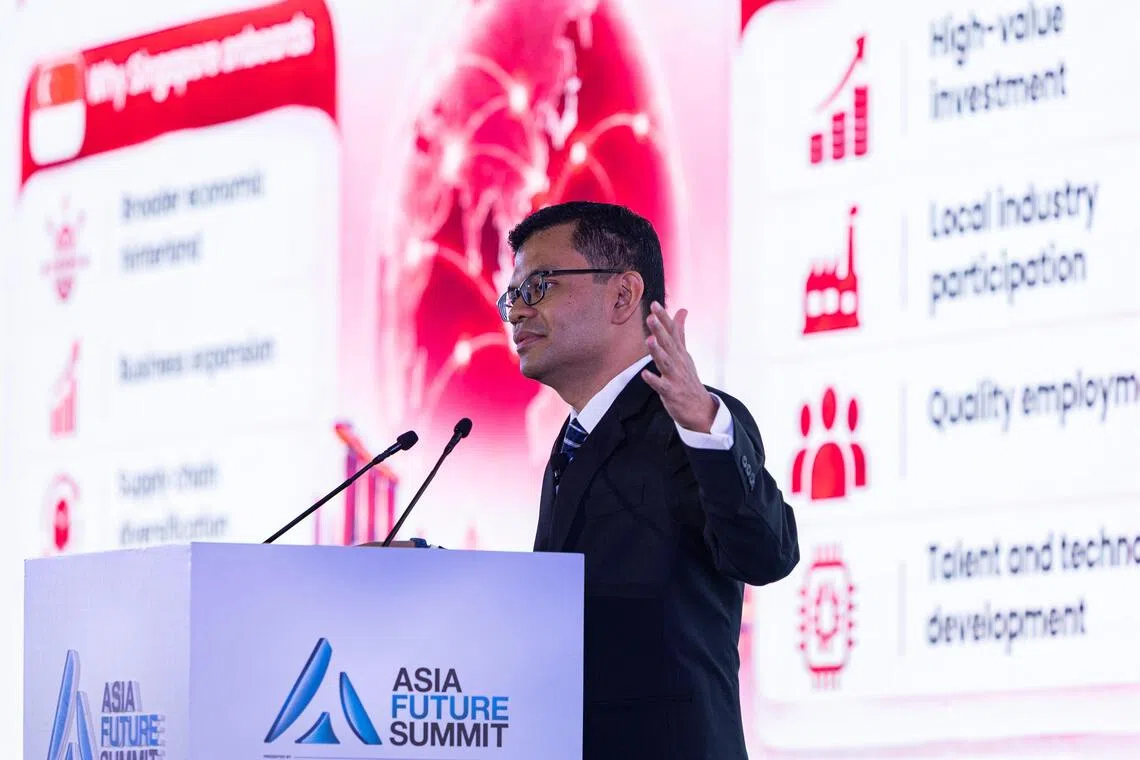
While the country has traditionally been known for chip testing and packaging, it is now looking to develop higher-value capabilities further up the chain.
The government is also becoming more selective about data centre investments, with closer scrutiny of their energy and water use.
The economic spillover of such investments should extend beyond real estate and construction, and into helping build up Malaysia’s AI capabilities and those of the wider region, he added.
The Malaysian minister concluded: “We cannot build our economic strength on geopolitical rivalries… we want to be part of the solution in this very challenging world (and) definitely we need to preserve our reputation.”
By contrast, India has had relatively little exposure to the market-led AI boom, said Nageswaran, pointing to the absence of listed Indian companies among the major beneficiaries of the investment surge.
He was responding to an audience question on India’s limited presence in the AI discourse despite its established software industry.
But this could also leave the country less exposed to a potential correction, he noted.
“It also means that, because India was not part of the party, it would not be part of the hangover,” he said, contending that the party was “more or less over”.
Decoding Asia newsletter: your guide to navigating Asia in a new global order. Sign up here to get Decoding Asia newsletter. Delivered to your inbox. Free.
Copyright SPH Media. All rights reserved.