Global fuel crisis adds urgency to Cambodian push to tap US$300 billion energy resources
Phnom Penh urges swift resolution of maritime row with Thailand to unlock assets; majors interested, but there are capacity challenges, minister says
[PHNOM PENH] The oil shock from the Iran conflict has created renewed urgency for Cambodia to resolve a festering maritime dispute with Thailand and unlock undersea energy resources worth US$300 billion, Cambodia’s energy minister said on Wednesday (May 27).
Iran’s grip on the Strait of Hormuz, the conduit for about a fifth of the global oil supply, has turned conflict there into the worst-ever global energy crisis.
Cambodia is relying on renewable energy sources including hydropower and a growing solar capacity to weather the current crisis, but its hopes for further industrialisation rest on more fossil fuel assets, Minister of Mines and Energy Keo Rottanak told Reuters in an interview.
“Before the crisis, perhaps all nations could take energy security a bit more lightly,” he said. “But the ongoing crisis, especially the pressure from the Strait of Hormuz, has only brought energy security of any nation into sharper focus.”
Cambodia has been in a boundary dispute for decades with its larger neighbour Thailand, discord that sparked two bouts of fighting last year that killed close to 150 people before the latest ceasefire in December.
An area of around 27,000 square kilometres in the Gulf of Thailand that is claimed by both countries is estimated to hold around 11 trillion cubic feet of natural gas, alongside large quantities of oil.
'%3e%3cpath%20d='M12.1475%2025.5262C13.7713%2025.4295%2014.94%2023.913%2014.94%2021.8832C14.94%2019.5359%2013.474%2018.093%2011.5917%2018.093C11.3745%2018.093%2010.9582%2018.093%2010.8393%2018.1413V25.2086L11.8891%2025.5745C11.8891%2025.5745%2012.207%2025.5262%2012.1475%2025.5262ZM11.4934%2017.6281C13.2567%2017.6281%2014.3843%2016.4292%2014.3843%2014.4501C14.3843%2012.372%2013.275%2011.2973%2011.4339%2011.2973H10.8393V17.6305H11.4934V17.6281ZM6.66078%2025.6482L7.39265%2025.5492C8.02617%2025.4502%208.26403%2025.3053%208.26403%2025.1097V11.6149C8.26403%2011.4193%208.1451%2011.3709%207.23484%2011.249L6.68137%2011.173L6.6219%2010.7588H11.9508C15.7153%2010.7588%2017.0624%2012.0797%2017.0624%2014.1578C17.0624%2015.9666%2015.7748%2017.1909%2013.4969%2017.6305V17.7041C16.111%2017.948%2017.6571%2019.5382%2017.6571%2021.7636C17.6571%2024.3318%2015.8937%2026.0417%2012.1109%2026.0417H6.60132L6.66078%2025.6482Z'%20fill='%232B2B2B'/%3e%3cpath%20d='M20.6287%2025.6505L21.5596%2025.5515C22.1725%2025.4779%2022.4104%2025.3076%2022.4104%2025.112V11.249H21.9346C20.073%2011.3479%2018.982%2013.0095%2018.408%2014.6227L18.1907%2015.5018H17.6555L18.1701%2010.7588H29.3837L29.6421%2015.4787H29.1664L28.9491%2014.6227C28.3728%2012.8645%2027.3047%2011.2743%2025.5002%2011.249H24.9856V25.1856C24.9856%2025.3812%2025.1251%2025.4548%2025.9965%2025.5515L26.7695%2025.6505L26.829%2026.0417H20.5693L20.6287%2025.6505Z'%20fill='%232B2B2B'/%3e%3c/g%3e%3cdefs%3e%3cclipPath%20id='clip0_5242_21648'%3e%3crect%20width='24'%20height='16.8'%20fill='white'%20transform='translate(6%2010)'/%3e%3c/clipPath%3e%3c/defs%3e%3c/svg%3e)
International oil and gas majors, including TotalEnergies, are keen on potentially starting offshore exploration activities if the neighbours can resolve their disagreements over a patch of sea in the Gulf of Thailand, he said, adding that harnessing the oil and gas resources would be a win-win for Thailand and Cambodia.
Despite protests from Cambodia, the Thai government this month unilaterally terminated a 25-year-old agreement to work towards joint offshore energy exploration, arguing the framework had made no progress.
Thailand’s move has meant that Cambodia will now have to rely on a compulsory conciliation process under the United Nations Convention on the Law of the Sea (Unclos) to reach an agreement on the maritime boundary, Rottanak said.
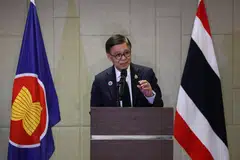
“We see that our choice of the Unclos Compulsory Conciliation... is the only possible avenue to sort out differences in a peaceful and amicable manner,” he noted, adding that the Cambodian government plans to reach out to the Thai side for discussions on this mechanism.
Thailand’s foreign ministry did not immediately respond to questions from Reuters.
Under the procedure, a panel of conciliators assists countries in settling their disputes, a process first utilised by Timor-Leste in 2016 to agree on permanent maritime boundaries with Australia.
Given the years needed for exploration and development, a swift resolution to the border quarrel was crucial, Rottanak pointed out.
“If you are going to wait for decades more, the chances of attracting financing to do oil and gas exploration and exploitation may not be there,” he explained. “And large firms are aware of that.”
TotalEnergies did not immediately respond to a request for comment.
Following years of delay, Cambodia extracted its first crude oil from fields in the Gulf of Thailand in late 2020, in a venture between the government and KrisEnergy.
Only months later, however, the Singapore-listed firm announced it was headed for liquidation, casting a shadow over a sector that the Cambodian government is eager to resuscitate.
“Even if the two parties were to solve everything today, it will take time to ramp up financial resources and technology to do this,” Rottanak said, referring to Cambodia and Thailand. REUTERS
Decoding Asia newsletter: your guide to navigating Asia in a new global order. Sign up here to get Decoding Asia newsletter. Delivered to your inbox. Free.
Share with us your feedback on BT's products and services