

Global inter-connectivity means Mers will come to Singapore in time: PM Lee
There's no need to panic if systems are prepared to cope with it, he says, after visiting TTSH facilities

Lee U-Wen
Singapore
IT is "a matter of time" before Singapore has its first Middle East Respiratory Syndrome (Mers) case, given the country's inter-connectivity and the fact that the virus has already reached neighbours Malaysia and the Philippines.
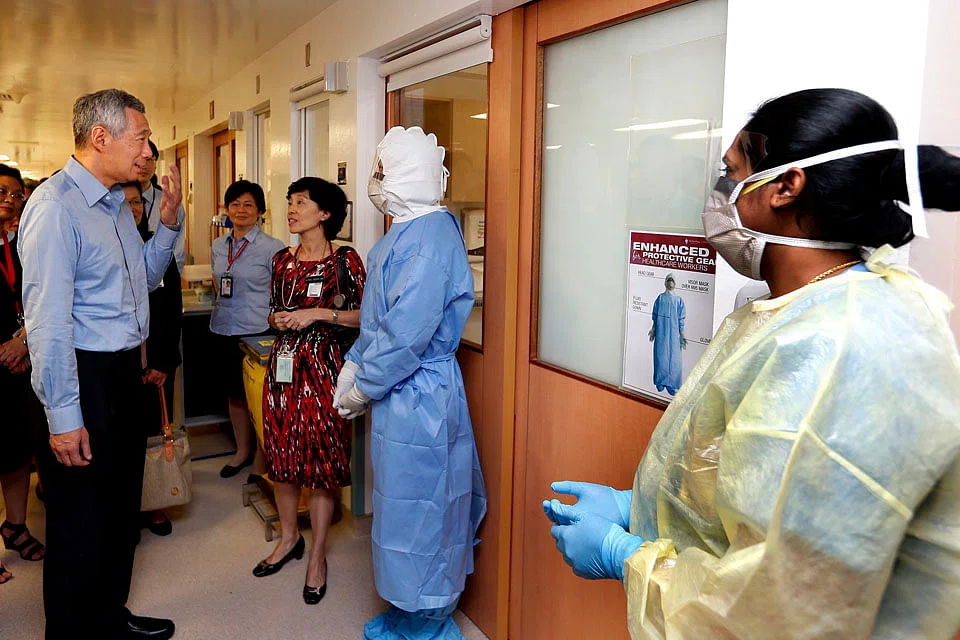
Making this point during a visit to Tan Tock Seng Hospital (TTSH) on Thursday, Prime Minister Lee Hsien Loong said that Singapore "must assume" that Mers can and will enter the country eventually.
"Malaysia has had one case, with two in the Philippines. Many of the European countries have had cases, and the United States too," he told reporters at the hospital's Communicable Diseases Centre (CDC) after learning more about its various emergency-preparedness measures.
"For us, it's a matter of time. And when it happens, I want to be quite sure that our medical facilities and medical staff, the hospitals - the whole team - are ready, that they know how to deal with it and don't fumble. We can contain it, and then put a stop to the disease in Singapore as quickly as we can."
Mers was first identified in Saudi Arabia in 2012. The disease has since spread to South Korea, where 10 people have died and more than 2,800 others quarantined as at Thursday.
There have been 122 confirmed cases there to date, and the fear of the disease spreading has grown to such an extent that some 2,700 schools have been shut across the country.
Mr Lee described the situation in South Korea as "quite a bad outbreak", adding that Singapore was keeping tabs on the problem there, given that both countries have a high volume of people-to-people exchanges.
He said that 40,000 people from Singapore go to South Korea each month, and many families head there for vacations, especially in a month like June, which coincides with the school holiday period. Singapore also receives anywhere from 15,000 to 20,000 travellers from the Middle East every month.
On Tuesday, Singapore began temperature screening at its air checkpoints for passengers arriving from South Korea. A day later, Singapore Airlines announced that it would waive cancellation and administration fees for refunds and rebookings or to re-route those holding confirmed tickets to and from Seoul.
Mr Lee stressed that, in addition to the medical professionals, the general public should also be extra vigilant and aware of what to do.
"If you have travelled and you come back and feel unwell with flu symptoms, take it seriously. Go to the hospital and get a check-up," he said, adding that Singaporeans should not panic in the event that Mers does make it way here. "We don't want to get into a panic - and we don't have to if we are well prepared."
TTSH is Singapore's designated isolation centre for suspected and confirmed Mers patients. The hospital has a dedicated task force that works with the Health Ministry to look into enhancing measures against the virus.
TTSH's practice is to isolate patients for up to 48 hours if they are suspected of having Mers. Those considered at risk would be isolated if they have symptoms of respiratory illness after having visited either South Korea or the Middle East.
Doctors will take a sputum sample or a swab from their nose or throat to test for the virus. Those confirmed with Mers will be isolated in either of the hospital's two CDCs. All healthcare workers will don protective gear when attending to these patients.
Thomas Lew, chairman of TTSH's medical board, told reporters that the hospital has attended to 500 people who could have come into contact with Mers since screening for the virus began in 2012. About 180 of them were sent for further testing, but all have turned out negative.
"We are equipped and ready. Given that Mers and other emerging diseases have been around for many years now, our staff are on constant alert," he said. "In terms of our facility and the organisation, we've certainly got a lot more preparedness built into the system."
TRENDING NOW

Nvidia reinstates Jensen Huang as CEO; Trump says move poses no national security risk

Indonesia’s coal tycoon Low Tuck Kwong replaced as Bayan Resources president-director

Nvidia surges 33% after reinstating Jensen Huang, reviving AI trade; stocks soar in US and Europe

Consider lowering homeownership barriers for some non-resident foreigners

