



After the US-Iran war, is free navigation in the Strait of Hormuz gone for good?
The US has said in the past that paying tolls to Iran’s government would be a sanctionable act
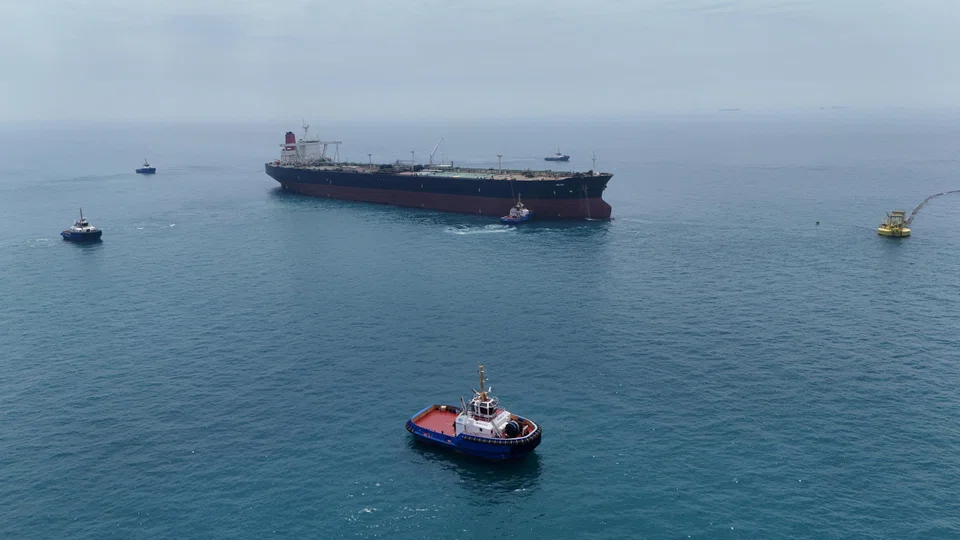
ON Jun 17, the US and Iran struck a deal to reopen the Strait of Hormuz, the world’s most important artery for shipping oil and natural gas, which was largely blocked after the two countries went to war in February.
As part of the interim accord, the two sides agreed to allow commercial shipping toll-free for 60 days while they work toward a permanent end to the conflict. This has led to an increase in traffic through the waterway, and oil prices have fallen sharply on the expectation that supplies of Middle Eastern crude are returning.
However, the situation remains volatile, with Iran continuing to assert control over the trade chokepoint and threatening to levy permanent tolls on ships passing through. It has pushed back against a US move to offer naval protection to commercial vessels in the strait. The lingering risks were underscored when a container ship and an oil tanker came under fire on Jun 25 and 27.
Here is why a restoration of normal, unfettered traffic through the strait, which connects the Persian Gulf to the Indian Ocean, remains a distant prospect at best:
The risk of attacks
The US naval support for vessels using a route that hugs the southern side of the strait close to Oman has persuaded more ship operators to brave the journey, allowing for millions of barrels of oil that were trapped in the Persian Gulf to make it out into the Gulf of Oman.
A separate route approved by Iran has also handled large amounts of oil and gas, especially the country’s own barrels.
Iran’s military has called the Oman route “unacceptable and extremely dangerous,” and the risk of violence against ships and their crews remains.
Following the two attacks in late June, which damaged the ships without injuring their crew, the Joint Maritime Information Center, which liaises between navies and merchant shipping, raised its threat level in the region to “substantial,” having only recently lowered it to “moderate.”
Merchant sailors are nervous about working in conflict zones at the best of times. At least 14 seafarers have died in the Iran conflict, and there had been 49 attacks that damaged ships as of Jun 30, according to the United Nations’ International Maritime Organization (IMO). So the shipping industry wants to be confident that hostilities have truly ended.
SEE ALSO


Mine threats
Iran is thought to have mined what was previously the most heavily-used Hormuz shipping channels, so ships have instead been sailing nearer to Iran’s coastline or closer to Oman’s. The question of how much traffic those alternative routes can handle has not been fully tested.
Clearing the centre of the channel of any mines would help to get flows back to normal. The 14-point agreement between Iran and the US refers to the need for Iran to neutralise mines.
The IMO has estimated there are about 80 mines in the Hormuz shipping lanes. Dealing with them could take many weeks, and there are disagreements over who will carry out the work.
Uncertainty about who is in charge
Until the war began, freedom of navigation was, with a few exceptions, taken for granted in Hormuz, just as it is in all major shipping straits.
Iran has come to view its ability to threaten shipping in the strait as a useful source of leverage in its dealings with foreign powers, and a new Iranian Persian Gulf Strait Authority has asserted that ships will in future require its permission to pass through.
Several shipowners told Bloomberg they would rather not be forced to communicate with anyone, but especially not the Iranian regime when sailing through waters that are meant to be subject to freedom of navigation rules.
The eventual arrangement is still up for discussion. Under the 14-point agreement, Iran and Oman are meant to “define the future administration and maritime services” in the strait in discussion with other states on the Persian Gulf.
Iranian Deputy Foreign Minister Kazem Gharibabadi said on June 30 that Iran wants to work out a bilateral arrangement with Oman to jointly oversee ship transits, but will move forward with its own plans if necessary.
The Baltic and International Maritime Council, the world’s top trade group for shipowners, says it must be clarified who, if anyone, will coordinate transits in the future. It suggested that either a United Nations organisation, or a neutral state, could be involved.
The possibility of tolls or fees
The US-Iran framework deal states that a fee-free period will end after the 60-day interim period, and it is unclear whether vessels will eventually be charged to pass through Hormuz.
Iranian officials have signalled they would be able to generate billions of dollars each year from any shipping fees, money that could help rebuild their country’s devastated economy.
While US Secretary of State Marco Rubio has said the goal is a return to full freedom of navigation, at least one senior US official has acknowledged that the future maritime administration in the strait might look quite different than before the war.
The issue is fraught for shipowners as the US has said in the past that paying tolls to Iran’s government would be a sanctionable act, and they are wary of having to pay Iran for passage only to get blacklisted by US sanctions authorities.
Big energy companies are apt to object to any tolls or fees. Chevron chief executive officer Mike Wirth said on Bloomberg Television in May that his company would not consider paying to pass through the strait.
Stalled oil and gas production
Wartime halts to oil and gas output are another impediment to fully normalising trade flows through the Strait of Hormuz.
Before the war, it handled around a fifth of the world’s oil and liquefied natural gas supply. The increased use of bypass routes provoked by the war has reduced the strait’s centrality, though only by a little.
Shutting down a well, even voluntarily, can degrade its efficiency and cause long-term operational losses. In other cases, war damage caused shutdowns. Rebuilding oil and gas infrastructure in the region will cost roughly US$42 billion, according to market research and data firm Rystad Energy.
In some cases, oil and gas production was halted simply because, with Hormuz blocked, exports became impossible.
Kuwait, which lacks alternative export pipelines, saw output plummet to 490,000 barrels a day in May, about a fifth of its prewar level. It started ramping back up in June.
Both the UAE and Saudi Arabia have managed to keep enough pressure in their oil wells to potentially return to prewar production rates within weeks, officials have said.
While the infrastructure restarts, tankers previously serving the Persian Gulf that scattered to other routes or were demobilised need to be repositioned. Rystad analysts said that should take about two months. They assess that the big increase in output from the Persian Gulf region will come in August and September as fields return to productivity. Some 85 to 90 per cent of the lost volume will be recovered by early in the fourth quarter of 2026, they project, rising to 100 per cent in January 2027.
The bulk of refineries in the region have been able to operate at minimal levels, avoiding the need for prolonged restarts, and only a few have sustained material damage from the war, according to Wood Mackenzie analysts.
If Hormuz continues to gradually reopen, crude exports will be prioritised over oil products, but shipments of fuels including jet fuel and diesel are expected to recover to 2025 levels by the end of 2026. BLOOMBERG
Decoding Asia newsletter: your guide to navigating Asia in a new global order. Sign up here to get Decoding Asia newsletter. Delivered to your inbox. Free.
Share with us your feedback on BT's products and services
TRENDING NOW

Two Singapore-listed palm oil firms named in Greenpeace report on Indonesian plantation fires
Singapore Airlines flight returns to San Francisco after ‘unruly’ passenger incident

Singapore looking into which companies responsible for haze-causing fires: PM Wong
Deluge IPO 3.86 times subscribed ahead of SGX debut

