AI boom for US stocks still a safe bet, less so for China: BlackRock
When the rules keep changing, invest in larger structural trends, says the world’s largest asset manager

[SINGAPORE] Ask any investor who has paid attention to the United States equities market in the last two years, and you are likely to hear the name Nvidia.
Few other stocks would be representative of the US tech bull run story than the chipmaker, whose stock price exploded nearly 900 per cent from the beginning of 2023 to the end of 2024. Market-wide optimism toward large language models and generative artificial intelligence (AI) placed Nvidia, with its critical graphics processing units, and the broader US tech sector among the most sought-after equities globally.
Since the start of the 2025, however, Nvidia has shed around 6 per cent, including a trough of 32 per cent in early April. In March, the tech-heavy Nasdaq Composite index – home to the “Magnificent Seven” stocks – slipped into correction territory, falling more than 10 per cent from its December highs.
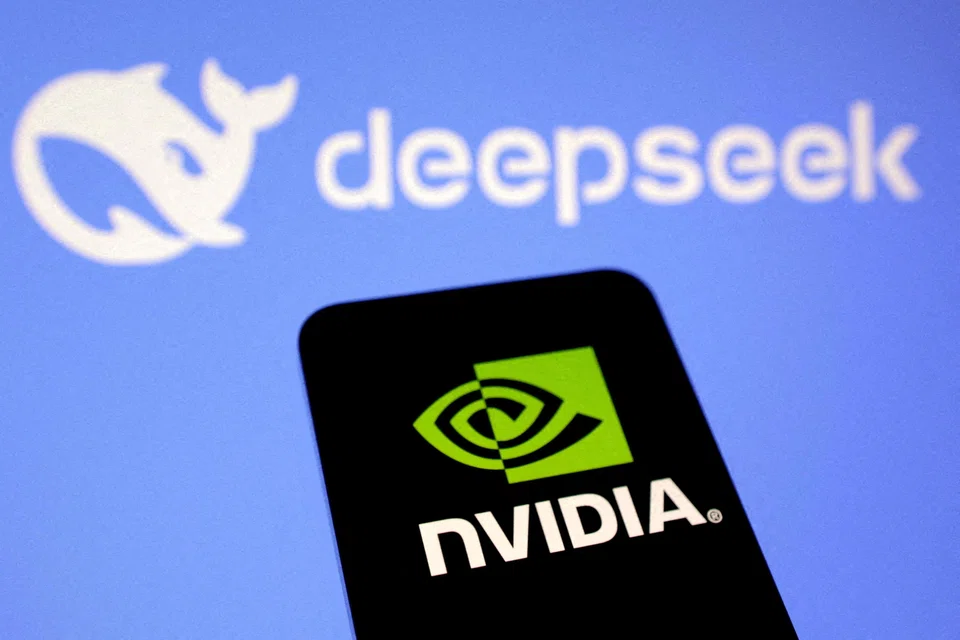
The development of a lower cost AI model by the Chinese startup DeepSeek, as well as several waves of heavy tariffs and subsequent reversals by US President Donald Trump, appear to have cast a lingering doubt over the US market.
It has prompted renewed questions about whether the US AI trade has run its course, or if it is China’s turn to surge.
But global asset manager BlackRock argues that such corrections reflect sentiment, not fundamentals, as the longer-term forces powering the market remain intact.

According to Ben Powell, chief investment strategist for the Middle East and Asia-Pacific at the BlackRock Investment Institute, AI remains a “mega force” that will continue to boost US equities in the upcoming six- to 12-month period.
The underlying thesis is that AI-led capital expenditure is not just about a few headline tech firms, but rather a cross-sector transformation that remains in its early stages.
“The US is at the forefront of the AI infrastructure buildout, and a leader on the global stage in both research and development spending and patent applications,” the firm said in its equity outlook for the year’s second quarter.

China’s AI hopes
Still, longer-term investors who have stuck with equities may underestimate the damage caused by geopolitical fragmentation to economic growth, said Powell. “Supply chain dependencies cannot be rewired quickly without disruption,” he said.
In China, tariff pressures have left the burgeoning AI sector clouded in uncertainty. The US and China announced a middle ground in their trade talks on Monday (May 12), with gargantuan reciprocal tariffs now paused for 90 days as the world’s two largest economies seek to avoid decoupling.
Despite this, BlackRock believes the damage may already have been done. “The uncertainty of trade barriers makes us more cautious, with potential policy stimulus only partly offsetting the drag,” the firm’s investment institute said of the Asian giant in a May 12 note.
In the US, tariffs would likewise increase inflation and slow growth, where “recession-like effects” can be expected in upcoming quarters, the note said.
Yet for the Chinese economy, other macroeconomic obstacles such as an ageing population, property sector woes and weak domestic consumption still have the potential to dampen the impact of technological advancement – which is why the asset manager has remained tactically neutral on Chinese equities despite DeepSeek’s breakthrough.
Nevertheless, China’s AI ecosystem remains compelling in the longer term from a technological standpoint, spanning chip manufacturing, Internet and software, autonomous driving and robotics, said the firm in its Q2 equity outlook note.
The country’s large tech giants, such as Tencent and Alibaba, might be able to stimulate demand in ways that government policy may not, BlackRock observed in the note. “Chinese companies have a pulse on people’s wants and incentives to spend,” the firm said.
The world’s second-largest economy is known for its inclination towards the adopting the latest technologies, by both businesses and individuals alike. Furthermore, mounting geopolitical pressures will only cue the country’s policymakers to turn inward, where private enterprises such as DeepSeek have already proved their immense potential.
Investing through disruption, volatility
It is such large, powerful trends – like the rise of AI or global fragmentation – that drive or drag economic growth, making the investment environment a fundamentally different one from a decade ago, said Powell.
“Investors need to update their playbooks to incorporate these drivers,” he said. “This is not a business cycle, but multiple overlapping long-term structural shifts that fundamentally alter the context for investors.”
Even so, along shorter time horizons, investors in today’s environment have a far greater set of tools at their disposal to manage volatility than in the past, BlackRock’s Brett Pybus believes.
For instance, exchange-traded funds (ETFs) have developed to offer investor a much wider selection of assets to diversify into during periods of uncertainty, said Pybus, who is the firm’s global co-head of iShares fixed income ETFs.
Even in areas like private markets and digital assets, financial innovation through ETFs has enabled greater access to assets that have traditionally been much harder to reach, Pybus noted. Others such as buffered ETFs – which typically seek to capture a capped upside potential while providing downside protection – have enabled investors to limit risk within volatile market environments.
“Bond ETFs, for instance, have proven particularly powerful during periods of volatility,” he said, adding that BlackRock’s flagship iShares ETFs witnessed tremendous demand from institutional investors during market downturns.
For example, Asian investors flocked to bond ETFs during the 2020 pandemic. Pybus noted that the number of institutional investors using iShares bond ETFs has more than doubled since then.
Such products enable investors to access greater price transparency and liquidity as they rebalance away from riskier assets during particularly volatile periods.
“There has been a shift towards quality in fixed income, with investors moving from riskier credit-sensitive sectors to more stable sovereign exposures or cash-like assets,” Pybus said, adding that the trend reflected a preference for defensive positions during volatility.
Decoding Asia newsletter: your guide to navigating Asia in a new global order. Sign up here to get Decoding Asia newsletter. Delivered to your inbox. Free.
Copyright SPH Media. All rights reserved.