Apac sees rising demand for sustainable aviation fuel but lack of refuelling points for airlines a pain point

Tay Peck Gek
DEMAND for sustainable aviation fuel (SAF) in Asia-Pacific is picking up, but its use is still limited by the number of airports in the region that supply the green fuel.
Countries and companies are therefore racing to build up the capabilities and capacity to produce and offer SAF, and Singapore stands a good chance of shining as an SAF hub.
Among the major players in the region are oil majors such as Shell, BP and ExxonMobil, as well as oil refining company Neste.
Shell became the first supplier of SAF to customers in Singapore this year, as it started offering the fuel at Changi Airport and Seletar Airport.
Doris Tan, general manager for Shell Aviation in Asia-Pacific and the Middle East, told The Business Times that it has delivered SAF in Singapore to SIA Engineering , Singapore Air Force, Japan Airlines (JAL) and Cebu Pacific, as well as business aviation services provider Jet Aviation and business jet maker Bombardier.
It has signed a memorandum of understanding to support JAL’s net-zero ambition, and another with Korean Airlines to supply 15,000 tonnes of SAF annually from 2026 to 2030 at major airports in Asia-Pacific and the Middle East.
Having completed the upgrading of a blending facility in Singapore, the oil major is contemplating a biofuels facility in the Republic. It is also “looking to supply SAF at more airports in our Asia network”. Within Asia-Pacific, Shell offers one other SAF refuelling point at Hong Kong International Airport.
A broader network would be valuable to its customers.
Cebu Pacific, which told BT it is in discussions with Shell to establish an off-take agreement for SAF, said procuring SAF closer to its network operations in Asia would mean lower cost and logistical complexity. It uses the green fuel for all new aircraft deliveries.
SEE ALSO
Also delivering SAF out of Singapore is ExxonMobil, which has commenced a year-long pilot to supply the green fuel to SIA and its budget airline Scoot. This agreement is for flights departing from Changi Airport beginning July 2022. The oil major supplies SAF to customers in France and the United Kingdom as well.
When asked about its expansion plans for SAF refuelling, an ExxonMobil spokesperson said the company is “continually evaluating plans and initiatives to provide lower-emission fuels and solutions”.
British company BP is supplying SAF to Asia-Pacific airlines outside the region. For instance, it supplies Qantas Airways with SAF flights between Australia and Heathrow Airport in the United Kingdom.
It expects to deliver 10 million litres of SAF in 2022 to the Australian airline, with an option to purchase up to a further 10 million litres in 2023 and 2024, representing up to 15 per cent of Qantas’ annual fuel use out of London.
Joshua Ng, an analyst at Alton Aviation Consultancy, said Asia-Pacific airlines are increasingly announcing targets for SAF use, as part of a broader emissions reduction goal. Such goals are becoming the norm rather than the exception.
Consequently, carriers’ adoption of SAF and rolling out of credits for purchase by customers serve as demand signals to SAF producers to channel investments into increasing SAF refining capacity in the region.
Finnish company Neste is one producer that is ramping up its SAF operations.
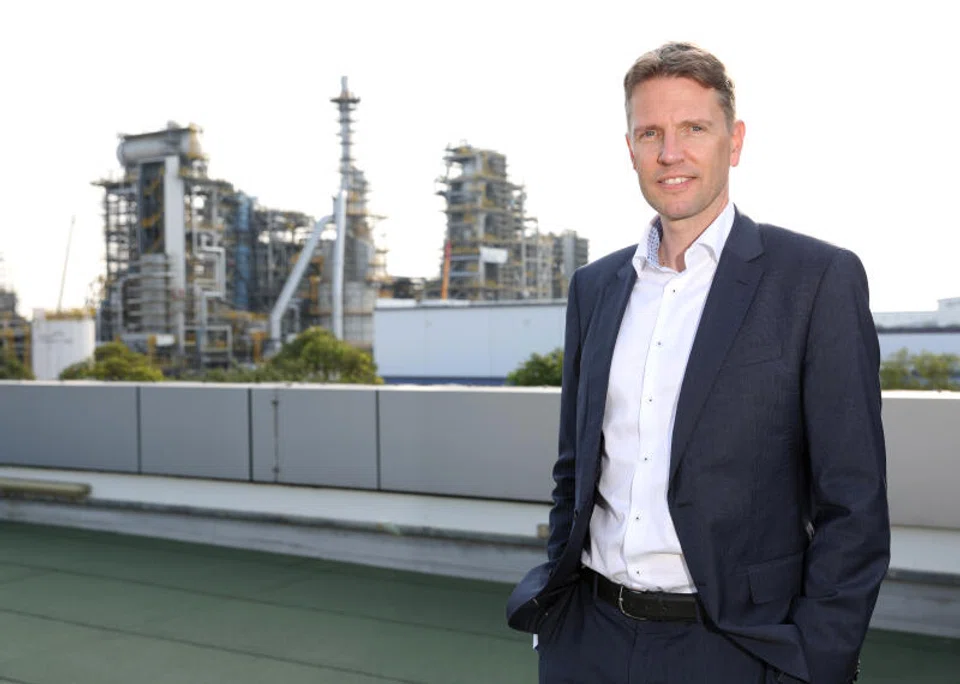
The company’s chief executive Matti Lehmus, who spoke to BT during a recent trip here to check on the construction of the company’s SAF plant in Tuas, said there is now interest in decarbonising aviation.
“The availability and the supply capability of SAF is growing in the coming years. As an example, we are growing our capacity from 100,000 tonnes today to 1.5 million tonnes by the end of 2023. And that means that the ability to also build efficient global supply chains can be created at the same time,” he said.
Neste’s SAF plant in Singapore, built at a cost of 1.5 billion euros (S$2.2 billion) has the capability to support a number of different markets, Lehmus said.
Ng noted that Neste’s SAF facility is slated to become the world’s largest SAF factory at launch in 2023, positioning the Republic – already the region’s leading jet fuel hub – as an SAF hub.
Meanwhile, SAF production facilities in China, Japan and Australia are also being developed.
BP’s crude oil refinery in Kwinana, Australia has ceased production and will instead be repurposed as a renewable fuels plant, which will include production of SAF. Separately, Qantas and Airbus are committing to invest up to US$200 million to accelerate the establishment of an SAF industry in Australia.
Lehmus said various regions are moving at their own pace with slightly different mechanisms. But he hopes to see alignment over time.
Even as the global economy slows, or if it goes into a recession, airlines should keep working on reducing emissions and using SAF, he said. “SAF is one (solution) that is available today and can contribute to this target. Working on creating the market is something that we should work on also in the coming years.”
Decoding Asia newsletter: your guide to navigating Asia in a new global order. Sign up here to get Decoding Asia newsletter. Delivered to your inbox. Free.
Copyright SPH Media. All rights reserved.