



Asia’s underlying inflation accelerates, signalling further rate hikes
Nomura’s latest inflation scorecard shows that inflation is running hot in Singapore, South Korea and India.

Angela Tan

WHILE energy and food prices have pushed inflation higher, the underlying price pressure towards core goods and services has accelerated across most Asian economies, signaling further policy rate hikes in the coming months, economists say.
Nomura’s latest estimate of underlying inflation in Asia showed inflation has accelerated further since May, and exceeded central bank targets in all economies except Hong Kong.
Its latest inflation scorecard shows that inflation is running hot in Singapore, South Korea and India; cold in Hong Kong; and warm for the rest of Asia (Indonesia, Thailand and the Philippines).
Research analysts Sonal Varma and Si Ying Toh said: “With real policy rates still negative across Asia, this points to further policy rate hikes in the coming months, despite the recent decline in commodity prices and rising medium-term global growth risks.”
They said that while headline inflation has accelerated due to higher food and oil prices, the pickup in underlying inflation suggested there had been some pass-through to the more sticky components of inflation, reflecting rising demand-side pressures due to Asia’s reopening.
In India, while the underlying inflation pace there is high, there has been a slight decline, possibly due to the government’s supply responses. The Reserve Bank of India (RBI) is expected to step down on the pace of hikes (35 basis points in September and two 25 basis points hikes thereafter), amid stable underlying inflation, higher inflation tolerance of less than 6 per cent, but above 4 per cent and as real policy rates inch closer to zero.

Nomura also expects Bank Indonesia (BI) to pivot soon. Even though core consumer price index (CPI) inflation was below 4 per cent year-on-year in July at 2.9 per cent, Nomura’s analysis suggests that underlying inflation in the archipelago is already at 4 per cent.
“(This) supports our view that BI is already behind the curve and will need to rapidly catch-up, as inflation continues to surprise on the upside. We expect 150 basis points in cumulative hikes by Q1 2023, starting this month,” Nomura’s analysts said.
South Korea’s headline inflation, meanwhile, is expected to peak in Q3 and fall closer to 2 per cent by Q2 2023, due to weak exports, a rising household debt services burden and easing pipeline price pressures - all supporting Nomura’s view that the Bank of Korea’s next hike in August will likely be the final one.



In Thailand, while the analysts are positive on the country’s tourism recovery, they expect the Bank of Thailand’s hiking cycle to remain gradual - three more 25 basis points hikes and a 1.5 per cent terminal rate - due to high household debt and a cautious global growth outlook for 2023.
Over at Goldman Sachs, its economists said that while inflation is close to its peak, the significant broadening of inflationary pressures means inflation is likely to remain higher for longer. “We expect Asean central banks to tighten policy further despite rising global recession risks,” they said.
As the current inflation shock is global rather than specific to emerging markets (EM), it will be more challenging for EM policymakers to address, they added.
The Wall Street investment bank has revised up its inflation projection in Indonesia and Singapore. The risks to its inflation forecasts in the Philippines, Malaysia and Thailand remain balanced.
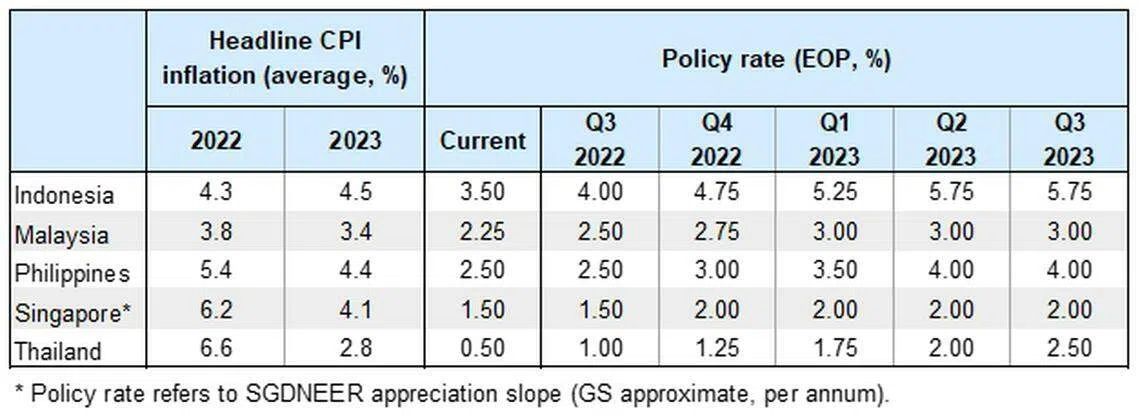
Indonesia’s 2022 headline inflation is projected to average 4.3 per cent, compared to 3.5 per cent previously on the increase in effective retail fuel prices. Goldman Sachs expects BI to kick start its tightening cycle this month, delivering a cumulative 125 basis points of rate hikes this year and another 100 basis points next year, bringing the policy rate to 5.75 per cent by the middle of 2023.
As for Singapore, the persistently strong rental market and increasing business cost pass-through are likely to push headline inflation forecast even higher to 6.2 per cent, from 5.6 per cent previously.
Goldman Sachs is revising its baseline forecast for the Monetary Authority of Singapore (MAS). It is now expecting a 50 basis point hike to the Singapore dollar nominal effective exchange rate (S$NEER) slope and re-centering to the prevailing rate, compared to only a slope increase previously. MAS’ monetary policy framework is centred on managing the Singapore dollar against a trade-weighted basket of currencies. This is also known as the S$NEER.
Malaysia could see as many as 3 consecutive hikes - in September and November this year, and in the first quarter of 2023 - of 25 basis points each to reach a terminal rate of 3 per cent.
Elsewhere, the Philippines’ central bank is seen delivering a 25 basis point hike at every meeting until it reaches a terminal rate of 4 per cent in Q1 2023. The Bank of Thailand is expected to continue to hike rates by 25 basis points at each meeting until it reaches a terminal level of 2.5 per cent in Q3 2023.
Decoding Asia newsletter: your guide to navigating Asia in a new global order. Sign up here to get Decoding Asia newsletter. Delivered to your inbox. Free.
Copyright SPH Media. All rights reserved.
TRENDING NOW

JPMorgan, BlackRock among those making bid to manage CPF savings

GIC in talks to lease bulk of 88,000 sq ft CapitaSky space to be vacated by Allianz

BN-PN’s Melaka election landslide puts spotlight on jobs, investments and political divides

Why Singapore, Johor and Riau Islands should build a cross-border ecosystem for AI

