

Bearish China sentiment sends Apac venture capital fundraising down by record 49% in 2022

ASIA-PACIFIC venture capital (VC) funds fell by a record 48.8 per cent in aggregate capital raised, to US$29.4 billion in 2022 from US$57.4 billion the previous year, according to a new report by private market-intelligence firm Preqin.
The number of regional funds that raised capital also fell in tandem, to just 217 from 550 in 2021. This extended the declining trend that started in 2018.
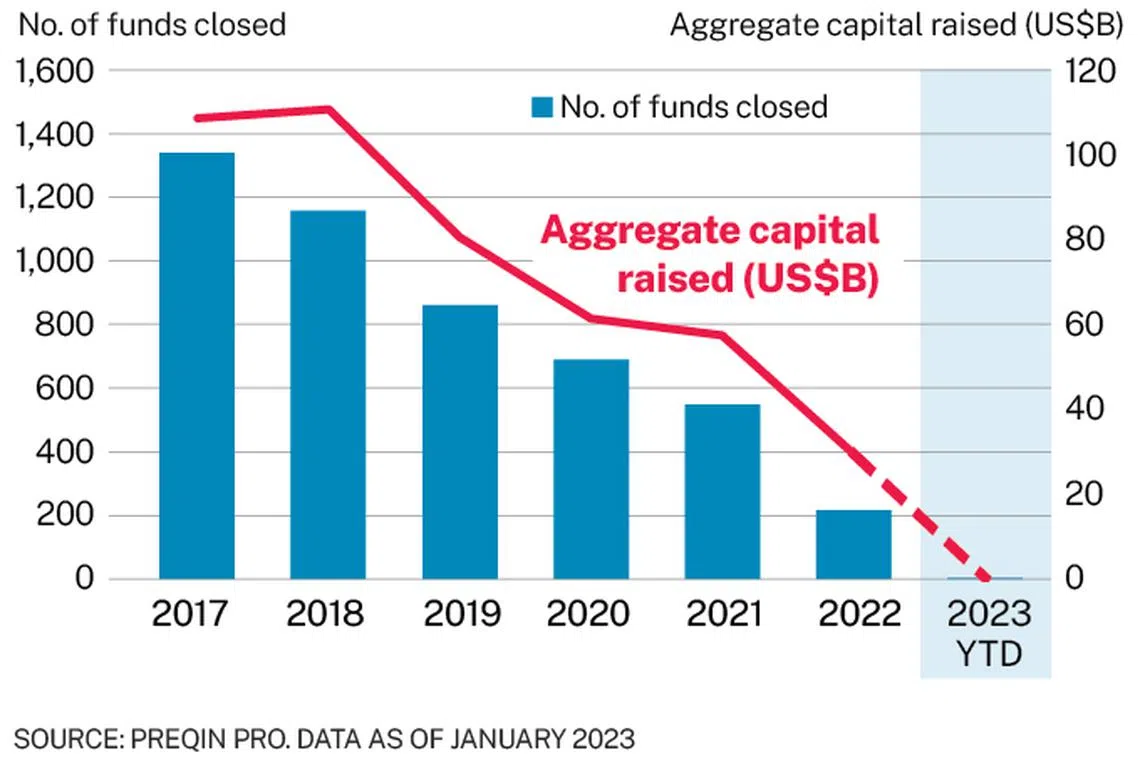
Preqin said in an e-mailed statement: “The sharp drop in fundraising among VC funds in the Asia-Pacific is due to dampened risk appetite among investors in China – the heavyweight fundraiser in the region. The decline is a consequence of China’s regulatory crackdown on tech firms, an economic slowdown exacerbated by strict Covid-19 policies and strained relations between US and China.”
VCs based in Greater China raised only US$17.8 billion in 2022, down 57 per cent from the previous year. This stands in contrast to 2018, when the country’s VC funds raised US$101.7 billion.
Asia-Pacific VCs have also grown more bearish with deploying capital. The aggregate value of VC deals fell 40 per cent from a record-high in 2021, to US$140 billion last year. This stands in contrast to the “spectacular” 88 per cent rise in deal value from 2020 to 2021, lifted by pandemic-era monetary easing.
Preqin said in its report: “Last year saw a shift in VC investing as central banks turned hawkish in response to inflation. This led to a decline in equity markets and dampened risk appetite. Investors scaled back their funding as they grew cautious amid falling valuations.”
That said, deal-making momentum was still robust, with 10,564 transactions, only a 13 per cent decrease from the previous year’s high. Sectors that were direct beneficiaries of higher commodities prices recorded more deal activity, such as in energy and utilities, as well as in raw materials and natural resources.
The largest deals of the year included the US$2.6 billion Series A raise of Chinese electric vehicle maker Aion, and the US$1 billion Series F round of fashion giant Shein.
Meanwhile, the deal count in the consumer discretionary industry fell by 26 per cent, “as investors tend to prefer defensive sectors over cyclical ones during market volatility”, the report noted.
The exit landscape for VCs has weakened, with the number of exits falling to a five-year low of 565, down 40 per cent from 2021. The aggregate deal value also shrank by 45 per cent to a four-year low of US$75.6 billion.
Trade sales were the most common means of VC exits last year, accounting for 294 of the 565 exits. There were 193 initial public offerings, down 52 per cent from the previous year.
Despite the rough seas, Preqin expects brighter days ahead for the VC asset class in this region. It is projecting that Asia-Pacific VC will take the global lead with 16 per cent in returns for the 2021-to-2027 period, surpassing Europe (14.1 per cent) and North America (13.8 per cent).
“With China being a wild card for some over the last few years, more venture capitalists have been turning to South-east Asia and India as regional alternatives. These newer emerging Asian markets are expected to drive future investment returns due to the rise of the middle class, and their large, young populations with high digital proficiency,” Preqin said.
Decoding Asia newsletter: your guide to navigating Asia in a new global order. Sign up here to get Decoding Asia newsletter. Delivered to your inbox. Free.
Copyright SPH Media. All rights reserved.
TRENDING NOW
‘My grandfather’s legacy’: Sherman Kwek lays out three-year plan for CDL to drive returns
CDL to hire dedicated CEO for fund management as it steps up push into private funds
Built on trust since 1964: How this award-winning finance company has grown with its SME customers
VSMC opens US$7.8 billion chip fab in Singapore, bets on ‘physical AI’ demand