BYD to drive Apac growth with mainstream rather than luxury focus: regional sales manager
The debut of its luxury brand Yangwang in the area could be a few years out, as the China carmaker concentrates on boosting export numbers

DESPITE introducing premium models and previewing luxury cars in the Asia-Pacific market, China carmaker BYD still expects mainstream models to form the bulk of regional sales for the next few years.
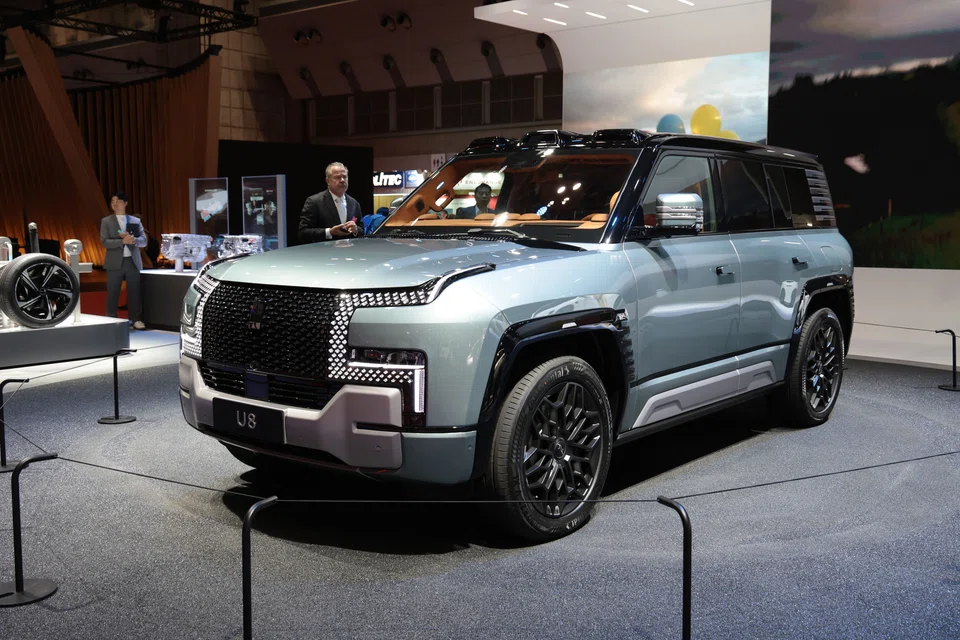
BYD introduced premium brand Denza to the region last year, and has been previewing its luxury brand Yangwang at motorshows and other showcases.
But Denza’s sales contributions will not be major and there are no immediate plans to introduce Yangwang to the region, BYD Auto’s general manager of Asia-Pacific sales Liu Xueliang told The Business Times.
Rather, mainstream models such as the Atto 3 sport utility vehicle (SUV) and Seal sedan will continue to be BYD’s bestsellers. This comes as the company strives to boost global exports, an area where it lags other Chinese carmakers such as Chery and Geely.
Stepping up
Denza was launched in Cambodia, Indonesia, Singapore, Thailand, Hong Kong and Macau in 2024, and is expected to debut in Australia and the Philippines this year.
In Singapore, Denza had a strong opening with around 300 orders of its D9 multi-purpose vehicle (MPV) at the brand’s debut in October. It has delivered around 200 units so far.
BYD did not provide regional sales figures for Denza, but Liu emphasised that the brand’s presence is still at an early stage.
“Denza will certainly contribute to sales, but how much depends on the specific markets (in Apac). It will not be (of the same scale) as BYD, because it is a high-end brand and it is more expensive,” he said.
Meanwhile, although BYD has showcased its luxury brand Yangwang in the region, an actual sales debut is not imminent.
SEE ALSO
The company has not decided when it will be introduced in Singapore or the region, said Liu.
“We will think about it, but we don’t have a specific timeframe. If there is a need in the future, we will consider it when the time is right, but this has not happened yet. Because (the target audience of) Yangwang is still a small group now,” he said.
Yangwang vehicles are the most expensive cars made by BYD.
The Yangwang U8 SUV costs around 1.1 million Chinese yuan (S$204,000), compared to 330,000 yuan for the Denza D9 and 120,000 yuan for the Atto 3. It was shown at the Thailand International Motor Expo and Japan Mobility Show, both in late 2023, and Bharat Mobility Global Expo 2025.
The U9 supercar – which costs 1.8 million yuan in China – was also previewed at the Singapore Motorshow in January.
One consideration is that current Yangwang models are left-hand drive, but many Apac markets are right-hand drive.
Recent media reports have said that a right-hand drive Yangwang model is still a few years away. But last year, a right-hand drive version of the U8 was seen being tested in Australia, in what the industry sees as a prelude to an Apac debut.
Green paths ahead
BYD will instead continue to make ground at the other end of the price spectrum, continuing to focus on mainstream models sales to consumers as well as ride-hailing and taxi companies.
The company aims to launch at least three new mainstream models in the region this year, Liu said.
First up is a new version of the E6 MPV, which will debut in February in Singapore. Like its predecessor, it is a low-cost model aimed at taxi and ride-hail services.
Such fleet sales could also get a boost from BYD’s new South-east Asia partnership with Grab, announced in January.
Under this tie-up, BYD will supply the ride-hailing giant with up to 50,000 cars. These will be mostly mainstream models, though including the premium Denza D9 MPV too.
The final number of units and timing of these sales will vary depending on market conditions, said Liu, who hopes to exceed the 50,000 estimate.
“The most important thing is that more consumers will learn about electric vehicles (EVs) through Grab’s platform,” he said in Mandarin.
But this benefit itself illustrates how the region remains at an early stage of EV adoption.
“The core problem is that there are many people who don’t know about electric vehicles… Exposing them to EVs through ride-hailing is a way for them to understand new energy vehicles,” he added.
In the region, EVs will not be the only contributor to sales of “new energy vehicles”, a Chinese market term that covers both EVs and plug-in hybrid vehicles (PHEVs).
PHEVs can be charged from an external source and travel short distances on electricity alone, but also use petrol. They accounted for 58 per cent of BYD’s global sales in 2024, though most of them were sold in China.
PHEVs accounted for less than 10 per cent of BYD’s Apac sales in 2024.
But Liu expects regional PHEV sales to increase significantly in 2025, noting that BYD began PHEV sales in the region only in the second half of 2024. The technology is suitable for areas with less developed EV charging networks – a description which applies to much of Apac.
Unsticking the middle
BYD also sees Apac as a key market to boost export numbers, where it lags its compatriots.
In 2024, BYD’s global sales increased 40 per cent to around 4.3 million units, making it the largest Chinese carmaker by production volume, ahead of domestic rivals Geely, Chery and Changan.
However, 90 per cent of its sales were in China. With total exports of around 430,000 units, it ranks sixth among China car groups for exports.
According to EIU, BYD aims to hit one million in exports in 2025.
In Apac, BYD’s sales rose to around 100,000 in 2024, from around 70,000 in 2023.
The Apac market will definitely expand in 2025, said Liu. He declined to give an estimate as varying market conditions make forecasts difficult.
The region has much potential as it is still at an early stage of EV adoption, with key markets being Australia, Indonesia, Malaysia and Thailand.
Indonesia and Malaysia, for example, have not seen EVs become popular yet – but when that happens, the numbers will be “very large”, he said.
BYD has already made moves to meet that demand. It opened a plant in Thailand last July, and will complete a US$1 billion plant in Indonesia by the end of 2025. Company sources stated that the latter is part of the brand’s plan for aggressive overseas expansion.
Decoding Asia newsletter: your guide to navigating Asia in a new global order. Sign up here to get Decoding Asia newsletter. Delivered to your inbox. Free.
Copyright SPH Media. All rights reserved.
TRENDING NOW
Grab CEO’s wife Chloe Tong on life with Anthony Tan and finding her purpose
Three ex-employees of Envy group join Ng Yu Zhi in bankruptcy
He built the Vingroup empire. Now South-east Asia’s richest man is handing some key roles to his sons
If AI has a one-in-five chance of destroying us, what do we do with the remaining four?