



Carney’s blunt message to Davos: The rules-based order is dead
His remarks amount to a call for a new architecture of cooperation among mid-sized countries
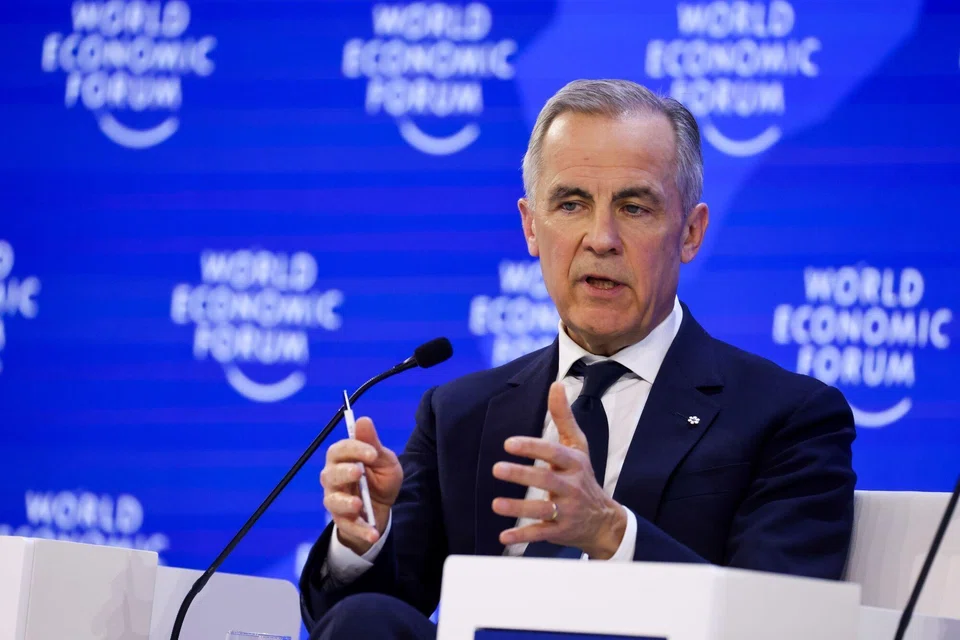
[DAVOS] Canadian Prime Minister Mark Carney used a major address in Davos to argue that the world’s middle powers must band together to resist coercion from aggressive superpowers.
Recent events have shown the “rules-based international order” is effectively dead, Carney said, which means Canada and other countries have no choice but to create new alliances to oppose pressure tactics and intimidation by the world’s great powers. His speech did not mention US President Donald Trump by name.
Canada stands firmly behind Greenland as tensions rise in the Arctic over Trump’s repeated statements that the US must own the territory for security reasons, the prime minister said at the World Economic Forum on Tuesday (Jan 20). The semi-autonomous island and Denmark have a “unique right to determine Greenland’s future,” he said.
His remarks amounted to a call for a new architecture of cooperation among mid-sized countries. The prime minister said such alliances can be the last line of defence in an era when dominant states use their economic and military might to impose their will, and he urged joint investments in deterrence.
“Stop invoking the ‘rules-based international order’ as though it still functions as advertised,” Carney said. “Call the system what it is: a period where the most powerful pursue their interests using economic integration as a weapon of coercion.”
Canada is working with partners in the North Atlantic Treaty Organization to secure the alliance’s northern and western flanks, and its commitment to Article 5 – Nato’s joint defence clause – is “unwavering,” Carney said.
His speech came amid a widening trans-Atlantic rift. Hours before Carney’s speech, France’s Emmanuel Macron attacked Trump’s trade strategy, which includes the threat of further tariffs on European nations unless the US is allowed to acquire Greenland.
Overnight, Trump posted a photo of a map that shows both Greenland and Canada covered by the American flag.
Faced with strong-arm tactics by larger nations, “there is a strong tendency for countries to go along to get along. To accommodate. To avoid trouble. To hope that compliance will buy safety,” Carney said. “It won’t.”
SEE ALSO
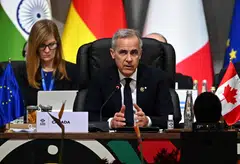
“Middle powers must act together because if you are not at the table, you are on the menu,” the prime minister added.
‘Weapon of coercion’
Canada and Mexico are also preparing for negotiations with the White House on the North American trade pact, and American officials have publicly mused about breaking up that accord and pursuing bilateral talks instead.
Carney called on world leaders and companies to start “naming reality.” He cited a famous essay from Czech dissident Václav Havel that described how the communist system sustained itself because people were willing to lie to each other, and to themselves, about its realities.
International leaders should not fall into that trap when talking about the geopolitical landscape, Carney said.
While Carney did not directly name the US – apart from a brief reference to “American hegemony” – his remarks clearly took aim at some of Trump’s preferred pressure tactics, including “tariffs as leverage, financial infrastructure as coercion, supply chains as vulnerabilities to be exploited.”
Carney’s comments were particularly striking given Canada’s longstanding economic integration with the US, and vulnerability to potential retaliation by Trump. Carney himself has opted to placate the US president at times, removing many of Canada’s retaliatory tariffs and apologising for an anti-tariff ad launched by the province of Ontario.
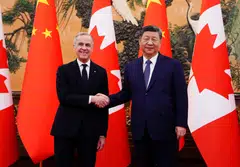
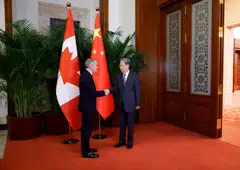
Canada has shifted its strategic posture, Carney argued. He alluded to a wide-ranging trade deal he signed last week with Chinese President Xi Jinping, in which China agreed to reduce tariffs on Canadian agriculture products while Canada eased levies on Chinese-made electric vehicles.
“We are engaging broadly, strategically, with open eyes,” he said in the Davos speech. “We actively take on the world as it is, not wait for the world as we wish it to be.”
Canada is also working on new trade and security partnerships with India, Qatar, Thailand, the Philippines, and trade alliances including Mercosur and Asean, he said.
He pointed to Canada’s moves to dramatically hike defence spending and develop new energy and trade infrastructure projects.
He listed Canada’s strategic advantages, including large reserves of conventional energy and critical minerals.
“Our pension funds are amongst the world’s largest and most sophisticated investors,” he said. “We have capital, talent and a government with the immense fiscal capacity to act decisively.” BLOOMBERG
Decoding Asia newsletter: your guide to navigating Asia in a new global order. Sign up here to get Decoding Asia newsletter. Delivered to your inbox. Free.
Share with us your feedback on BT's products and services
TRENDING NOW
Far East Organization’s The Serra Residences sells less than a quarter of units released at average S$3,460 psf
A bumpy road ahead for some of Singapore’s fresh graduates in their job search

Philippine power giant First Gen rebuffs foreign offers, plans up to US$2.6 billion in expansion

No chicken feed: How Malayan Flour Mills built an empire from flour to fowl

