



CEOs need to be on ‘high alert’ for AI impact on their businesses, says Bain’s global chief
Consulting on AI and technology now accounts for around 35% of Bain’s practice, and “is growing fast to 50 % of our business”, he adds

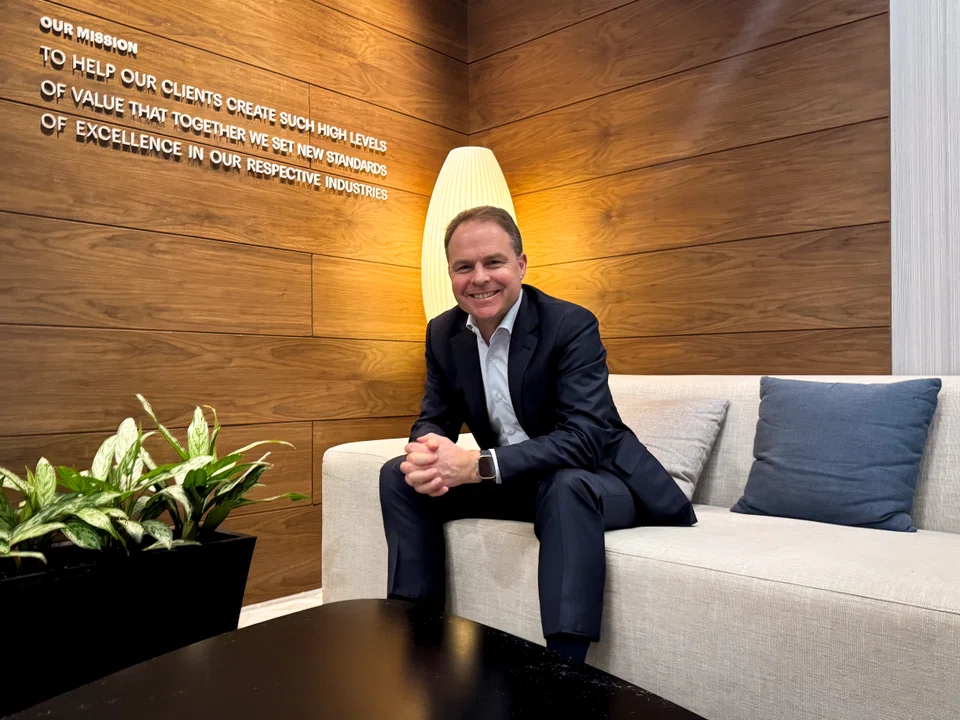
[SINGAPORE] Only 10 to 15 per cent of the world’s companies are on “high alert” for the impact of artificial intelligence (AI) on their businesses, says Bain & Company worldwide managing partner and chief executive Christophe De Vusser.
Those are companies, he said, that “really understand how AI is going to impact them and are using it as a No 1 priority to drive business transformation”. He believes AI is a “once-in-a-generation” innovation and technology wave.
“People now understand that AI is real. Chief executives need to understand top-down where the opportunities are,” he said.
“Two-thirds of the value will come from reinventing your company processes, the data you work with or new data you’re going to create. It’s a great moment because it’s a time you can reinvent yourself. And one-third of the value will come from applying the AI.”
“AI will impact everyone and the progress has been incredibly fast… It has been two years since ChatGPT, and in 2025 we’ll have agentic solutions and deep research.”
Generative AI – of which ChatGPT is a tool – learns from existing data to generate content including video and images. Agentic AI takes it further as it’s designed to be autonomous, with the ability to make decisions.
De Vusser said consulting on AI and technology now accounts for around 35 per cent of Bain’s practice, and “is growing fast to 50 per cent of our business”.
“Increasingly we see it as part of every single thing we do because every solution we bring to the market has AI components,” he said.
De Vusser sees four megatrends that will impact companies globally, some of which are converging.


These are a trend towards a multi-polar world, which he sees as a post-globalisation trend; AI; energy; and a higher cost of capital. Energy comprises the triple challenge of availability, affordability and decarbonisation.
A multi-polar world is driven by the need for a secure industrial base and a fair balance of trade. It is in this context that tariffs under the Trump administration may be viewed. The trend also manifests itself in geopolitical risks and supply chain challenges.
“Eighty per cent of companies nowadays say they want to bring their production and supply chains closer to where they are. Pre-Covid, this proportion was 20 per cent; it’s a fundamental shift, not just in the US but pretty much everywhere in the world.”
Companies typically try to anticipate what might happen. “But it’s very hard to predict. If you can’t fully predict, you need to do two things – make sure you can adapt and that you’re resilient, so whatever the outcome, you will survive as a company.”
Companies may model their options by running through scenarios such as tariffs at varying levels and potential relocation sites for manufacturing.
“We call this ‘strategy under uncertainty’… If I make capacity decisions for the next 10 or 30 years, is that choice going to survive different tariff structures? Is my relative cost position attractive enough over a long period?” he said.
De Vusser is a 20-year veteran at Bain, where he built a reputation for deal advisory for portfolio companies owned by global clients.
He has also supported due diligence efforts for private equity (PE) and mergers and acquisitions. He was previously head of Bain’s PE practice for Europe, Middle East and Africa.
AI, he said, will have a big impact on PE firms and how they invest.
“All PE firms are investing and enabling their processes with AI… They need to know that their portfolio companies will not be disrupted by competitors with better AI, and (that) their companies can emerge as leaders,” he said.
“There is no due diligence or value creation initiative where they don’t think about the impact of AI offensively and defensively. Some leaders in PE have already done an entire scan of their portfolio. They are asking – how can we deploy AI, and make our customer proposition better? It’s a way to win if they can sell their company as a leader in AI and in their market.”
De Vusser believes that South-east Asia and India are among the “most attractive, forward-looking regions” globally, thanks to the region’s underlying economic health and the positive demographics in some countries.
Singapore, he said, can help drive development by boosting intra-regional trade and supporting AI adoption and energy infrastructure.
“You have to make sure you’re oriented towards the future and de-risk yourself from being too dependent on global trade. And of course, to support the skills of the population so that the skills are right for the future,” he said.
Bain has defied the wave of consolidation among large consulting firms that began in 2023. Firms that have cut staff included PwC, Deloitte, EY and McKinsey & Co.
De Vusser said Bain’s business has grown in “healthy double digits”, and he expects similar growth in the future.
“We are going to continue to invest and grow here; South-east Asia and India are probably best placed in the world to benefit from all the shifts happening.” Singapore is the hub for the firm’s South-east Asian practice.
Bain has acquired 26 businesses since 2018 in efforts to boost its capabilities.
In 2023, for instance, it acquired Rainmaking Apac, the Asia-Pacific arm of global venture-building and startup development studio Rainmaking. Both Bain and Rainmaking Apac were appointed to take part in the Corporate Venture Launchpad 2.0 programme, a S$20 million initiative launched by the Singapore Economic Development Board.
Decoding Asia newsletter: your guide to navigating Asia in a new global order. Sign up here to get Decoding Asia newsletter. Delivered to your inbox. Free.
Copyright SPH Media. All rights reserved.
TRENDING NOW

Three ex-employees of Envy group join Ng Yu Zhi in bankruptcy

He built the Vingroup empire. Now South-east Asia’s richest man is handing some key roles to his sons

Grab CEO’s wife Chloe Tong on life with Anthony Tan and finding her purpose
Incidence of civil servants buying property near unannounced MRT stations ‘a concern’, but may not establish misconduct: PSD

