China’s Q4 GDP growth slows to 3-year low, full-year pace meets official target
Its manufacturing sector provided much-needed economic lift
 Add BT as a preferred source
[BEIJING] China’s economic growth slowed to a three-year low in the fourth quarter as domestic demand softened, and while the full-year pace hit Beijing’s target, trade tensions and structural imbalances pose significant risks to the outlook.
The world’s second-largest economy showed remarkable resilience in 2025, helped by smaller-than-expected US tariff hikes and exporters’ efforts to diversify away from the United States, allowing policymakers to keep stimulus to modest levels.
But demand at home further weakened since late last year as confidence has remained low amid a prolonged property crisis.
China’s economy grew 4.5 per cent in the fourth quarter from a year earlier, data from the National Bureau of Statistics (NBS) showed on Monday (Jan 19), slowing from the third-quarter’s 4.8 per cent pace as consumption and investment dragged.
Analysts polled by Reuters had forecast fourth-quarter gross domestic product would expand 4.4 per cent from a year earlier. Last quarter’s growth was the slowest in three years.
For the whole of 2025, the economy expanded 5.0 per cent, meeting the official target of around 5 per cent. Analysts had forecast 4.9 per cent growth and the economy grew 5.0 per cent in 2024.
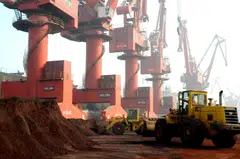
China’s mighty manufacturing machine provided the much-needed economic lift. The nation last week reported a record trade surplus of nearly US$1.2 trillion in 2025, driven by booming exports to non-US markets as producers diversified to offset tariff pressure from Washington.
But the reliance on external demand underscores vulnerabilities in China’s economy, which is grappling with weak domestic spending amid a prolonged property slump and persistent deflationary strains.
On a quarterly basis, GDP grew 1.2 per cent in October-December, compared with a forecast 1 per cent increase and a 1.1 per cent gain in July-September.
SEE ALSO




Industrial output up in December, retail sales disappoint
For December alone, industrial output rose 5.2 per cent from a year earlier, faster than the 4.8 per cent pace in November. Retail sales grew only 0.9 per cent last month, compared with the 1.3 per cent growth in November and analysts’ forecast of 1.2 per cent rise.
Fixed asset investment contracted 3.8 per cent in 2025, the first annual drop since 1989.
Property investment slumped 17.2 per cent last year.
The 2026 economic outlook is clouded by rising global trade protectionism and by US President Donald Trump’s unpredictable economic policies. Trump has threatened to impose a 25 per cent tariff on countries that trade with Iran.
Providing an early boost to demand, China’s central bank last week cut sector-specific interest rates and kept the door open for further reductions in banks’ cash reserve requirements and broader rate cuts.
At an agenda-setting economic meeting in December, Chinese leaders promised to maintain a “proactive” fiscal policy this year to support economic growth, which analysts expect Beijing to target at roughly 5 per cent again.
Chinese leaders have also vowed to “significantly” lift household consumption’s share of the economy over the next five years, without revealing a specific target.
China’s household spending is less than 40 per cent of annual economic output, some 20 percentage points below the global average.
Analysts say China will need to boost household incomes, which have been slowing, and strengthen its weak social safety net to curb high precautionary savings.
The tepid demand has not been reflected in employment figures with the nationwide urban survey-based jobless rate staying at 5.1 per cent per cent in December, unchanged from November.
Falling property prices have also eroded household wealth, adding to the policy challenge.
The World Bank and International Monetary Fund have long urged China to shift towards consumption-led growth and rely less on investment and exports, warning that the current model poses long-term risks.
Beijing has moved to curb excess industrial capacity and eliminate price wars, but economists say more needs to be done. REUTERS
Decoding Asia newsletter: your guide to navigating Asia in a new global order. Sign up here to get Decoding Asia newsletter. Delivered to your inbox. Free.
Share with us your feedback on BT's products and services